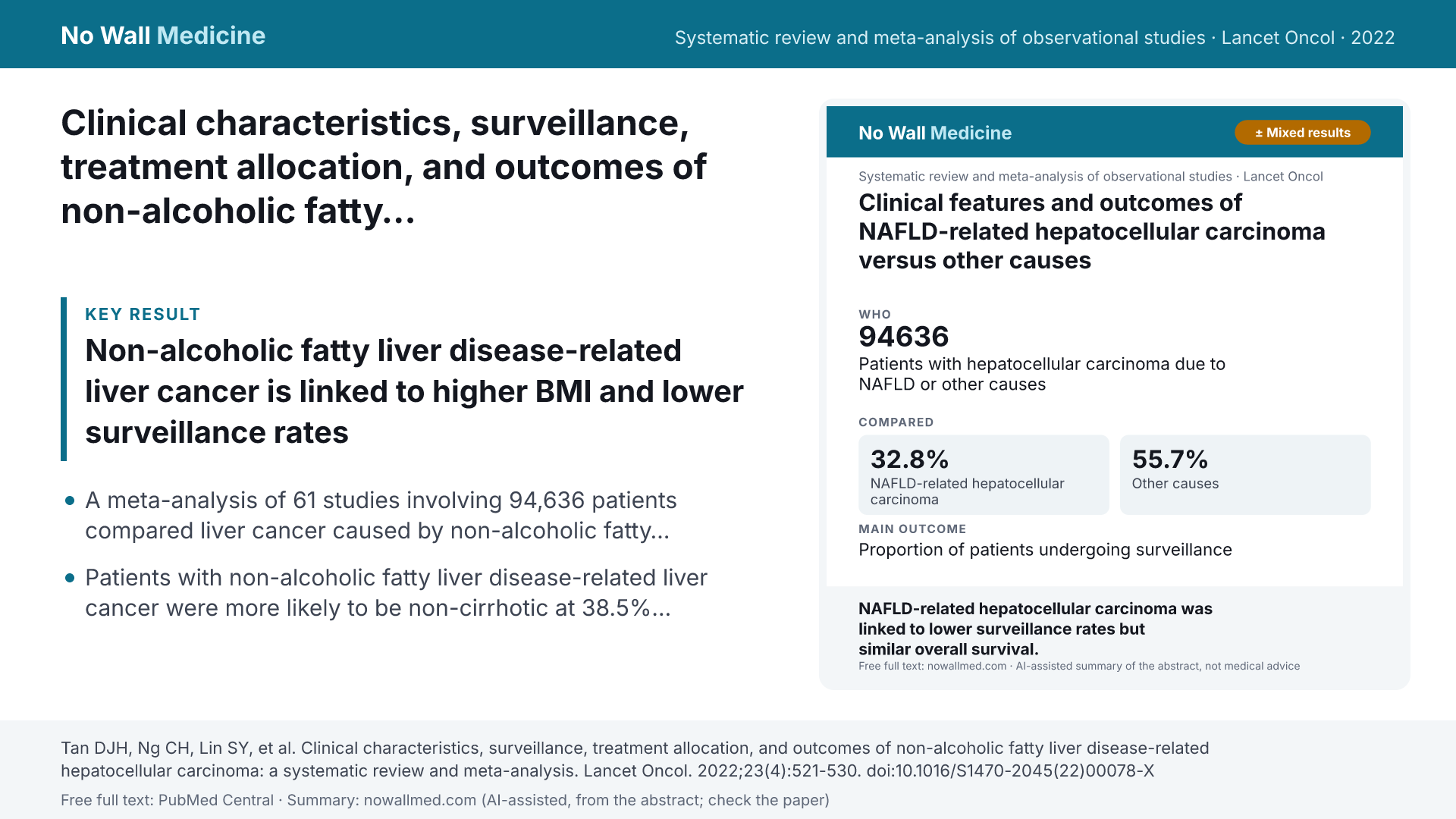
Non-alcoholic fatty liver disease-related liver cancer is linked to higher BMI and lower surveillance rates
Clinical characteristics, surveillance, treatment allocation, and outcomes of non-alcoholic fatty liver disease-related hepatocellular carcinoma: a systematic review and meta-analysis
Systematic review and meta-analysisMixed results
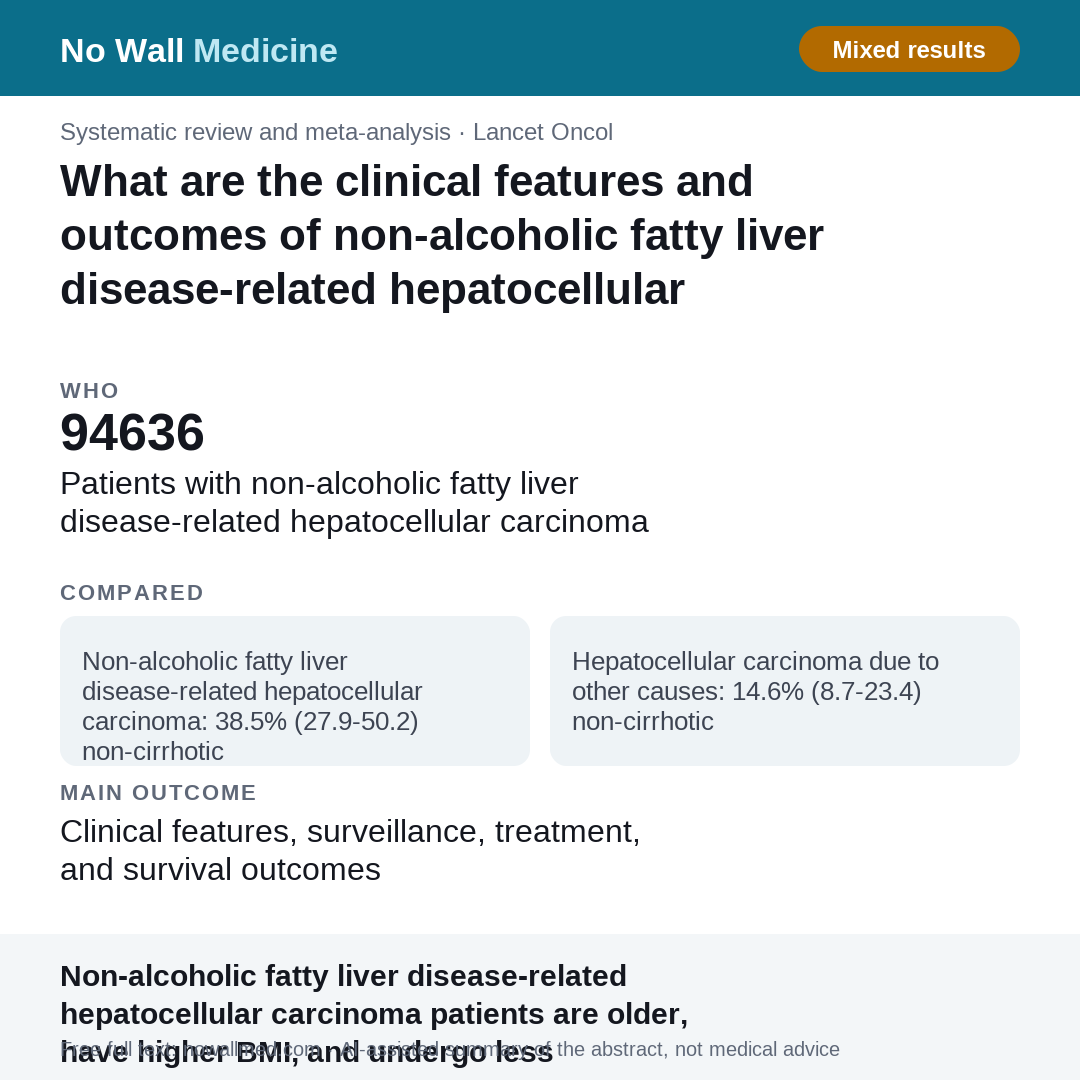
What are the clinical features and outcomes of non-alcoholic fatty liver disease-related hepatocellular carcinoma?
Who
94636
Patients with non-alcoholic fatty liver disease-related hepatocellular carcinoma
Compared
Non-alcoholic fatty liver disease-related hepatocellular carcinoma: 38.5% (27.9-50.2) non-cirrhotic
Hepatocellular carcinoma due to other causes: 14.6% (8.7-23.4) non-cirrhotic
Main outcome
Clinical features, surveillance, treatment, and survival outcomes
Result: hazard ratio 1.05 (95% CI 0.92-1.20) for overall survival
Bottom line: Non-alcoholic fatty liver disease-related hepatocellular carcinoma patients are older, have higher BMI, and undergo less surveillance than other causes.
Limitation: There was substantial heterogeneity in most analyses (I2>75%)
Lancet Oncol · 2022-03-04Download image
Clinical question: What are the clinical features and outcomes of non-alcoholic fatty liver disease-related hepatocellular carcinoma?
Why it matters: The clinical presentation, surveillance rates, and survival outcomes of liver cancer related to non-alcoholic fatty liver disease compared to other causes are unclear.
Key points
- A meta-analysis of 61 studies involving 94,636 patients compared liver cancer caused by non-alcoholic fatty liver disease to cancer caused by other factors.
- Patients with non-alcoholic fatty liver disease-related liver cancer were more likely to be non-cirrhotic at 38.5% compared to 14.6% for other causes.
- Surveillance rates were lower in the non-alcoholic fatty liver disease group at 32.8% compared to 55.7% for other causes, though overall survival did not differ.
Limitation the authors note: There was substantial heterogeneity in most analyses (I2>75%).
Headline and key points written with AI from the paper’s abstract, with every number checked against it. Read the paper before relying on them.
Was this summary helpful?
Abstract
Background
The clinical presentation and outcomes of non-alcoholic fatty liver disease (NAFLD)-related hepatocellular carcinoma are unclear when compared with hepatocellular carcinoma due to other causes. We aimed to establish the prevalence, clinical features, surveillance rates, treatment allocation, and outcomes of NAFLD-related hepatocellular carcinoma. Methods
In this systematic review and meta-analysis, we searched MEDLINE and Embase from inception until Jan 17, 2022, for articles in English that compared clinical features, and outcomes of NAFLD-related hepatocellular carcinoma versus hepatocellular carcinoma due to other causes. We included cross-sectional and longitudinal observational studies and excluded paediatric studies. Study-level data were extracted from the published reports. The primary outcomes were (1) the proportion of hepatocellular carcinoma secondary to NAFLD, (2) comparison of patient and tumour characteristics of NAFLD-related hepatocellular carcinoma versus other causes, and (3) comparison of surveillance, treatment allocation, and overall and disease-free survival outcomes of NAFLD-related versus non-NAFLD-related hepatocellular carcinoma. We analysed proportional data using a generalised linear mixed model. Pairwise meta-analysis was done to obtain odds ratio (OR) or mean difference, comparing NAFLD-related with non-NAFLD-related hepatocellular carcinoma. We evaluated survival outcomes using pooled analysis of hazard ratios. Findings
Of 3631 records identified, 61 studies (done between January, 1980, and May, 2021; 94 636 patients) met inclusion criteria. Overall, the proportion of hepatocellular carcinoma cases secondary to NAFLD was 15·1% (95% CI 11·9-18·9). Patients with NAFLD-related hepatocellular carcinoma were older (p<0·0001), had higher BMI (p<0·0001), and were more likely to present with metabolic comorbidities (diabetes [p<0·0001], hypertension [p<0·0001], and hyperlipidaemia [p<0·0001]) or cardiovascular disease at presentation (p=0·0055) than patients with hepatocellular carcinoma due to other causes. They were also more likely to be non-cirrhotic (38·5%, 27·9-50·2 vs 14·6%, 8·7-23·4 for hepatocellular carcinoma due to other causes; p<0·0001). Patients with NAFLD-related hepatocellular carcinoma had larger tumour diameters (p=0·0087), were more likely to have uninodular lesions (p=0·0003), and had similar odds of Barcelona Clinic Liver Cancer stages, TNM stages, alpha fetoprotein concentration, and Eastern Cooperative Oncology Group (ECOG) performance status to patients with non-NAFLD-related hepatocellular carcinoma. A lower proportion of patients with NAFLD-related hepatocellular carcinoma underwent surveillance (32·8%, 12·0-63·7) than did patients with hepatocellular carcinoma due to other causes (55·7%, 24·0-83·3; p<0·0001). There were no significant differences in treatment allocation (curative therapy, palliative therapy, and best supportive care) between patients with NAFLD-related hepatocellular carcinoma and those with hepatocellular carcinoma due to other causes. Overall survival did not differ between the two groups (hazard ratio 1·05, 95% CI 0·92-1·20, p=0·43), but disease-free survival was longer for patients with NAFLD-related hepatocellular carcinoma (0·79, 0·63-0·99; p=0·044). There was substantial heterogeneity in most analyses (I2>75%), and all articles had low-to-moderate risk of bias. Interpretation
NAFLD-related hepatocellular carcinoma is associated with a higher proportion of patients without cirrhosis and lower surveillance rates than hepatocellular carcinoma due to other causes. Surveillance strategies should be developed for patients with NAFLD without cirrhosis who are at high risk of developing hepatocellular carcinoma. Funding
None.
Abstract reproduced under the article’s CC BY licence.
Subject terms
Cite this article
Tan DJH, Ng CH, Lin SY, Pan XH, Tay P, Lim WH. Clinical characteristics, surveillance, treatment allocation, and outcomes of non-alcoholic fatty liver disease-related hepatocellular carcinoma: a systematic review and meta-analysis. Lancet Oncol. 2022. doi:10.1016/S1470-2045(22)00078-X
Spotted a mistake? Suggest a correction