Clinical decision support system shows no independent effect on chronic kidney disease management in primary care
Clinical Decision Support for Chronic Kidney Disease in Primary Care: A Cluster Randomized Clinical Trial
Cluster randomized clinical trialNo clear difference
Does a clinical decision support system improve physician behavior and patient outcomes in chronic kidney disease?
Who
3390
Adults aged 18 years or older with chronic kidney disease · 30 Chinese primary care centers
Compared
Intervention group: CKD diagnosis rates increased by 21.4% (95% CI, 18.6-24.3) percentage points
Control group: CKD diagnosis rates increased by 27.9% (95% CI, 24.4-31.3) percentage points
Main outcome
6-month process measures and clinical outcomes
Result: adjusted odds ratio 0.91 (95% CI, 0.72-1.14)
Bottom line: The clinical decision support system showed no independent effect on chronic kidney disease diagnosis or clinical outcomes.
JAMA Netw Open · 2026-05-01Download image
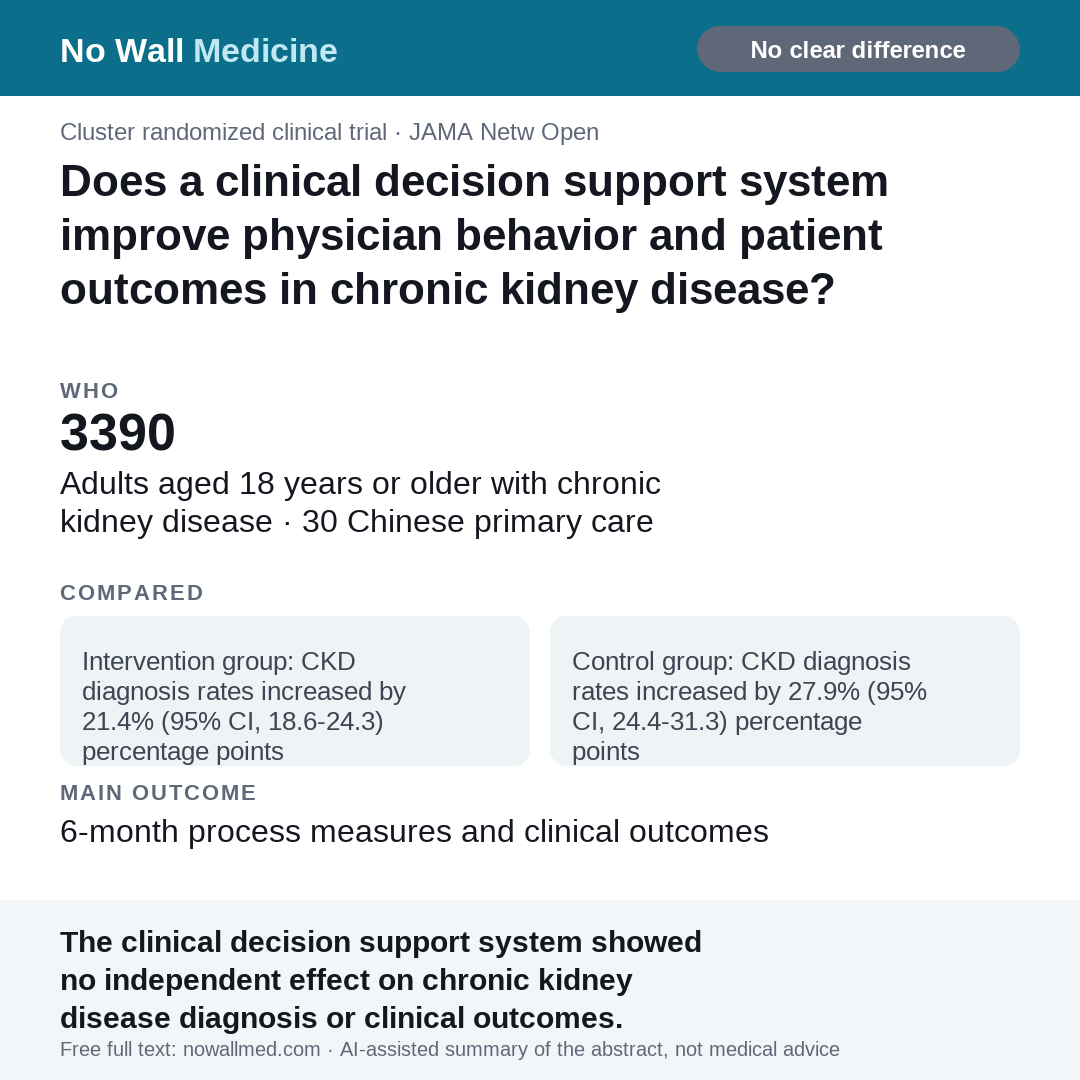
Clinical question: Does a clinical decision support system improve physician behavior and patient outcomes in chronic kidney disease?
Why it matters: The optimal way to implement digital clinical decision support systems for managing chronic kidney disease in Chinese primary care remains undefined.
Key points
- Researchers studied 3390 adults with chronic kidney disease across 30 Chinese primary care centers to compare a digital decision support system against standard training.
- At 6 months, the intervention group and control group showed comparable improvements in kidney disease diagnosis rates and medication use with no significant between-group differences.
- No improvements were detected in blood pressure or glycated hemoglobin, which is a measure of long-term blood sugar control.
Headline and key points written with AI from the paper’s abstract, with every number checked against it. Read the paper before relying on them.
Topics
Cite this article
Zheng X, Hui M, Yang H, Yang Z, Tang L, Zhao Y. Clinical Decision Support for Chronic Kidney Disease in Primary Care: A Cluster Randomized Clinical Trial. JAMA Netw Open. 2026. doi:10.1001/jamanetworkopen.2026.11112
Spotted a mistake? Suggest a correction