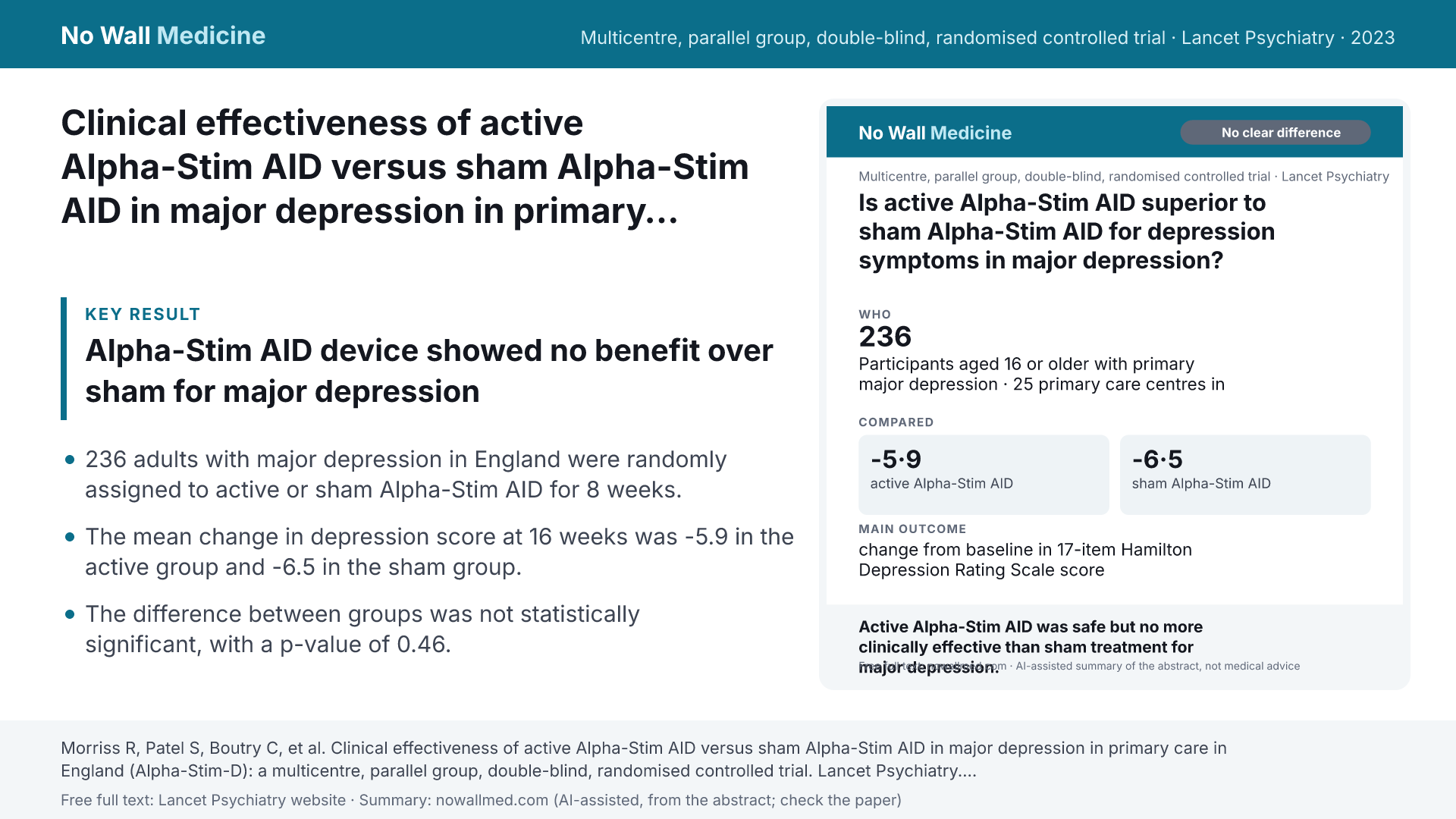
Alpha-Stim AID device showed no benefit over sham for major depression
Clinical effectiveness of active Alpha-Stim AID versus sham Alpha-Stim AID in major depression in primary care in England (Alpha-Stim-D): a multicentre, parallel group, double-blind, randomised controlled trial
Multicentre, parallel group, double-blind, randomised controlled trialNo clear difference
Is active Alpha-Stim AID superior to sham Alpha-Stim AID for depression symptoms in major depression?
Who
236
Participants aged 16 or older with primary major depression · 25 primary care centres in two regions in England, UK
Compared
-5·9active Alpha-Stim AID (95% CI -7·1 to -4·8)
-6·5sham Alpha-Stim AID (-7·7 to -5·4)
Main outcome
change from baseline in 17-item Hamilton Depression Rating Scale score
Result: mean change difference -0·6 (95% CI -1·0 to 2·2)
Bottom line: Active Alpha-Stim AID was safe but no more clinically effective than sham treatment for major depression.
Funded by: National Institute for Health Research and Electromedical Products International
Lancet Psychiatry · 2023-01-29Download image
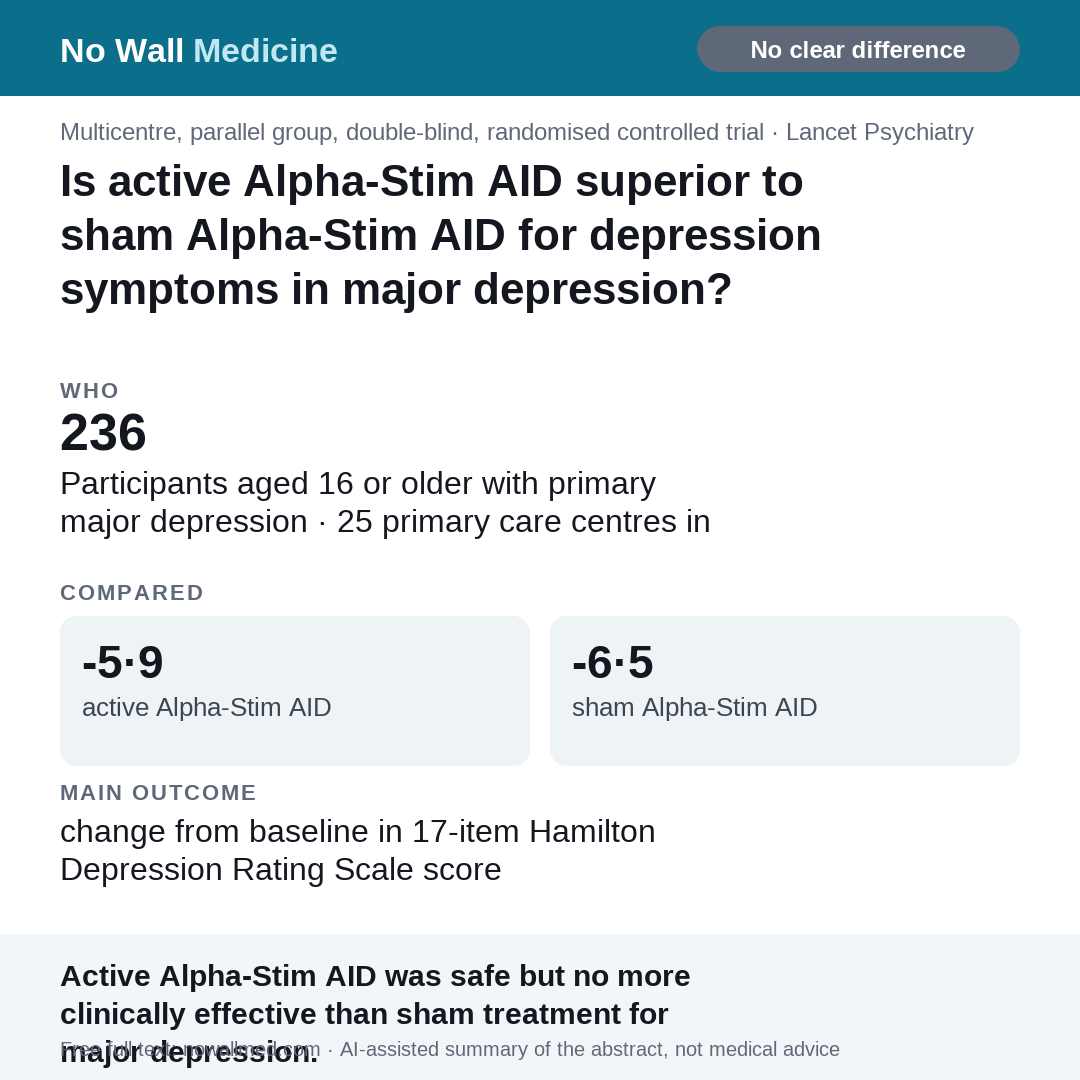
Clinical question: Is active Alpha-Stim AID superior to sham Alpha-Stim AID for depression symptoms in major depression?
Key points
- 236 adults with major depression in England were randomly assigned to active or sham Alpha-Stim AID for 8 weeks.
- The mean change in depression score at 16 weeks was -5.9 in the active group and -6.5 in the sham group.
- The difference between groups was not statistically significant, with a p-value of 0.46.
Limitation the authors note: The study excluded participants with persistent suicidal ideation, self-harm, or those receiving psychological treatment in the past 3 months.
Headline and key points written with AI from the paper’s abstract, with every number checked against it. Read the paper before relying on them.
Was this summary helpful?
Abstract
Background
Randomised sham-controlled trials of cranial electrostimulation with the Alpha-Stim Anxiety Insomnia and Depression (AID) device have reported improved anxiety and depression symptoms; however, no adequately powered sham-controlled trials in major depression are available. We investigated whether active Alpha-Stim AID is superior to sham Alpha-Stim AID in terms of clinical effectiveness for depression symptoms in major depression. Methods
The Alpha-Stim-D trial was a multicentre, parallel group, double-blind, randomised controlled trial, recruiting participants from 25 primary care centres in two regions in England, UK. Eligible participants were aged 16 years or older with a current diagnosis of primary major depression, a score of 10-19 on the nine-item Patient Health Questionnaire, and had been offered or prescribed and reported taking antidepressant medication for at least 6 weeks in the previous 3 months. Main exclusion criteria were contraindications to Alpha-Stim AID device use, having persistent suicidal ideation or self-harm, neurological conditions, a substance use disorder or dependence, an eating disorder, bipolar disorder, or non-affective psychosis, or receiving psychological treatment in the past 3 months. Eligible participants were randomly assigned (1:1, minimised by region, anxiety disorder, and antidepressant use) to 1 h daily use of active (100 μA) or sham Alpha-Stim AID treatment for 8 weeks. Randomisation was via an independent web-based system, with participants, outcome assessors, and data analyst masked to treatment assignment. The primary outcome was change from baseline in score on the 17-item Hamilton Depression Rating Scale (HDRS-17, GRID version) at 16 weeks after randomisation, with participants analysed by intention to treat (ITT; all randomly assigned participants). Safety was assessed in all randomly assigned participants. The trial is registered with the ISRCTN registry (ISRCTN11853110); status completed. Findings
Between Sept 8, 2020, and Jan 14, 2022, 236 eligible participants were randomly assigned to active or sham Alpha-Stim AID (n=118 each). 156 (66%) participants were women, 77 (33%) were men, and three (1%) self-reported as other gender; 200 (85%) were White British or Irish; and the mean age was 38·0 years (SD 15·3; range 16-83). 102 (86%) participants in the active Alpha-Stim AID group and 98 (83%) in the sham group were followed up 16 weeks after randomisation. In the ITT population, mean change in GRID-HDRS-17 at 16 weeks was -5·9 (95% CI -7·1 to -4·8) in the active Alpha-Stim AID group and -6·5 (-7·7 to -5·4) in the sham group (mean change difference -0·6 [95% CI -1·0 to 2·2], p=0·46). Among the 236 participants, 17 adverse events were reported in 17 (7%) participants (nine [8%] participants in the active Alpha-Stim AID group; and eight [7%] participants in the sham group). One serious adverse event of suicidal ideation leading to hospitalisation was reported in the sham group, which was judged to be unrelated to the device. Interpretation
Active Alpha-Stim AID was safe and acceptable, but no more clinically effective than sham Alpha-Stim AID in major depression. Funding
National Institute for Health Research Applied Research Collaboration East Midlands and Electromedical Products International.
Abstract reproduced under the article’s CC BY licence.
Subject terms
Headline, design, result, key points, caveat and citation as plain text.
Cite this article
Morriss R, Patel S, Boutry C, et al. Clinical effectiveness of active Alpha-Stim AID versus sham Alpha-Stim AID in major depression in primary care in England (Alpha-Stim-D): a multicentre, parallel group, double-blind, randomised controlled trial. Lancet Psychiatry. 2023. doi:10.1016/S2215-0366(23)00007-X
Spotted a mistake? Suggest a correction