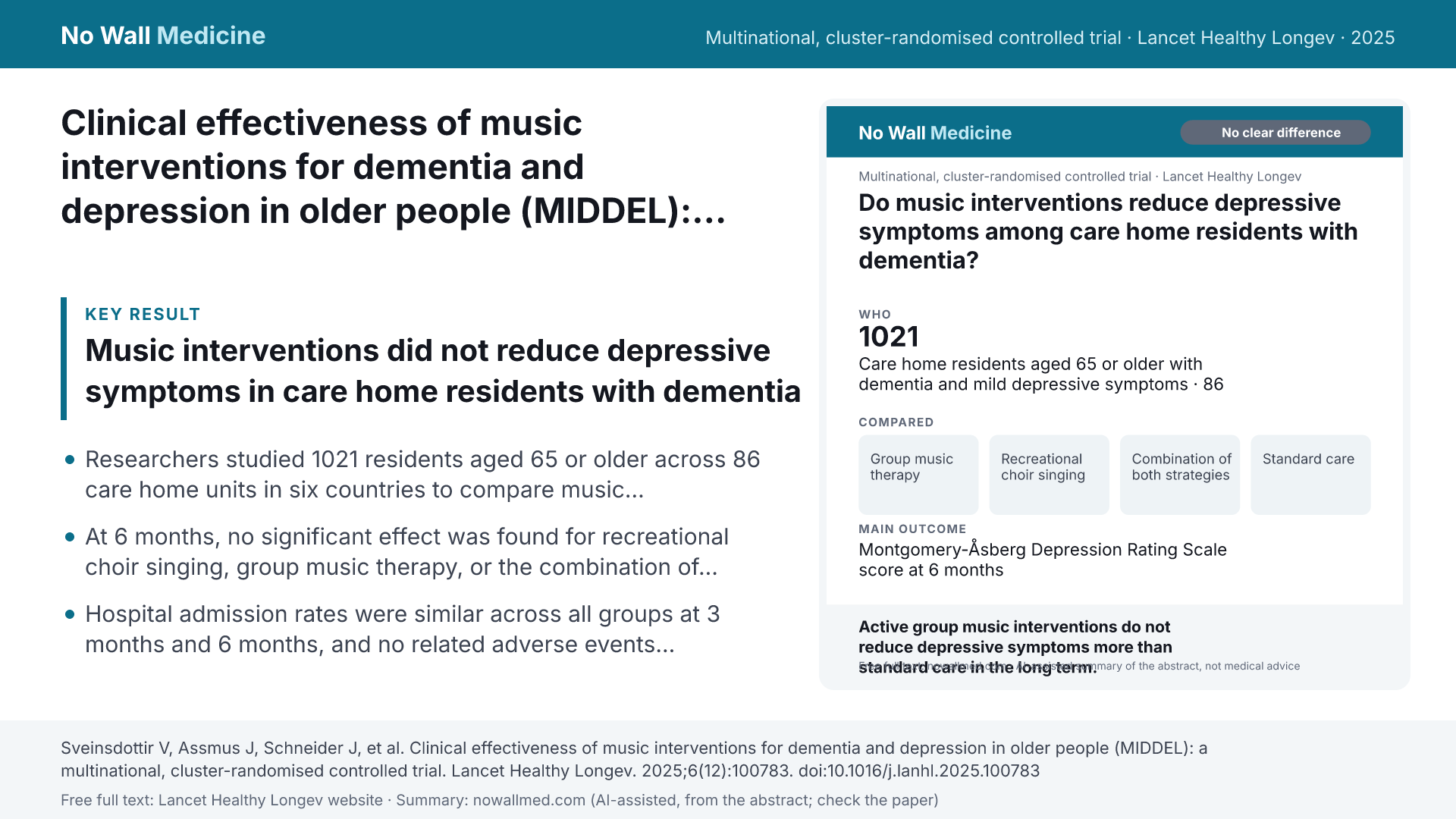
Music interventions did not reduce depressive symptoms in care home residents with dementia
Clinical effectiveness of music interventions for dementia and depression in older people (MIDDEL): a multinational, cluster-randomised controlled trial
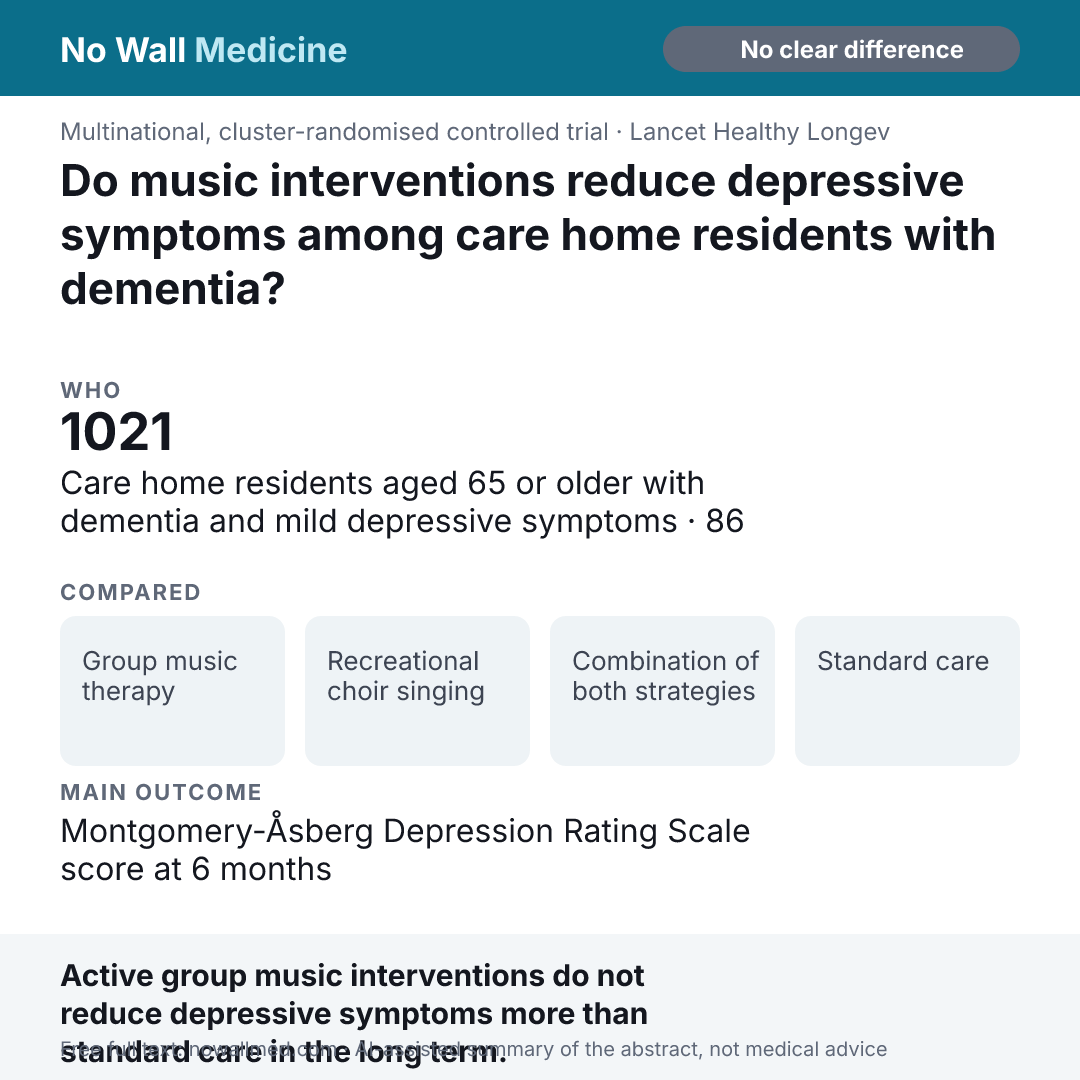
Multinational, cluster-randomised controlled trialNo clear difference
Do music interventions reduce depressive symptoms among care home residents with dementia?
Who
1021
Care home residents aged 65 or older with dementia and mild depressive symptoms · 86 care home units in six countries
Compared
Group music therapy
Recreational choir singing
Combination of both strategies
Standard care
Main outcome
Montgomery-Åsberg Depression Rating Scale score at 6 months
Result: no significant effect on MADRS scores
Bottom line: Active group music interventions do not reduce depressive symptoms more than standard care in the long term.
Lancet Healthy Longev · 2025-12-08 · Save PNG
Same trial (NCT03496675)
Papers we list that report this registered trial, oldest first. Read a secondary analysis alongside the main results.
- Main results Mixed results
Recreational choir singing was associated with lower depression scores in people with dementia Lancet Healthy Longev 2022-09 - Related analysis No clear difference
This paper Lancet Healthy Longev 2025-12
Clinical question: Do music interventions reduce depressive symptoms among care home residents with dementia?
Why it matters: Effective and scalable non-pharmacological approaches are needed to address the global disease burden of dementia and depression.
Key points
- Researchers studied 1021 residents aged 65 or older across 86 care home units in six countries to compare music therapy, choir singing, or both against standard care.
- At 6 months, no significant effect was found for recreational choir singing, group music therapy, or the combination of both on depression rating scale scores.
- Hospital admission rates were similar across all groups at 3 months and 6 months, and no related adverse events were reported.
Headline and key points written with AI from the paper’s abstract, with every number checked against it. Read the paper before relying on them.
Was this summary helpful?
Subject terms
Headline, design, result, key points, caveat and citation as plain text.
Cite this article
Sveinsdottir V, Assmus J, Schneider J, et al. Clinical effectiveness of music interventions for dementia and depression in older people (MIDDEL): a multinational, cluster-randomised controlled trial. Lancet Healthy Longev. 2025;6(12):100783. doi:10.1016/j.lanhl.2025.100783
Spotted a mistake? Suggest a correction