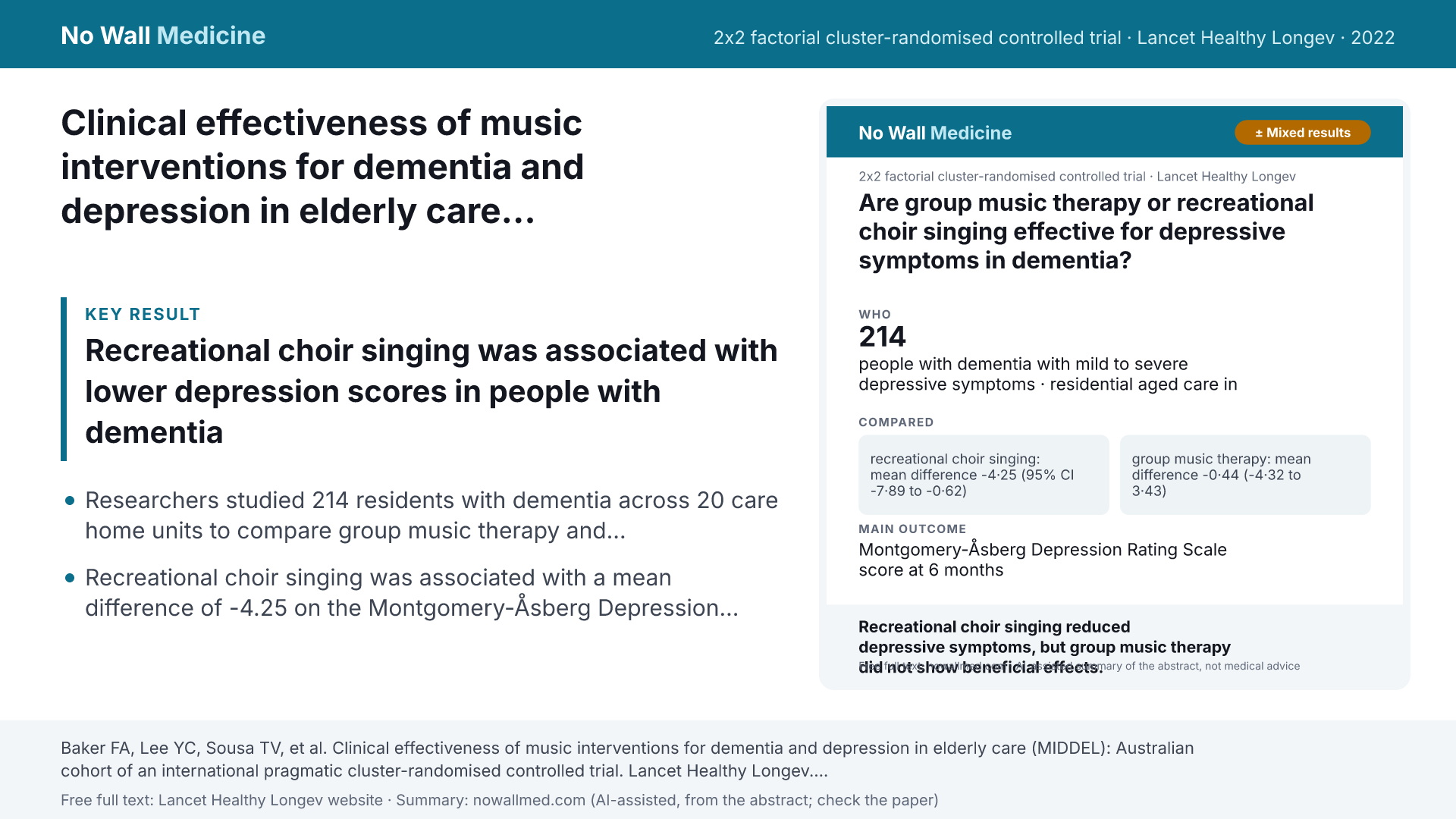
Recreational choir singing was associated with lower depression scores in people with dementia
Clinical effectiveness of music interventions for dementia and depression in elderly care (MIDDEL): Australian cohort of an international pragmatic cluster-randomised controlled trial
2x2 factorial cluster-randomised controlled trialMixed results
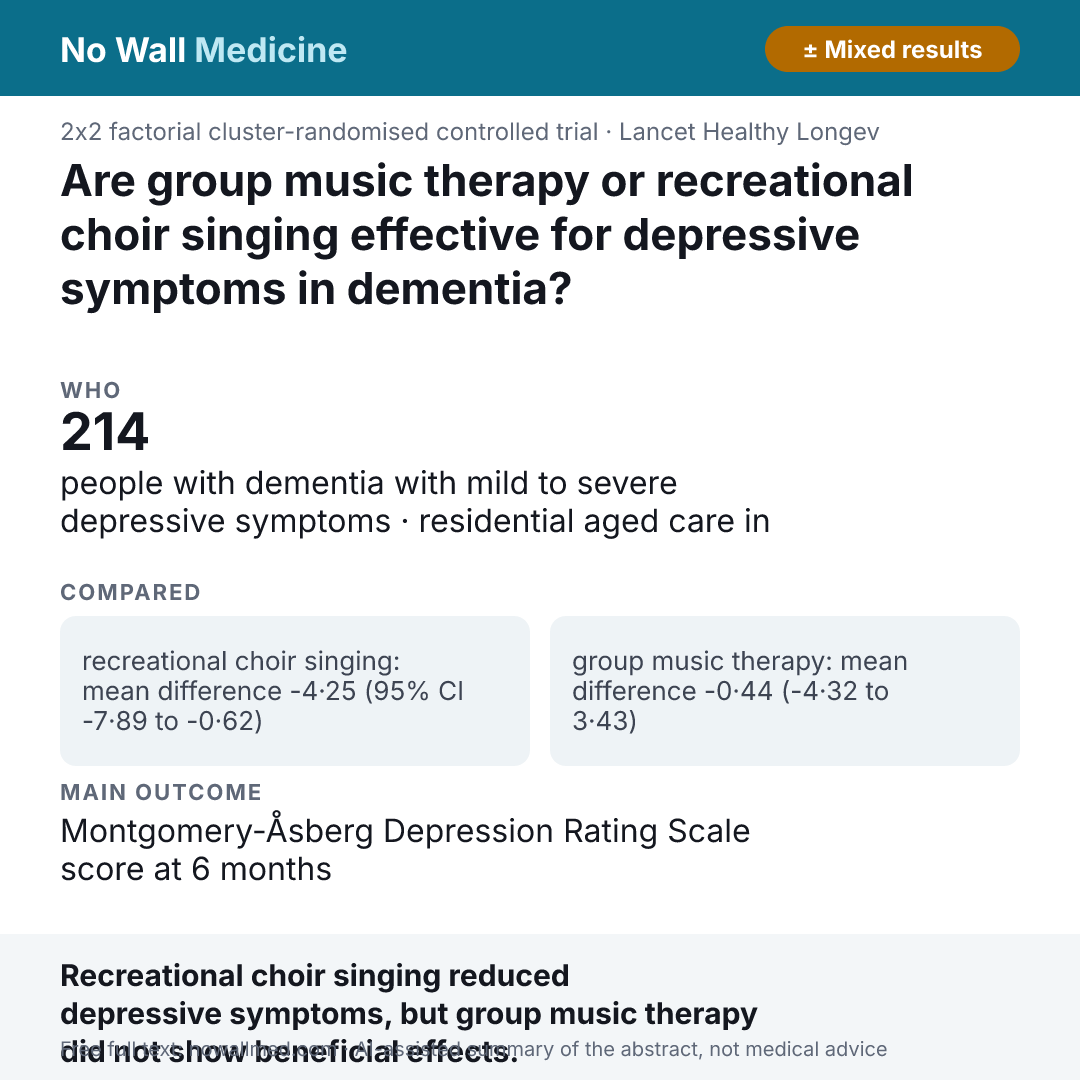
Are group music therapy or recreational choir singing effective for depressive symptoms in dementia?
Who
214
people with dementia with mild to severe depressive symptoms · residential aged care in Australia
Compared
recreational choir singing: mean difference -4·25 (95% CI -7·89 to -0·62)
group music therapy: mean difference -0·44 (-4·32 to 3·43)
Main outcome
Montgomery-Åsberg Depression Rating Scale score at 6 months
Result: mean difference -4·25 (95% CI -7·89 to -0·62) for RCS
Bottom line: Recreational choir singing reduced depressive symptoms, but group music therapy did not show beneficial effects.
Funded by: National Health and Medical Research Council, Australia
Lancet Healthy Longev · 2022-09-13 · Save PNG
Same trial (NCT03496675, ACTRN12618000156280)
Papers we list that report this registered trial, oldest first. Read a secondary analysis alongside the main results.
- Main results Mixed results
This paper Lancet Healthy Longev 2022-09 - Related analysis No clear difference
Music interventions did not reduce depressive symptoms in care home residents with dementia Lancet Healthy Longev 2025-12
Clinical question: Are group music therapy or recreational choir singing effective for depressive symptoms in dementia?
Why it matters: The current evidence base regarding the effectiveness of music interventions for depressive symptoms in people with dementia is inconclusive.
Key points
- Researchers studied 214 residents with dementia across 20 care home units to compare group music therapy and recreational choir singing against standard care.
- Recreational choir singing was associated with a mean difference of -4.25 on the Montgomery-Åsberg Depression Rating Scale at 6 months (95% CI -7.89 to -0.62; p=0.0221).
- Group music therapy did not show a significant effect on depression scores with a mean difference of -0.44 (95% CI -4.32 to 3.43; p=0.8224).
Headline and key points written with AI from the paper’s abstract, with every number checked against it. Read the paper before relying on them.
Was this summary helpful?
Abstract
Background
Dementia and depression are highly prevalent and comorbid conditions among older adults living in care homes and are associated with individual distress and rising societal costs. Effective, scalable, and feasible interventions are needed. Music interventions have shown promising effects, but the current evidence base is inconclusive. The present study aimed to determine the effectiveness of two different music interventions on the depressive symptoms of people with dementia living in residential aged care. Methods
We implemented a 2 × 2 factorial cluster-randomised controlled trial to determine whether group music therapy (GMT) is more effective than no GMT with standard care, or recreational choir singing (RCS) is more effective than no RCS with standard care, for reducing depressive symptoms and other secondary outcomes in people with dementia with mild to severe depressive symptoms living in residential aged care. Care home units with at least ten residents were allocated to GMT, RCS, GMT plus RCS, or standard care, using a computer-generated list with block randomisation (block size four). The protocolised interventions were delivered by music therapists (GMT) and community musicians (RCS). The primary outcome was Montgomery-Åsberg Depression Rating Scale score at 6 months, assessed by a masked assessor and analysed on an intention-to-treat basis using linear mixed-effects models, which examined the effects of GMT versus no-GMT and RCS versus no-RCS, as well as interaction effects of GMT and RCS. We report on the Australian cohort of an international trial. This trial is registered with ClinicalTrials.gov, NCT03496675, and anzctr.org.au, ACTRN12618000156280. Findings
Between June 15, 2018, and Feb 18, 2020, we approached 12 RAC facilities with 26 eligible care home units and, excluding six units who could not be enrolled due to COVID-19 lockdowns, we screened 818 residents. Between July 18, 2018, and Nov 26, 2019, 20 care home units were randomised (318 residents). Recruitment ceased on March 17, 2020, due to COVID-19. The primary endpoint, available from 20 care home units (214 residents), suggested beneficial effects of RCS (mean difference -4·25, 95% CI -7·89 to -0·62; p=0·0221) but not GMT (mean difference -0·44, -4·32 to 3·43; p=0·8224). No related serious adverse events occurred. Interpretation
Our study supports implementing recreational choir singing as a clinically relevant therapeutic intervention in reducing depressive symptoms for people with dementia in the Australian care home context. Funding
National Health and Medical Research Council, Australia.
Abstract reproduced under the article’s CC BY NC ND licence.
Subject terms
Headline, design, result, key points, caveat and citation as plain text.
Cite this article
Baker FA, Lee YC, Sousa TV, et al. Clinical effectiveness of music interventions for dementia and depression in elderly care (MIDDEL): Australian cohort of an international pragmatic cluster-randomised controlled trial. Lancet Healthy Longev. 2022;3(3):e153-e165. doi:10.1016/S2666-7568(22)00027-7
Spotted a mistake? Suggest a correction