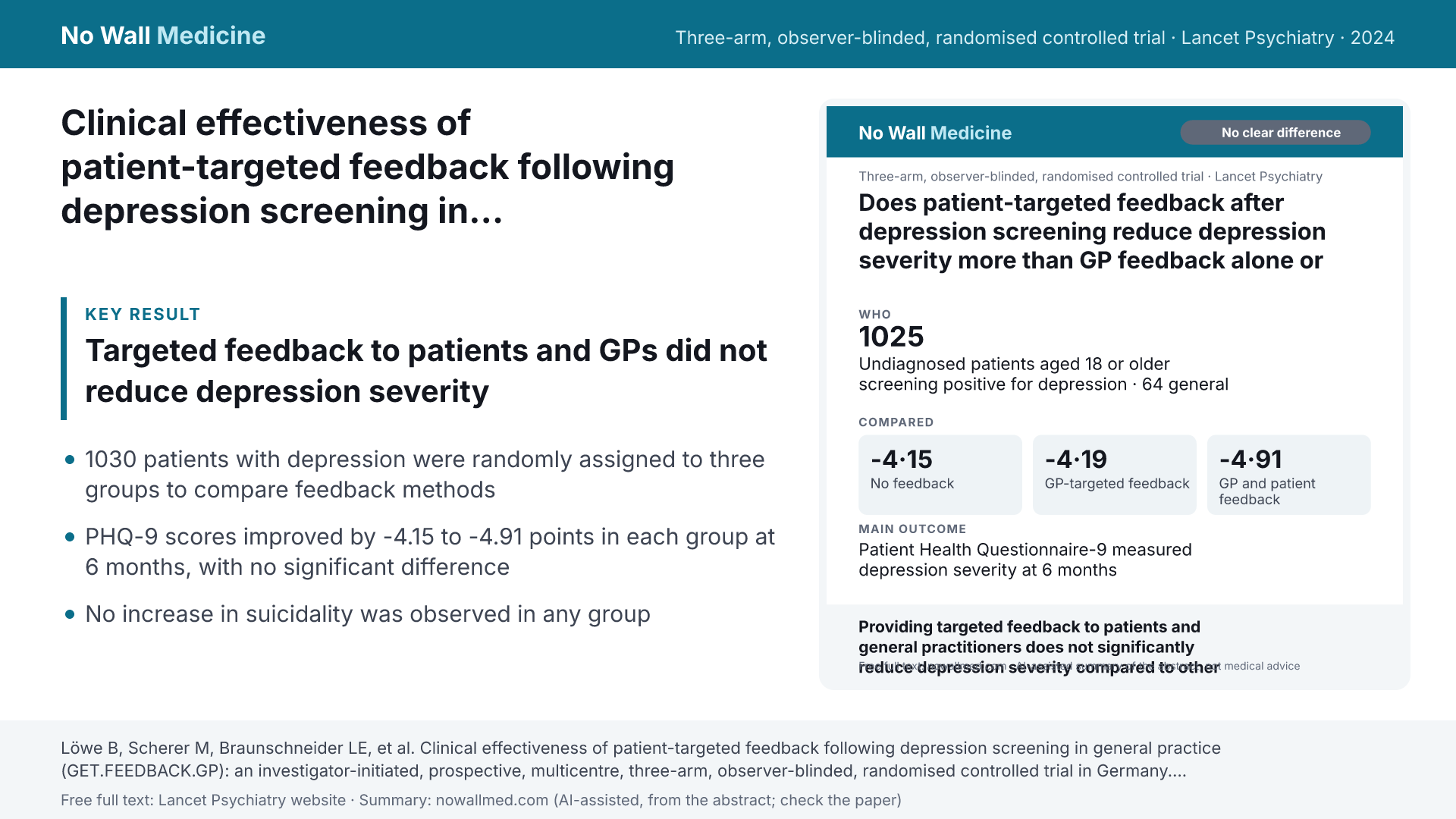
Targeted feedback to patients and GPs did not reduce depression severity
Clinical effectiveness of patient-targeted feedback following depression screening in general practice (GET.FEEDBACK.GP): an investigator-initiated, prospective, multicentre, three-arm, observer-blinded, randomised controlled trial in Germany
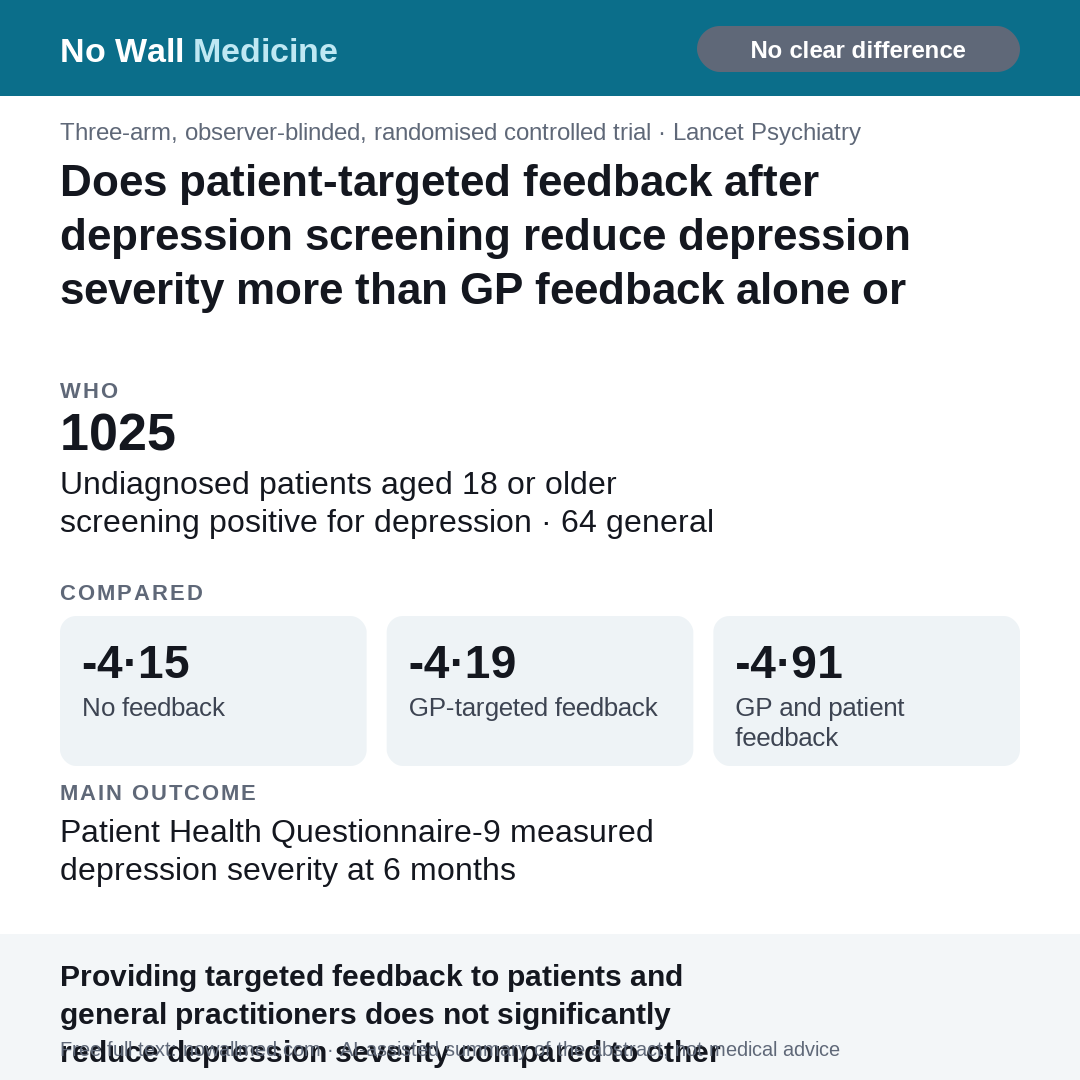
Three-arm, observer-blinded, randomised controlled trialNo clear difference
Does patient-targeted feedback after depression screening reduce depression severity more than GP feedback alone or no feedback?
Who
1025
Undiagnosed patients aged 18 or older screening positive for depression · 64 general practice sites in five regions in Germany
Compared
-4·15No feedback (95% CI -4·99 to -3·30)
-4·19GP-targeted feedback (-5·04 to -3·33)
-4·91GP and patient feedback (-5·76 to -4·07)
Main outcome
Patient Health Questionnaire-9 measured depression severity at 6 months
Result: no significant difference between the three groups (global p=0·13)
Bottom line: Providing targeted feedback to patients and general practitioners does not significantly reduce depression severity compared to other feedback methods.
Funded by: German Innovation Fund
Lancet Psychiatry · 2024-02-29Download image
Same trial (NCT03988985)
Papers we list that report this registered trial, oldest first. Read a secondary analysis alongside the main results.
- Main results No clear difference
This paper Lancet Psychiatry 2024-02 - Related report
Cost-effectiveness of targeted feedback interventions after depression screening in primary care: health economic evaluation of the GET.FEEDBACK.GP trial BJPsych Open 2026-02
Clinical question: Does patient-targeted feedback after depression screening reduce depression severity more than GP feedback alone or no feedback?
Key points
- 1030 patients with depression were randomly assigned to three groups to compare feedback methods.
- PHQ-9 scores improved by -4.15 to -4.91 points in each group at 6 months, with no significant difference.
- No increase in suicidality was observed in any group.
Headline and key points written with AI from the paper’s abstract, with every number checked against it. Read the paper before relying on them.
Was this summary helpful?
Abstract
Background
Screening for depression in primary care alone is not sufficient to improve clinical outcomes. However, targeted feedback of the screening results to patients might result in beneficial effects. The GET.FEEDBACK.GP trial investigated whether targeted feedback of the depression screening result to patients, in addition to feedback to general practitioners (GPs), leads to greater reductions in depression severity than GP feedback alone or no feedback. Methods
The GET.FEEDBACK.GP trial was an investigator-initiated, multicentre, three-arm, observer-blinded, randomised controlled trial. Depression screening was conducted electronically using the Patient Health Questionnaire-9 (PHQ-9) in 64 GP practices across five regions in Germany while patients were waiting to see their GP. Currently undiagnosed patients (aged ≥18 years) who screened positive for depression (PHQ-9 score ≥10), were proficient in the German language, and had a personal consultation with a GP were randomly assigned (1:1:1) into a group that received no feedback on their depression screening result, a group in which only the GP received feedback, or a group in which both GP and patient received feedback. Randomisation was stratified by treating GP and PHQ-9 depression severity. Trial staff were masked to patient enrolment and study group allocation and GPs were masked to the feedback recieved by the patient. Written feedback, including the screening result and information on depression, was provided to the relevant groups before the consultation. The primary outcome was PHQ-9-measured depression severity at 6 months after randomisation. An intention-to-treat analysis was conducted for patients who had at least one follow-up visit. This study is registered at ClinicalTrials.gov (NCT03988985) and is complete. Findings
Between July 17, 2019, and Jan 31, 2022, 25 279 patients were approached for eligibility screening, 17 150 were excluded, and 8129 patients completed screening, of whom 1030 (12·7%) screened positive for depression. 344 patients were randomly assigned to receive no feedback, 344 were assigned to receive GP-targeted feedback, and 339 were assigned to receive GP-targeted plus patient-targeted feedback. 252 (73%) patients in the no feedback group, 252 (73%) in the GP-targeted feedback group, and 256 (76%) in the GP-targeted and patient-targeted feedback group were included in the analysis of the primary outcome at 6 months, which reflected a follow-up rate of 74%. Gender was reported as female by 637 (62·1%) of 1025 participants, male by 384 (37·5%), and diverse by four (0·4%). 169 (16%) of 1026 patients with available migration data had a migration background. Mean age was 39·5 years (SD 15·2). PHQ-9 scores improved for each group between baseline and 6 months by -4·15 (95% CI -4·99 to -3·30) in the no feedback group, -4·19 (-5·04 to -3·33) in the GP feedback group, and -4·91 (-5·76 to -4·07) in the GP plus patient feedback group, with no significant difference between the three groups (global p=0·13). The difference in PHQ-9 scores when comparing the GP plus patient feedback group with the no feedback group was -0·77 (-1·60 to 0·07, d=-0·16) and when comparing with the GP-only feedback group was -0·73 (-1·56 to 0·11, d=-0·15). No increase in suicidality was observed as an adverse event in either group. Interpretation
Providing targeted feedback to patients and GPs after depression screening does not significantly reduce depression severity compared with GP feedback alone or no feedback. Further research is required to investigate the potential specific effectiveness of depression screening with systematic feedback for selected subgroups. Funding
German Innovation Fund. Translation
For the German translation of the abstract see Supplementary Materials section.
Abstract reproduced under the article’s CC BY licence.
Subject terms
Headline, design, result, key points, caveat and citation as plain text.
Cite this article
Löwe B, Scherer M, Braunschneider LE, et al. Clinical effectiveness of patient-targeted feedback following depression screening in general practice (GET.FEEDBACK.GP): an investigator-initiated, prospective, multicentre, three-arm, observer-blinded, randomised controlled trial in Germany. Lancet Psychiatry. 2024. doi:10.1016/S2215-0366(24)00035-X
Spotted a mistake? Suggest a correction