Automated feedback after internet depression screening does not change depression severity or help-seeking behavior
The efficacy of automated feedback after internet-based depression screening (DISCOVER): an observer-masked, three-armed, randomised controlled trial in Germany
Observer-masked, three-armed, randomised controlled trialNo clear difference
Does automated feedback after internet-based depression screening improve depression severity?
Who
1178
Undiagnosed individuals who screened positive for depression · Germany
Compared
No feedback: 3.4 PHQ-9 points
3.5 pointsNon-tailored feedback
3.7 pointsTailored feedback
Main outcome
Change in depression severity at 6 months
Result: p=0.72
Bottom line: Automated feedback after internet-based depression screening did not reduce depression severity or increase help-seeking behavior.
Funded by: German Research Foundation
Lancet Digit Health · 2024-06-22Download image
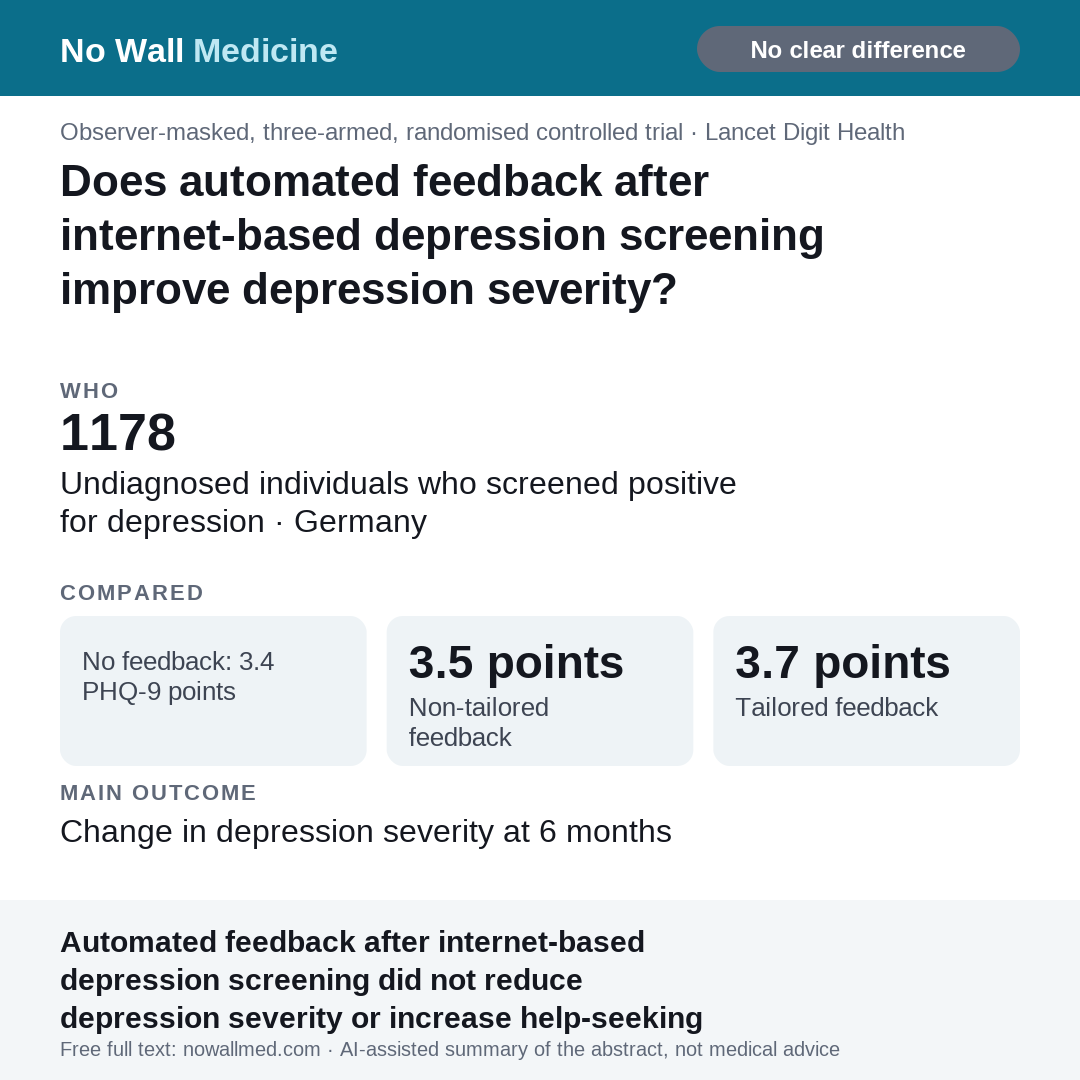
Clinical question: Does automated feedback after internet-based depression screening improve depression severity?
Why it matters: It is unknown if providing automated feedback after internet-based depression screening can reduce depression severity or encourage people to seek professional care.
Key points
- Researchers studied 1,178 individuals who screened positive for depression and compared no feedback, non-tailored feedback, and tailored feedback.
- At 6 months, depression severity decreased by 3.4 points in the no feedback group, 3.5 points in the non-tailored group, and 3.7 points in the tailored group.
- There were no significant differences in depression severity or the number of participants seeking psychotherapy or antidepressant treatment among the three groups.
Headline and key points written with AI from the paper’s abstract, with every number checked against it. Read the paper before relying on them.
Was this summary helpful?
Abstract
Background
Despite the availability of effective treatments, most depressive disorders remain undetected and untreated. Internet-based depression screening combined with automated feedback of screening results could reach people with depression and lead to evidence-based care. We aimed to test the efficacy of two versions of automated feedback after internet-based screening on depression severity compared with no feedback. Methods
DISCOVER was an observer-masked, three-armed, randomised controlled trial in Germany. We recruited individuals (aged ≥18 years) who were undiagnosed with depression and screened positive for depression on an internet-based self-report depression rating scale (Patient Health Questionnaire-9 [PHQ-9] ≥10 points). Participants were randomly assigned 1:1:1 to automatically receive no feedback, non-tailored feedback, or tailored feedback on the depression screening result. Randomisation was stratified by depression severity (moderate: PHQ-9 score 10-14 points; severe: PHQ-9 score ≥15 points). Participants could not be masked but were kept unaware of trial hypotheses to minimise expectancy bias. The non-tailored feedback included the depression screening result, a recommendation to seek professional diagnostic advice, and brief general information about depression and its treatment. The tailored feedback included the same basic information but individually framed according to the participants' symptom profiles, treatment preferences, causal symptom attributions, health insurance, and local residence. Research staff were masked to group allocation and outcome assessment as these were done using online questionnaires. The primary outcome was change in depression severity, defined as change in PHQ-9 score 6 months after random assignment. Analyses were conducted following the intention-to-treat principle for participants with at least one follow-up visit. This trial was registered at ClinicalTrials.gov, NCT04633096. Findings
Between Jan 12, 2021, and Jan 31, 2022, 4878 individuals completed the internet-based screening. Of these, 1178 (24%) screened positive for depression (mean age 37·1 [SD 14·2] years; 824 [70%] woman, 344 [29%] men, and 10 [1%] other gender identity). 6 months after random assignment, depression severity decreased by 3·4 PHQ-9 points in the no feedback group (95% CI 2·9-4·0; within-group d 0·67; 325 participants), by 3·5 points in the non-tailored feedback group (3·0-4·0; within-group d 0·74; 319 participants), and by 3·7 points in the tailored feedback group (3·2-4·3; within-group d 0·71; 321 participants), with no significant differences among the three groups (p=0·72). The number of participants seeking help for depression or initiating psychotherapy or antidepressant treatment did not differ among study groups. The results remained consistent when adjusted for fulfilling the DSM-5-based criteria for major depressive disorder or subjective belief of having a depressive disorder. Negative effects were reported by less than 1% of the total sample 6 months after random assignment. Interpretation
Automated feedback following internet-based depression screening did not reduce depression severity or prompt sufficient depression care in individuals previously undiagnosed with but affected by depression. Funding
German Research Foundation.
Abstract reproduced under the article’s CC BY NC ND licence.
Subject terms
Cite this article
Kohlmann S, Sikorski F, König HH, Schütt M, Zapf A, Löwe B. The efficacy of automated feedback after internet-based depression screening (DISCOVER): an observer-masked, three-armed, randomised controlled trial in Germany. Lancet Digit Health. 2024. doi:10.1016/S2589-7500(24)00070-0
Spotted a mistake? Suggest a correction
Top studies every Monday
The week’s key trials and guidelines in your specialties, plus any topics you follow. By email, free.
Get the weekly digest