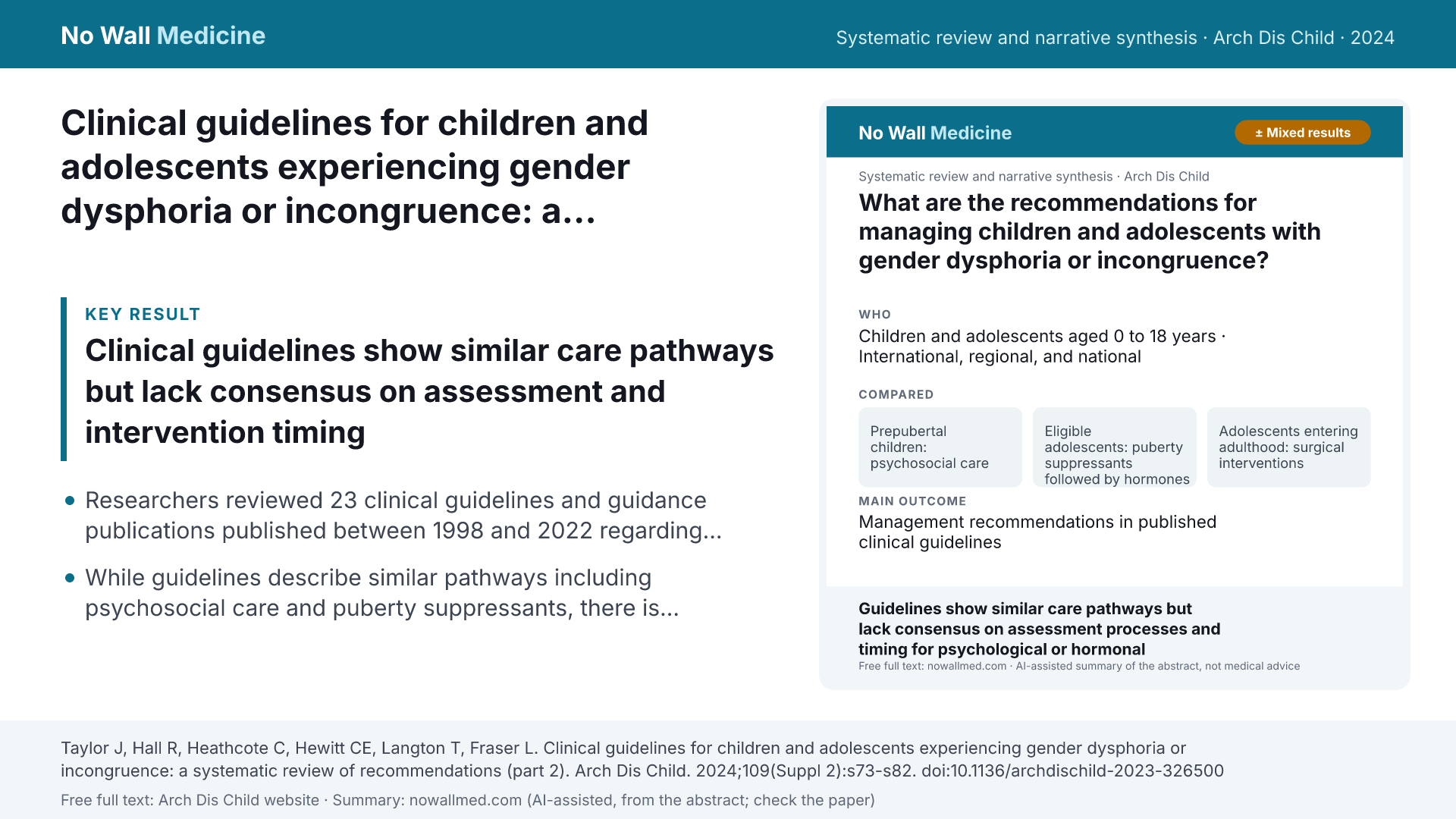
Clinical guidelines show similar care pathways but lack consensus on assessment and intervention timing
Clinical guidelines for children and adolescents experiencing gender dysphoria or incongruence: a systematic review of recommendations (part 2)
Systematic review and narrative synthesisMixed results
What are the recommendations for managing children and adolescents with gender dysphoria or incongruence?
Who
Children and adolescents aged 0 to 18 years · International, regional, and national guidelines
Compared
Prepubertal children: psychosocial care
Eligible adolescents: puberty suppressants followed by hormones
Adolescents entering adulthood: surgical interventions
Main outcome
Management recommendations in published clinical guidelines
Bottom line: Guidelines show similar care pathways but lack consensus on assessment processes and timing for psychological or hormonal interventions.
Limitation: Limited guidance on psychological care, prepubertal management, or non-binary gender identity.
Arch Dis Child · 2024-10-30 · Save PNG
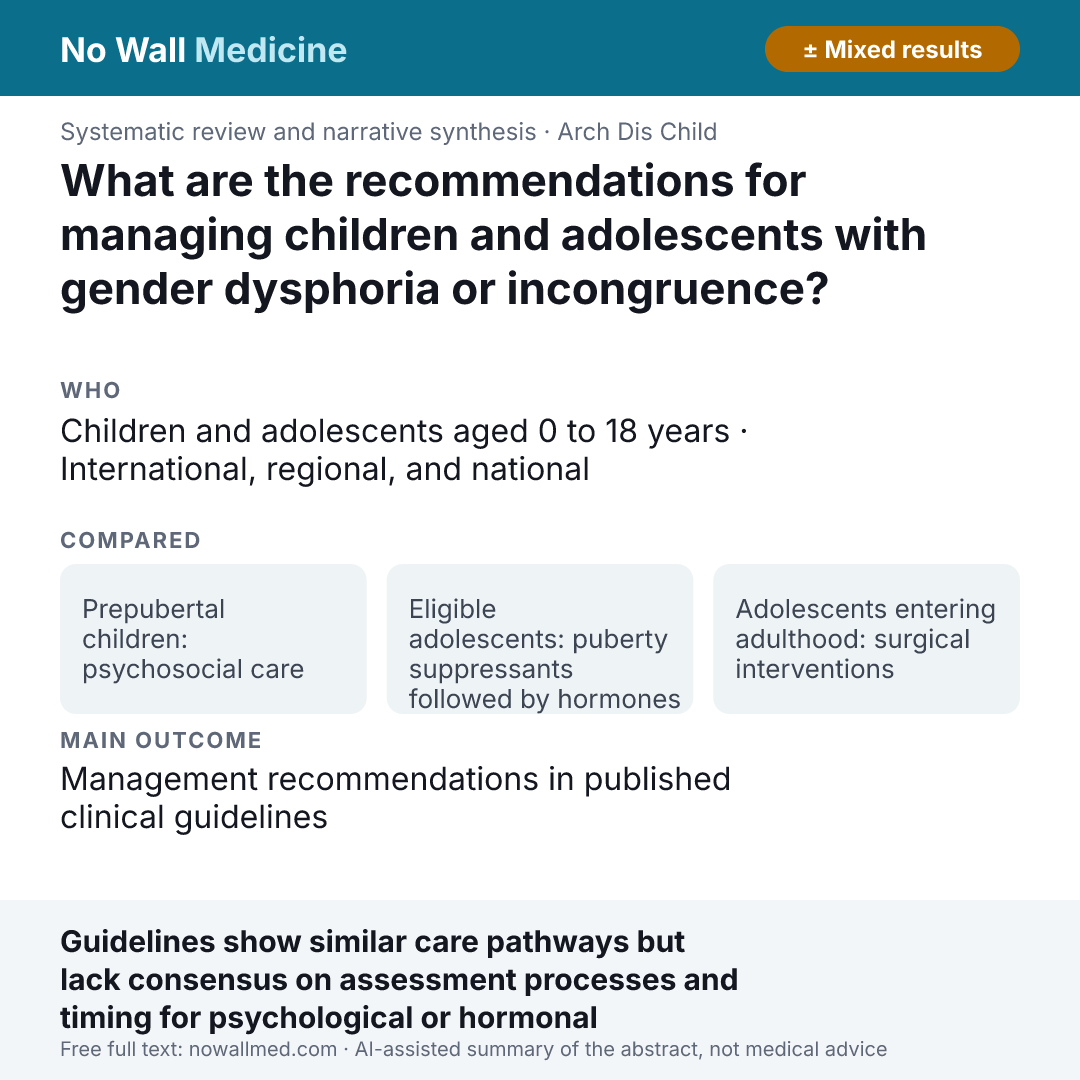
Clinical question: What are the recommendations for managing children and adolescents with gender dysphoria or incongruence?
Key points
- Researchers reviewed 23 clinical guidelines and guidance publications published between 1998 and 2022 regarding children and adolescents with gender dysphoria or incongruence.
- While guidelines describe similar pathways including psychosocial care and puberty suppressants, there is no consensus on the purpose of assessments or when to offer interventions.
- Guidance is limited regarding the management of prepubertal children, non-binary gender identities, and the specific types of psychological care to be provided.
Headline and key points written with AI from the paper’s abstract, with every number checked against it. Read the paper before relying on them.
Was this summary helpful?
Abstract
Background
Increasing numbers of children and adolescents experiencing gender dysphoria/incongruence are being referred to specialist gender services and there are various published guidelines outlining approaches to clinical care. Aim
To examine the recommendations about the management of children and/or adolescents (age 0-18) experiencing gender dysphoria/incongruence in published guidelines or clinical guidance. A separate paper examines the quality and development of guidelines. Methods
A systematic review and narrative synthesis. Databases (Medline, Embase, CINAHL, PsycINFO, Web of Science) were searched to April 2022 and web-based searches and contact with international experts continued to December 2022, with results assessed independently by two reviewers. The Appraisal of Guidelines for Research and Evaluation tool was used to examine guideline quality. Results
23 guidelines/clinical guidance publications (1998-2022) were identified (4 international, 3 regional, 16 national). Guidelines describe a similar care pathway starting with psychosocial care for prepubertal children, puberty suppressants followed by hormones for eligible adolescents and surgical interventions as these adolescents enter adulthood. In general, there is consensus that adolescents should receive a multidisciplinary assessment, although clear guidance about the purpose or approach is lacking. There are differing recommendations about when and on what basis psychological and medical interventions should be offered. There is limited guidance about what psychological care should be provided, about the management of prepubertal children or those with a non-binary gender identity, nor about pathways between specialist gender services and other providers. Conclusions
Published guidance describes a similar care pathway; however, there is no current consensus about the purpose and process of assessment for children or adolescents with gender dysphoria/incongruence, or about when psychological or hormonal interventions should be offered and on what basis. Prospero registration number
CRD42021289659.
Abstract reproduced under the article’s CC BY NC licence.
Subject terms
Headline, design, result, key points, caveat and citation as plain text.
Cite this article
Taylor J, Hall R, Heathcote C, Hewitt CE, Langton T, Fraser L. Clinical guidelines for children and adolescents experiencing gender dysphoria or incongruence: a systematic review of recommendations (part 2). Arch Dis Child. 2024;109(Suppl 2):s73-s82. doi:10.1136/archdischild-2023-326500
Spotted a mistake? Suggest a correction