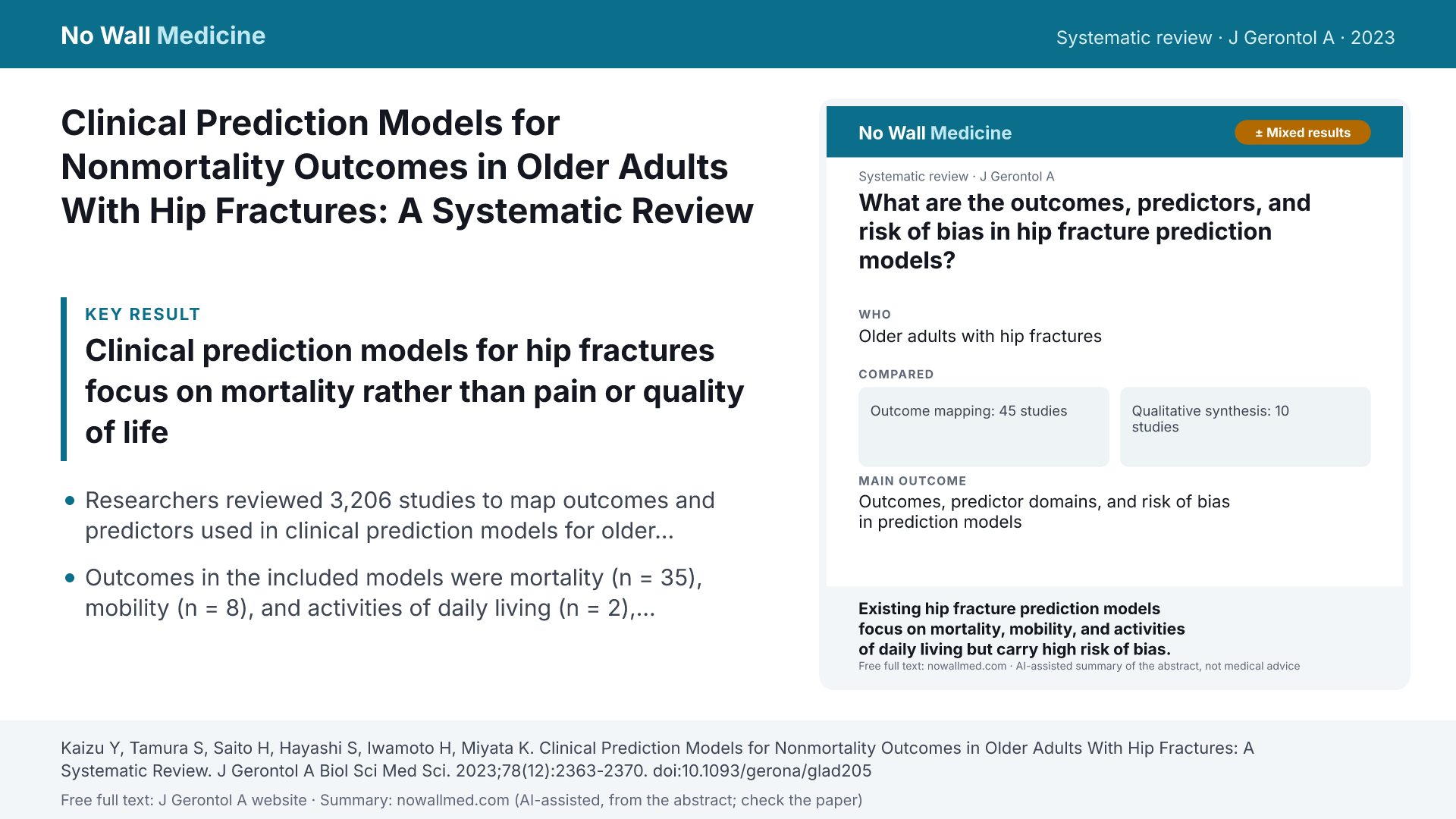
Clinical prediction models for hip fractures focus on mortality rather than pain or quality of life
Clinical Prediction Models for Nonmortality Outcomes in Older Adults With Hip Fractures: A Systematic Review
Systematic reviewMixed results
What are the outcomes, predictors, and risk of bias in hip fracture prediction models?
Who
Older adults with hip fractures
Compared
Outcome mapping: 45 studies
Qualitative synthesis: 10 studies
Main outcome
Outcomes, predictor domains, and risk of bias in prediction models
Bottom line: Existing hip fracture prediction models focus on mortality, mobility, and activities of daily living but carry high risk of bias.
Limitation: All ten studies eligible for qualitative synthesis showed a high risk of bias.
J Gerontol A · 2023-08-22 · Save PNG
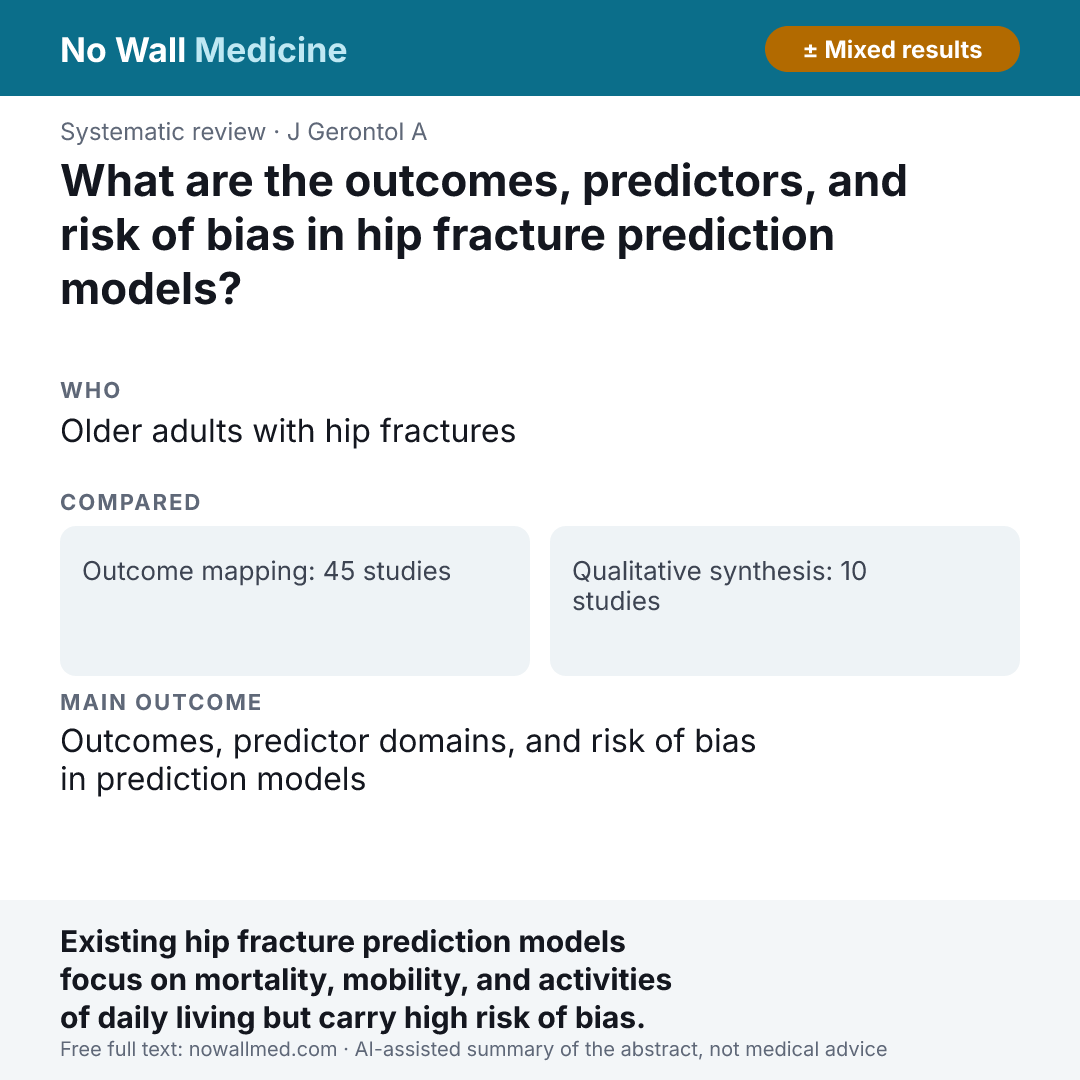
Clinical question: What are the outcomes, predictors, and risk of bias in hip fracture prediction models?
Key points
- Researchers reviewed 3,206 studies to map outcomes and predictors used in clinical prediction models for older adults with hip fractures.
- Outcomes in the included models were mortality (n = 35), mobility (n = 8), and activities of daily living (n = 2), but none included pain or health-related quality of life.
- The 10 studies eligible for qualitative synthesis showed a high risk of bias according to the Prediction Study Risk Of Bias Assessment Tool.
Limitation the authors note: The 10 studies included in the qualitative synthesis showed a high risk of bias.
Headline and key points written with AI from the paper’s abstract, with every number checked against it. Read the paper before relying on them.
Was this summary helpful?
Subject terms
Headline, design, result, key points, caveat and citation as plain text.
Cite this article
Kaizu Y, Tamura S, Saito H, Hayashi S, Iwamoto H, Miyata K. Clinical Prediction Models for Nonmortality Outcomes in Older Adults With Hip Fractures: A Systematic Review. J Gerontol A Biol Sci Med Sci. 2023;78(12):2363-2370. doi:10.1093/gerona/glad205
Spotted a mistake? Suggest a correction