Clinical remission rates vary based on definition used for patients with severe asthma
Clinical remission attainment, definitions, and correlates among patients with severe asthma treated with biologics: a systematic review and meta-analysis
Systematic review and meta-analysisMixed results
What are the attainment rates and correlates of clinical remission in severe asthma treated with biologics?
Who
Patients with severe asthma treated with biologics
Compared
38%Three-component definition (95% CI 29-47)
30%Four-component definition (27-34)
Main outcome
Clinical remission attainment
Bottom line: Clinical remission is achieved by a minority of severe asthma patients treated with biologics, with attainment rates varying by definition.
Limitation: Little consensus was found between studies regarding the clinical remission definition.
Funded by: Health Data Research UK
Lancet Respir Med · 2024-11-14Download image
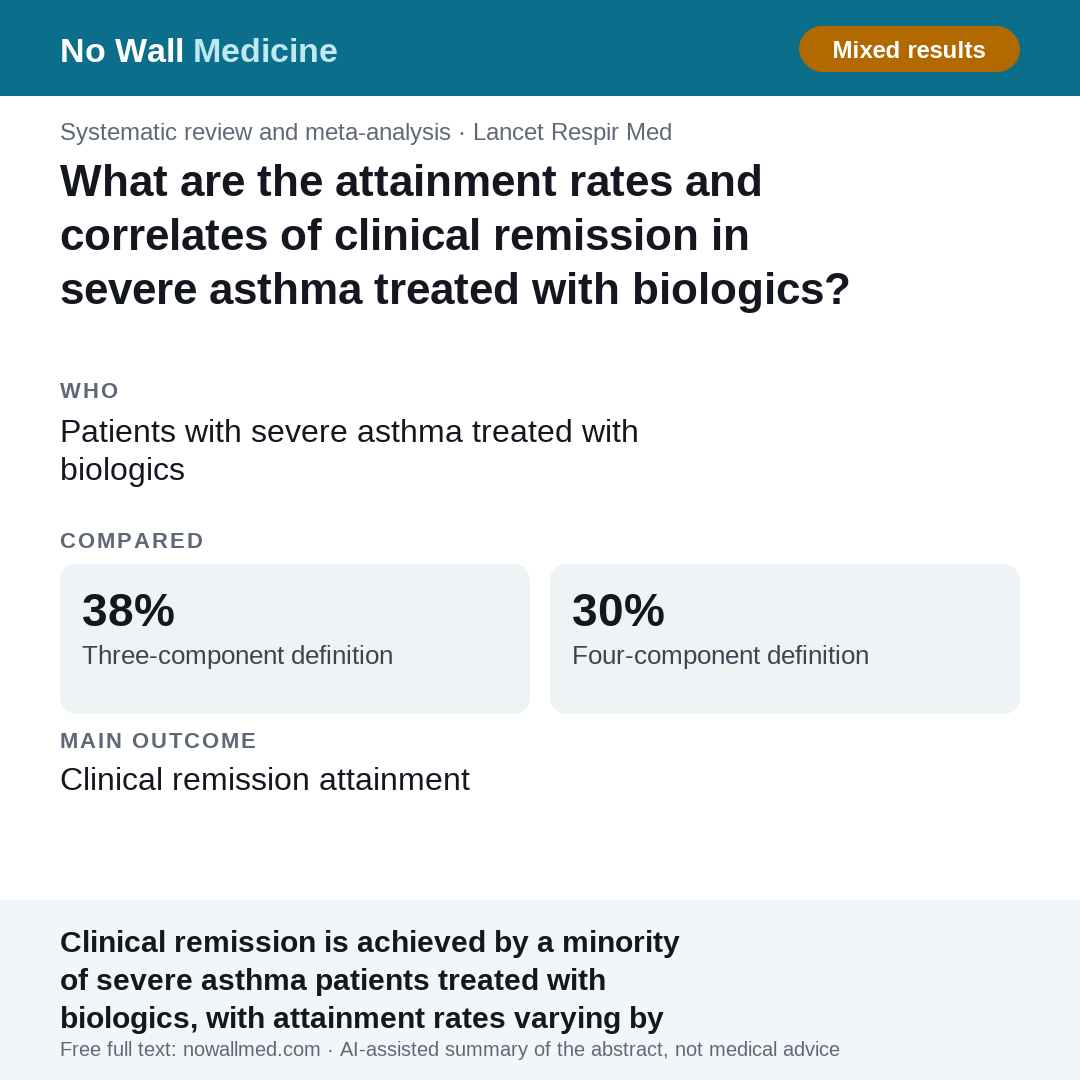
Clinical question: What are the attainment rates and correlates of clinical remission in severe asthma treated with biologics?
Why it matters: Clinical remission rates for severe asthma are inconsistent because studies use different definitions for symptoms, lung function, and corticosteroid use.
Key points
- Researchers analyzed 25 studies involving 28 analyses of patients with severe asthma treated with biologic therapies.
- The pooled remission rate was 38% using a three-component definition and 30% using a four-component definition.
- Lower remission rates were associated with worse lung function, worse symptoms, longer asthma duration, and use of maintenance oral corticosteroids.
Headline and key points written with AI from the paper’s abstract, with every number checked against it. Read the paper before relying on them.
Abstract
Background
Clinical remission has emerged as an important treatment goal in severe asthma; however, studies have reported variable attainment due to differences in study populations, definitions, and methods. We aimed to perform a systematic review and meta-analysis of clinical remission attainment, definitions, and correlates among patients with severe asthma who have been treated with biologics. Methods
In this systematic review and meta-analysis, we searched Web of Science, Embase, and MEDLINE, using the keywords "asthma" and "remission", for studies published between database inception and June 13, 2024, that reported clinical remission among patients with severe asthma treated with biologics. Studies were eligible for inclusion in both the systematic review and meta-analysis if they were published in English language peer-reviewed journals and reported rates of clinical remission for patients treated with biologics for severe asthma. There were no limitations by study design. Two reviewers independently screened identified papers (AS and CR), with disagreements resolved through consensus or referral to a third reviewer (JB). Study-level data on study characteristics, clinical remission definitions, clinical remission attainment, and the potential correlates of clinical remission were extracted independently by two reviewers (AS and CR) using Covidence. We defined a three-component definition of clinical remission, which included use of maintenance oral corticosteroids, exacerbations, and asthma symptom burden, and a four-component definition, which additionally included lung function. We meta-analysed the rate of attainment of clinical remission and assessed the correlates of clinical remission using DerSimonian-Laird random-effects models. Statistical heterogeneity was assessed using the I2 statistic. This study was registered with PROSPERO, CRD42024507233. Findings
Our search identified 3014 potentially eligible studies, of which 1812 were screened. 25 studies were included, which reported 28 analyses of clinical remission attainment. 68 definitions of clinical remission were identified, of which 48 were unique. Little consensus was found between studies in terms of the clinical remission definition, particularly for symptoms and lung function. Eight analyses used the three-component definition of clinical remission and 25 used the four-component definition. The pooled proportion of patients who attained clinical remission was 38% (95% CI 29-47; I2=93%) for the three-component definition and 30% (27-34; I2=83%) for the four-component definition. Several pulmonary factors were associated with lower clinical remission rates, including worse FEV1 (odds ratio 0·09 [95% CI 0·01-0·92]; I2=87%), worse asthma symptoms (0·23 [0·17-0·33]; I2=0%), longer asthma duration (0·49 [0·32-0·76]; I2=22%), and use of maintenance oral corticosteroids (0·57 [0·40-0·79]; I2=49%). The presence of comorbidities, in particular depression (0·38 [0·23-0·61]; I2=6%) and obesity (0·41 [0·31-0·54]; I2=0%), were important non-pulmonary barriers to clinical remission. Interpretation
Clinical remission is an achievable goal for a minority of patients with severe asthma treated with biologics. Definitions of clinical remission varied substantially between studies, and materially affected attainment, suggesting an urgent need for further consensus-driven definitions. Longer disease duration, higher asthma severity, and the presence of comorbidities were identified as important barriers to clinical remission, suggesting that earlier intervention with effective treatments and a broader treatable traits approach might improve outcomes. Funding
Health Data Research UK, Inflammation and Immunity driver project.
Abstract reproduced under the article’s CC BY licence.
Topics
Cite this article
Shackleford A, Heaney LG, Redmond C, McDowell PJ, Busby J. Clinical remission attainment, definitions, and correlates among patients with severe asthma treated with biologics: a systematic review and meta-analysis. Lancet Respir Med. 2024. doi:10.1016/S2213-2600(24)00293-5
Spotted a mistake? Suggest a correction
Top studies every Monday
The week’s key trials and guidelines in your specialties, by email. Free.
Get the weekly digest