Clinical tests for confirming breathing tube placement show varying rates of false positive results
Clinical tests for confirming tracheal intubation or excluding oesophageal intubation: a diagnostic test accuracy systematic review and meta-analysis
Systematic review and meta-analysisHarm found
How accurate are clinical tests for confirming tracheal intubation or excluding oesophageal intubation?
Who
10,654
Participants undergoing tracheal intubation
Compared
Misting: false positive rate (95%CI) of 0.69 (0.43-0.87)
0.14Lung auscultation (0.08-0.23)
0.18Five-point auscultation (0.08-0.36)
0.05Oesophageal detector device (0.02-0.09)
Main outcome
False positive rate of clinical tests to confirm tracheal intubation
Bottom line: Misting and auscultation have too high a false positive rate to reliably exclude oesophageal intubation.
Anaesthesia · 2023-06-16Download image
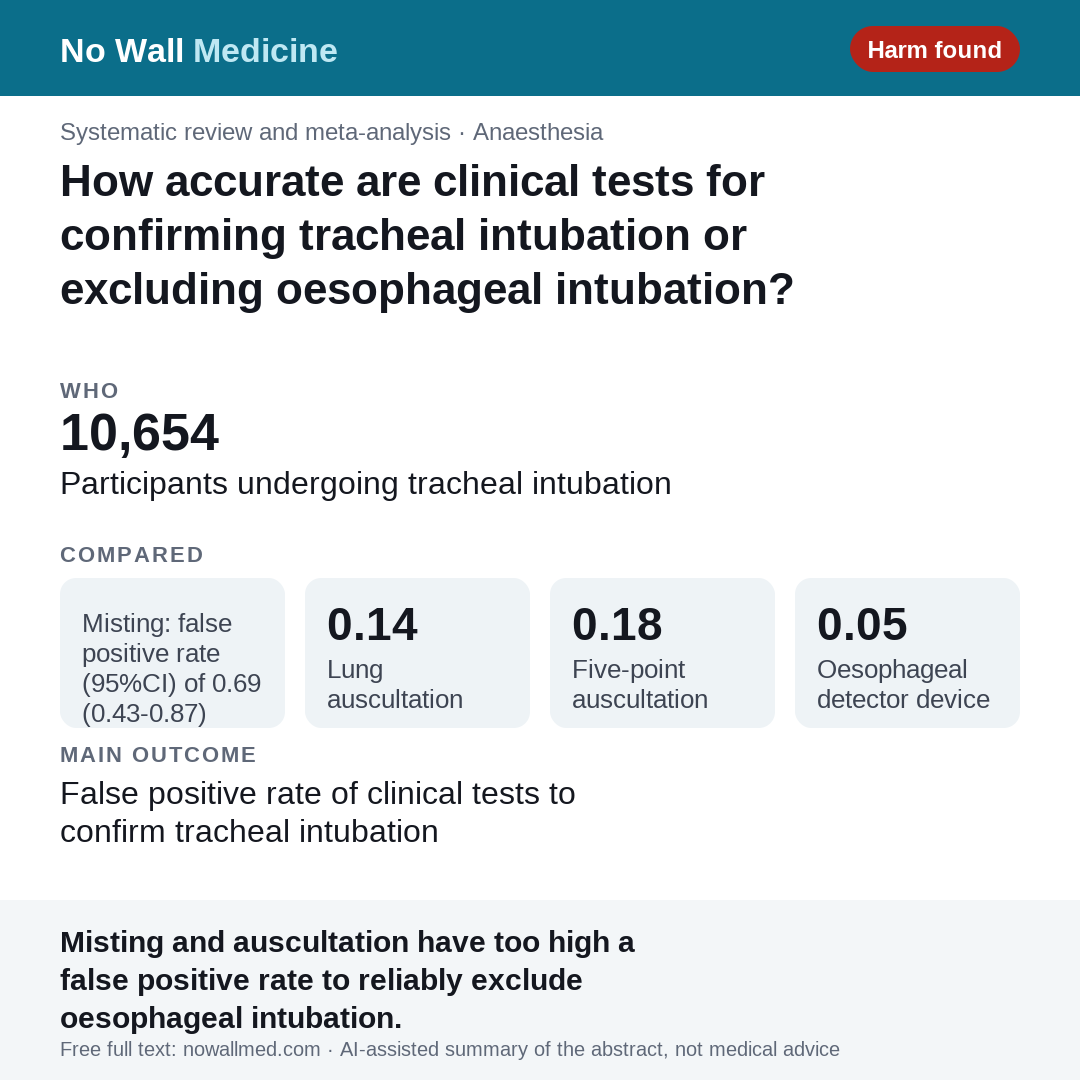
Clinical question: How accurate are clinical tests for confirming tracheal intubation or excluding oesophageal intubation?
Why it matters: Clinicians often use clinical findings to confirm breathing tube placement when capnography, or measuring carbon dioxide levels, is unavailable or doubted.
Key points
- Researchers analyzed 49 studies involving 10,654 participants to evaluate the accuracy of clinical tests for confirming tracheal intubation, which is the placement of a breathing tube in the windpipe.
- The oesophageal detector device had a false positive rate of 0.05 (95%CI 0.02-0.09), while misting was 0.69 (95%CI 0.43-0.87) and lung auscultation, or listening to breath sounds, was 0.14 (0.08-0.23).
- Misting and auscultation had false positive rates too high to reliably exclude oesophageal intubation, which is the incorrect placement of a breathing tube in the food pipe.
Headline and key points written with AI from the paper’s abstract, with every number checked against it. Read the paper before relying on them.
Topics
Cite this article
Hansel J, Law JA, Chrimes N, Higgs A, Cook TM. Clinical tests for confirming tracheal intubation or excluding oesophageal intubation: a diagnostic test accuracy systematic review and meta-analysis. Anaesthesia. 2023. doi:10.1111/anae.16059
Spotted a mistake? Suggest a correction
Top studies every Monday
The week’s key trials and guidelines in your specialties, plus any topics you follow. By email, free.
Get the weekly digest