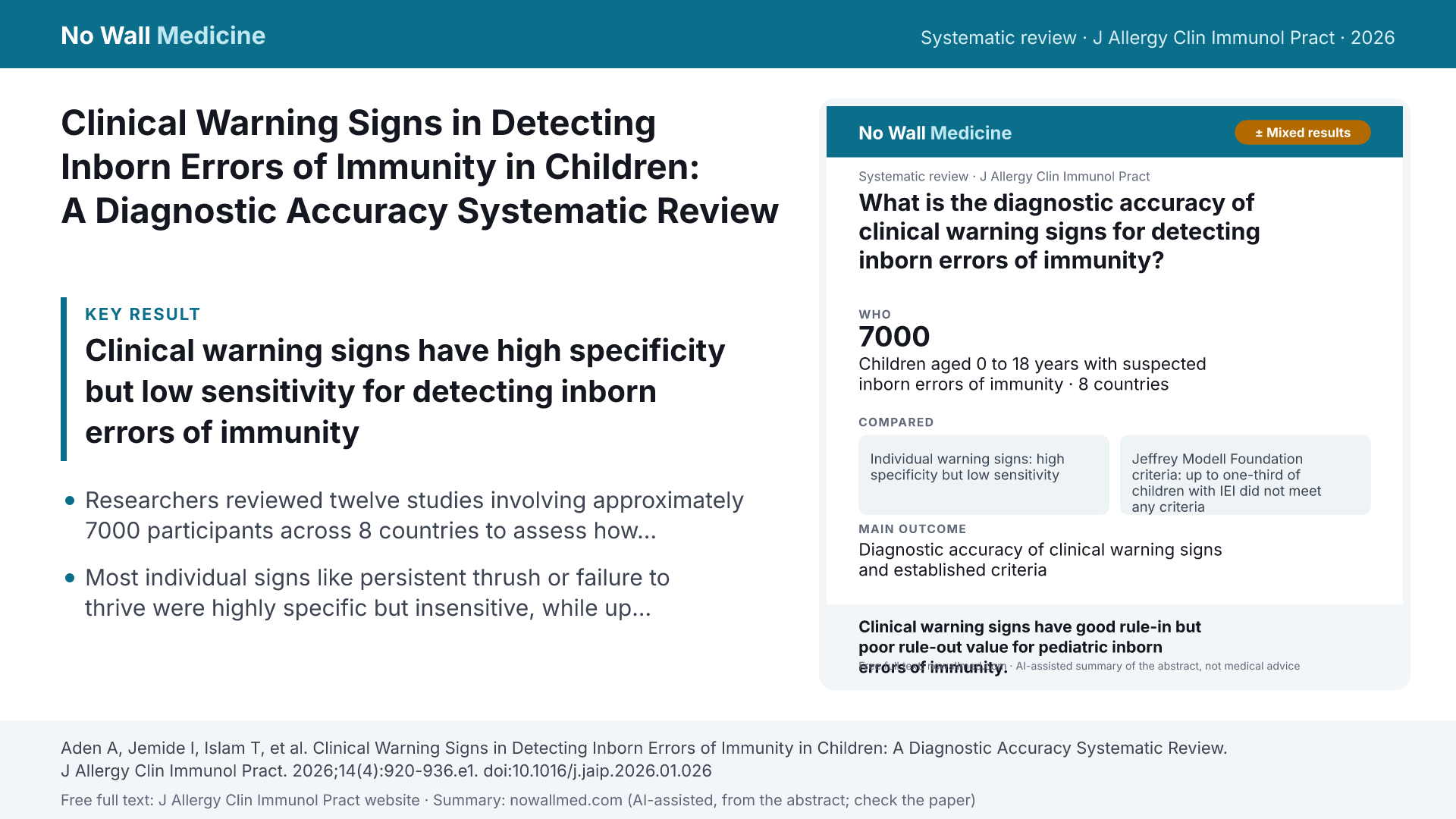
Clinical warning signs have high specificity but low sensitivity for detecting inborn errors of immunity
Clinical Warning Signs in Detecting Inborn Errors of Immunity in Children: A Diagnostic Accuracy Systematic Review
Systematic reviewMixed results
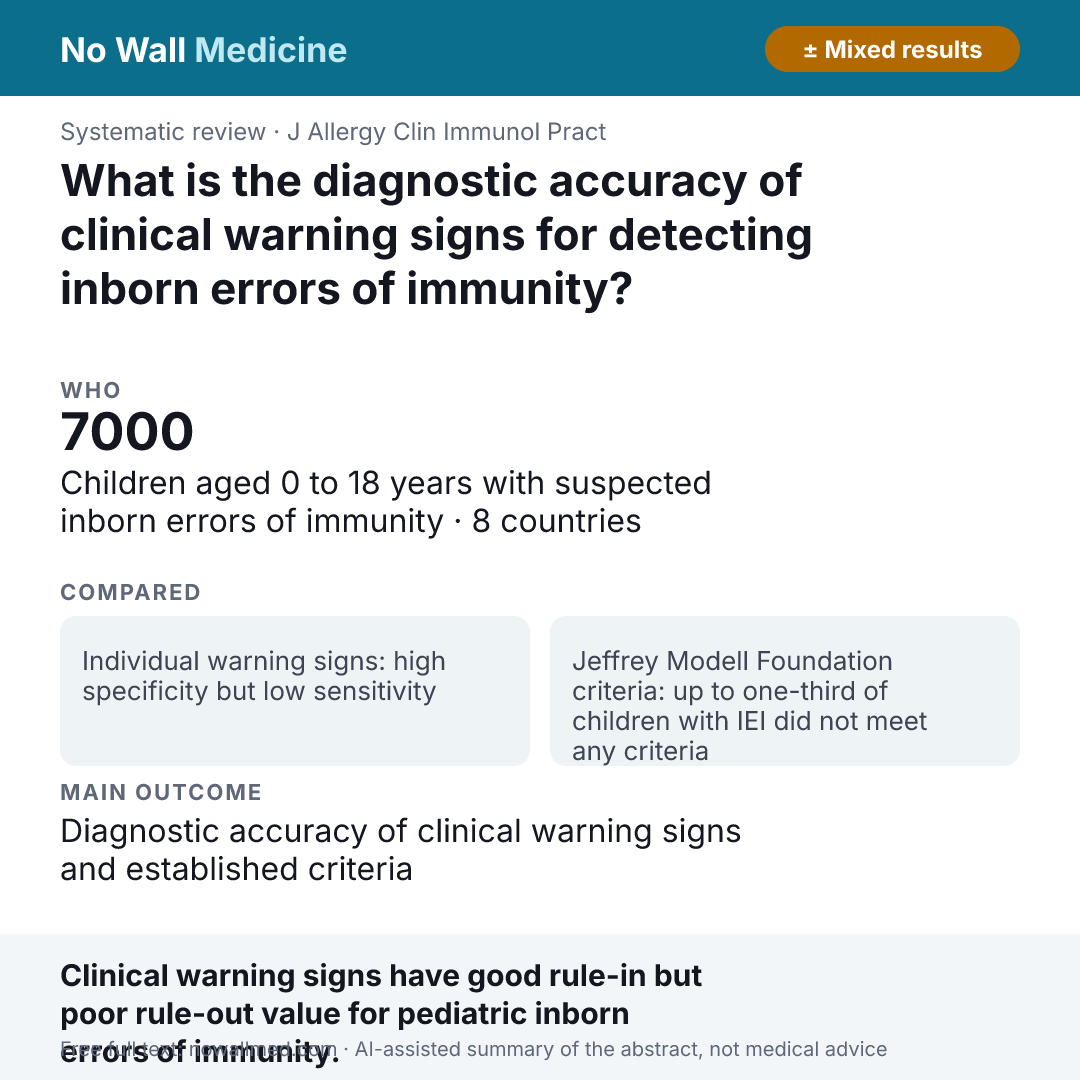
What is the diagnostic accuracy of clinical warning signs for detecting inborn errors of immunity?
Who
7000
Children aged 0 to 18 years with suspected inborn errors of immunity · 8 countries
Compared
Individual warning signs: high specificity but low sensitivity
Jeffrey Modell Foundation criteria: up to one-third of children with IEI did not meet any criteria
Main outcome
Diagnostic accuracy of clinical warning signs and established criteria
Bottom line: Clinical warning signs have good rule-in but poor rule-out value for pediatric inborn errors of immunity.
Limitation: Diagnostic performance was highly heterogeneous and pooled estimates are exploratory.
J Allergy Clin Immunol Pract · 2026-02-02 · Save PNG
Clinical question: What is the diagnostic accuracy of clinical warning signs for detecting inborn errors of immunity?
Why it matters: The diagnostic accuracy of widely promoted clinical warning signs for identifying inborn errors of immunity in children is currently uncertain.
Key points
- Researchers reviewed twelve studies involving approximately 7000 participants across 8 countries to assess how well clinical warning signs identify inborn errors of immunity in children.
- Most individual signs like persistent thrush or failure to thrive were highly specific but insensitive, while up to one-third of children did not meet any Jeffrey Modell Foundation criteria.
- Infection-based signs such as recurrent pneumonia provided a more balanced profile but remained imperfect for identifying these immune system disorders.
Limitation the authors note: Diagnostic performance was highly heterogeneous and pooled estimates are exploratory.
Headline and key points written with AI from the paper’s abstract, with every number checked against it. Read the paper before relying on them.
Was this summary helpful?
Subject terms
Headline, design, result, key points, caveat and citation as plain text.
Cite this article
Aden A, Jemide I, Islam T, et al. Clinical Warning Signs in Detecting Inborn Errors of Immunity in Children: A Diagnostic Accuracy Systematic Review. J Allergy Clin Immunol Pract. 2026;14(4):920-936.e1. doi:10.1016/j.jaip.2026.01.026
Spotted a mistake? Suggest a correction