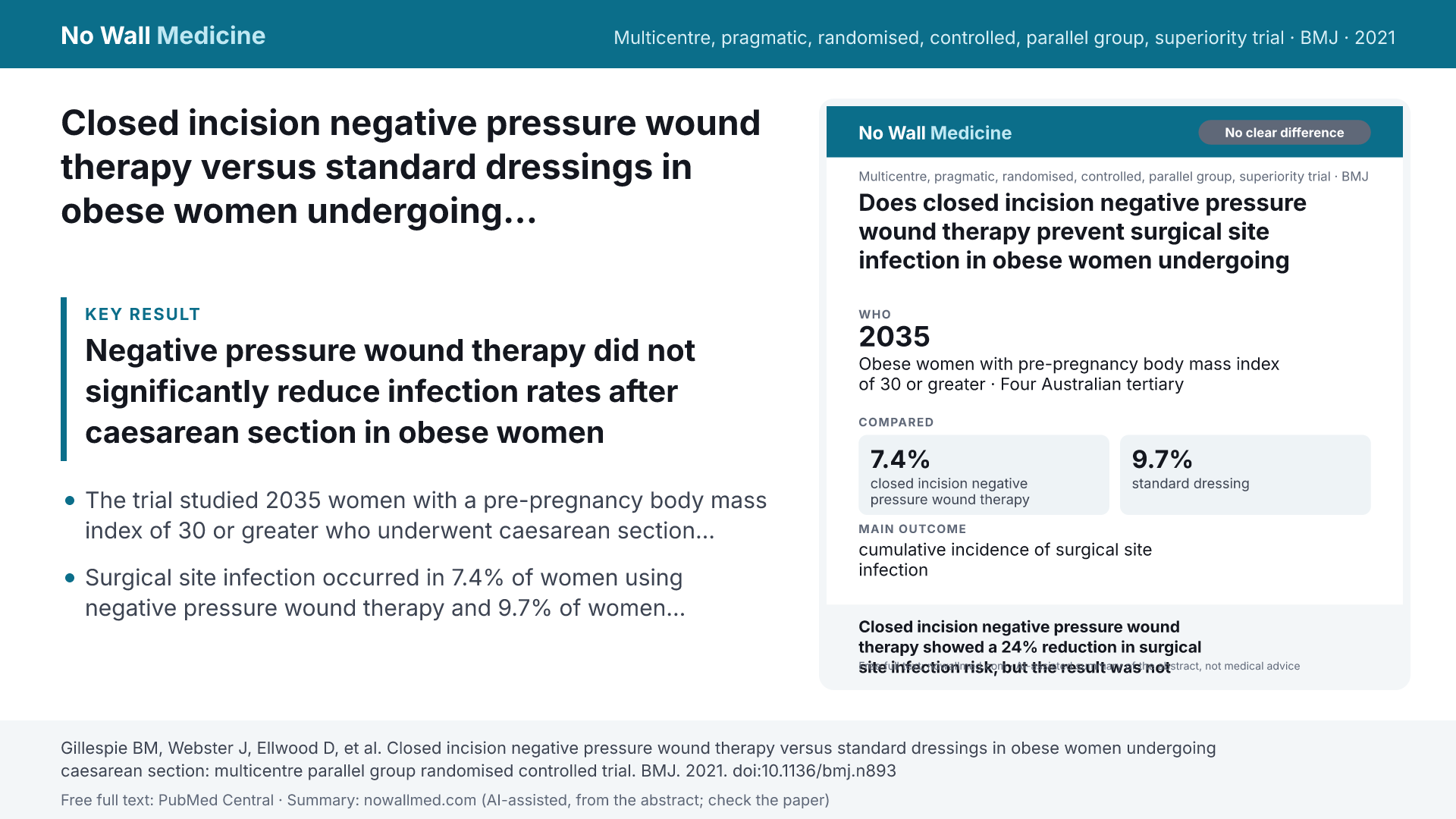
Negative pressure wound therapy did not significantly reduce infection rates after caesarean section in obese women
Closed incision negative pressure wound therapy versus standard dressings in obese women undergoing caesarean section: multicentre parallel group randomised controlled trial
Multicentre, pragmatic, randomised, controlled, parallel group, superiority trialNo clear difference
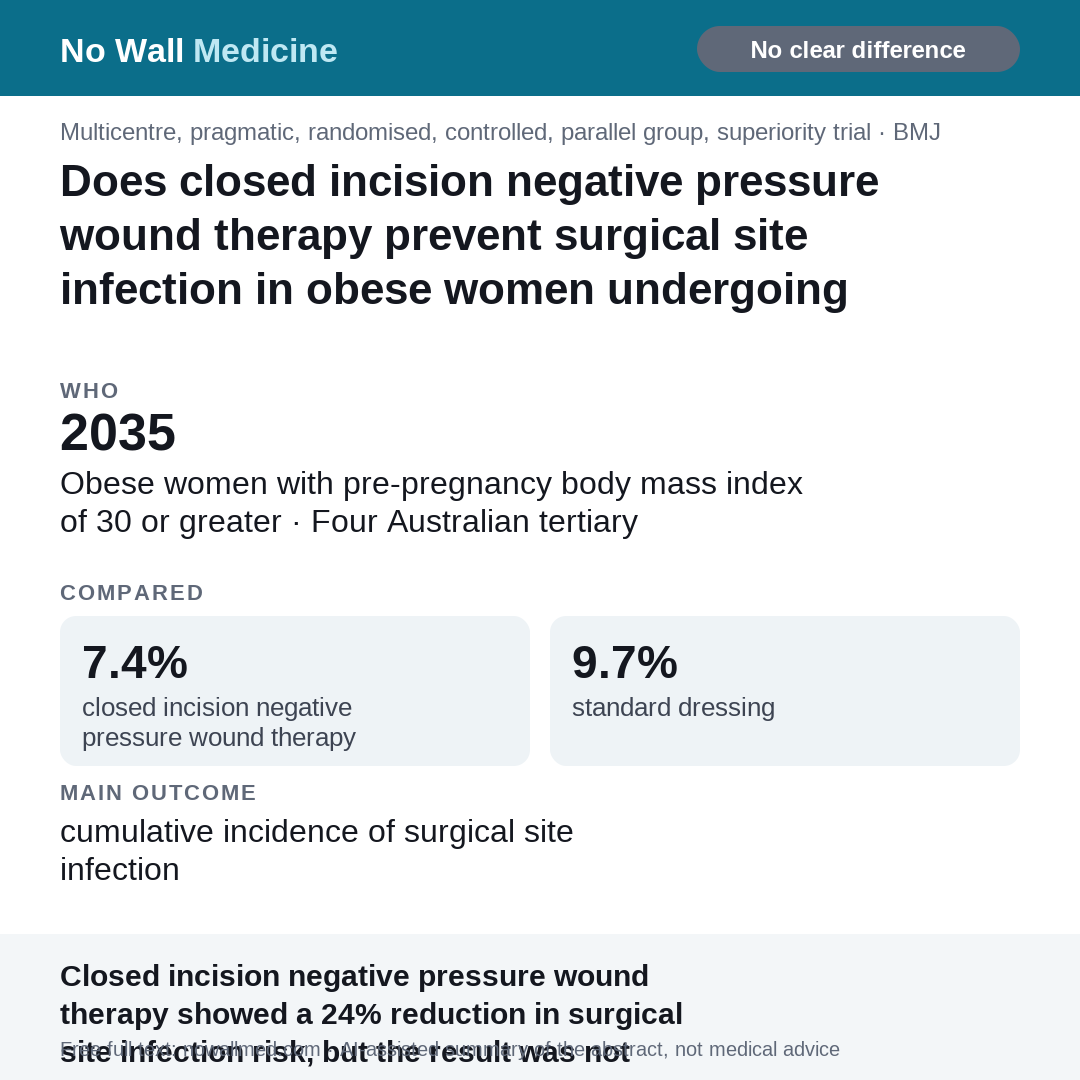
Does closed incision negative pressure wound therapy prevent surgical site infection in obese women undergoing caesarean section?
Who
2035
Obese women with pre-pregnancy body mass index of 30 or greater · Four Australian tertiary hospitals
Compared
7.4%closed incision negative pressure wound therapy
9.7%standard dressing
Main outcome
cumulative incidence of surgical site infection
Result: risk ratio 0.76 (95% confidence interval 0.57 to 1.01)
Bottom line: Closed incision negative pressure wound therapy showed a 24% reduction in surgical site infection risk, but the result was not statistically significant.
BMJ · 2021-05-05Download image
Clinical question: Does closed incision negative pressure wound therapy prevent surgical site infection in obese women undergoing caesarean section?
Key points
- The trial studied 2035 women with a pre-pregnancy body mass index of 30 or greater who underwent caesarean section and compared negative pressure wound therapy to standard dressings.
- Surgical site infection occurred in 7.4% of women using negative pressure wound therapy and 9.7% of women using standard dressings, which was not a statistically significant difference.
- Skin blistering occurred in 4.0% of women in the negative pressure wound therapy group compared to 2.3% in the standard dressing group.
Headline and key points written with AI from the paper’s abstract, with every number checked against it. Read the paper before relying on them.
Was this summary helpful?
Abstract
Objective
To determine the effectiveness of closed incision negative pressure wound therapy (NPWT) compared with standard dressings in preventing surgical site infection (SSI) in obese women undergoing caesarean section. Design
Multicentre, pragmatic, randomised, controlled, parallel group, superiority trial. Setting
Four Australian tertiary hospitals between October 2015 and November 2019. Participants
Eligible women had a pre-pregnancy body mass index of 30 or greater and gave birth by elective or semi-urgent caesarean section. Intervention
2035 consenting women were randomised before the caesarean procedure to closed incision NPWT (n=1017) or standard dressing (n=1018). Allocation was concealed until skin closure. Main outcome measures
The primary outcome was cumulative incidence of SSI. Secondary outcomes included depth of SSI (superficial, deep, or organ/body space), rates of wound complications (dehiscence, haematoma, seroma, bleeding, bruising), length of stay in hospital, and rates of dressing related adverse events. Women and clinicians were not masked, but the outcome assessors and statistician were blinded to treatment allocation. The pre-specified primary intention to treat analysis was based on a conservative assumption of no SSI for a minority of women (n=28) with missing outcome data. Post hoc sensitivity analyses included best case analysis and complete case analysis. Results
In the primary intention to treat analysis, SSI occurred in 75 (7.4%) women treated with closed incision NPWT and in 99 (9.7%) women with a standard dressing (risk ratio 0.76, 95% confidence interval 0.57 to 1.01; P=0.06). Post hoc sensitivity analyses to explore the effect of missing data found the same direction of effect (closed incision NPWT reducing SSI), with statistical significance. Blistering occurred in 40/996 (4.0%) women who received closed incision NPWT and in 23/983 (2.3%) who received the standard dressing (risk ratio 1.72, 1.04 to 2.85; P=0.03). Conclusion
Prophylactic closed incision NPWT for obese women after caesarean section resulted in a 24% reduction in the risk of SSI (3% reduction in absolute risk) compared with standard dressings. This difference was close to statistical significance, but it likely underestimates the effectiveness of closed incision NPWT in this population. The results of the conservative primary analysis, multivariable adjusted model, and post hoc sensitivity analysis need to be considered alongside the growing body of evidence of the benefit of closed incision NPWT and given the number of obese women undergoing caesarean section globally. The decision to use closed incision NPWT must also be weighed against the increases in skin blistering and economic considerations and should be based on shared decision making with patients. Trial registration
ANZCTR identifier 12615000286549.
Abstract reproduced under the article’s CC BY NC licence.
Subject terms
Headline, design, result, key points, caveat and citation as plain text.
Cite this article
Gillespie BM, Webster J, Ellwood D, et al. Closed incision negative pressure wound therapy versus standard dressings in obese women undergoing caesarean section: multicentre parallel group randomised controlled trial. BMJ. 2021. doi:10.1136/bmj.n893
Spotted a mistake? Suggest a correction