Closed incision negative pressure wound therapy versus standard dressings in obese women undergoing caesarean section: multicentre parallel group randomised controlled trial
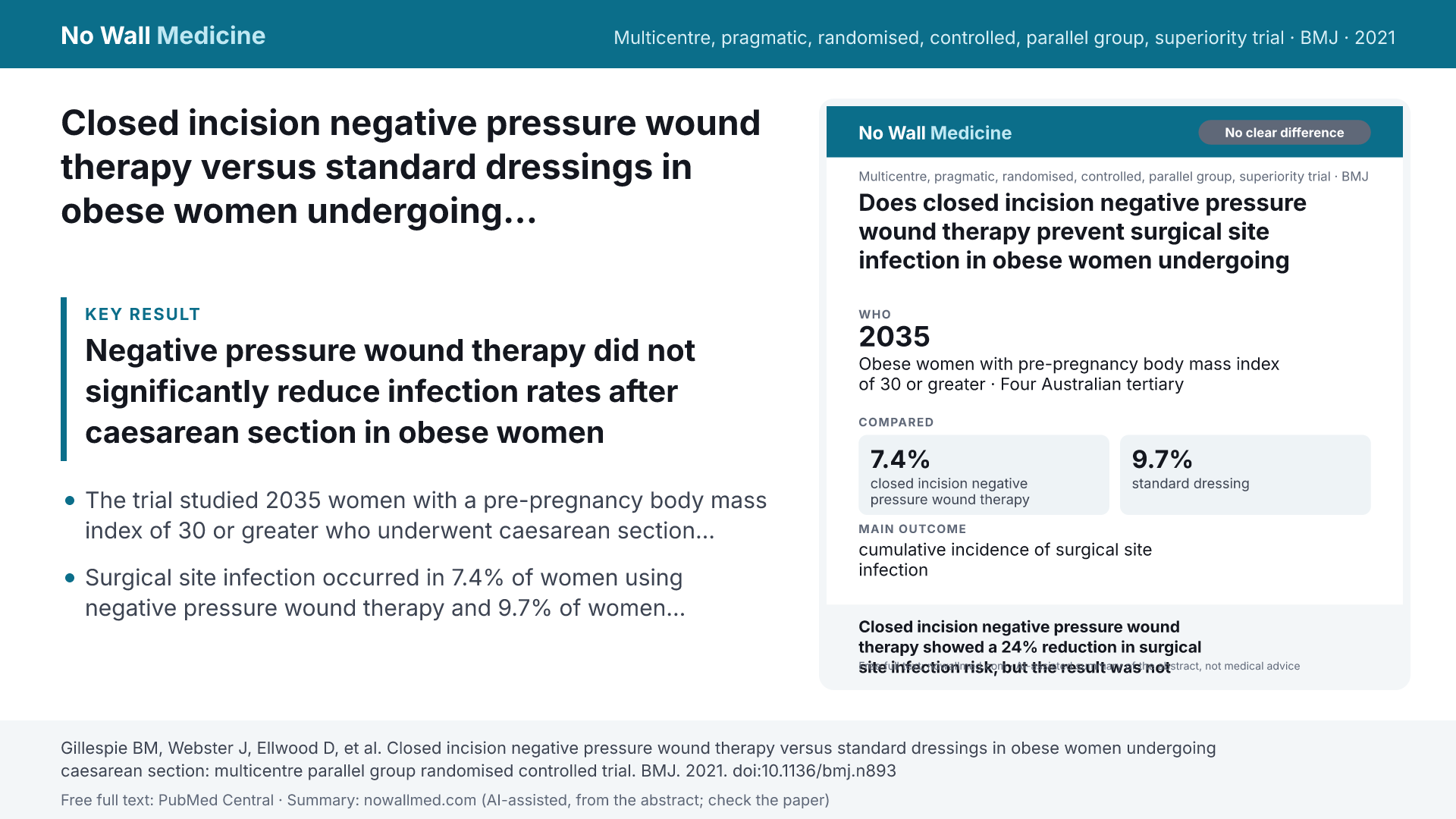
Key result: Negative pressure wound therapy did not significantly reduce infection rates after caesarean section in obese women
Multicentre, pragmatic, randomised, controlled, parallel group, superiority trialNo clear difference
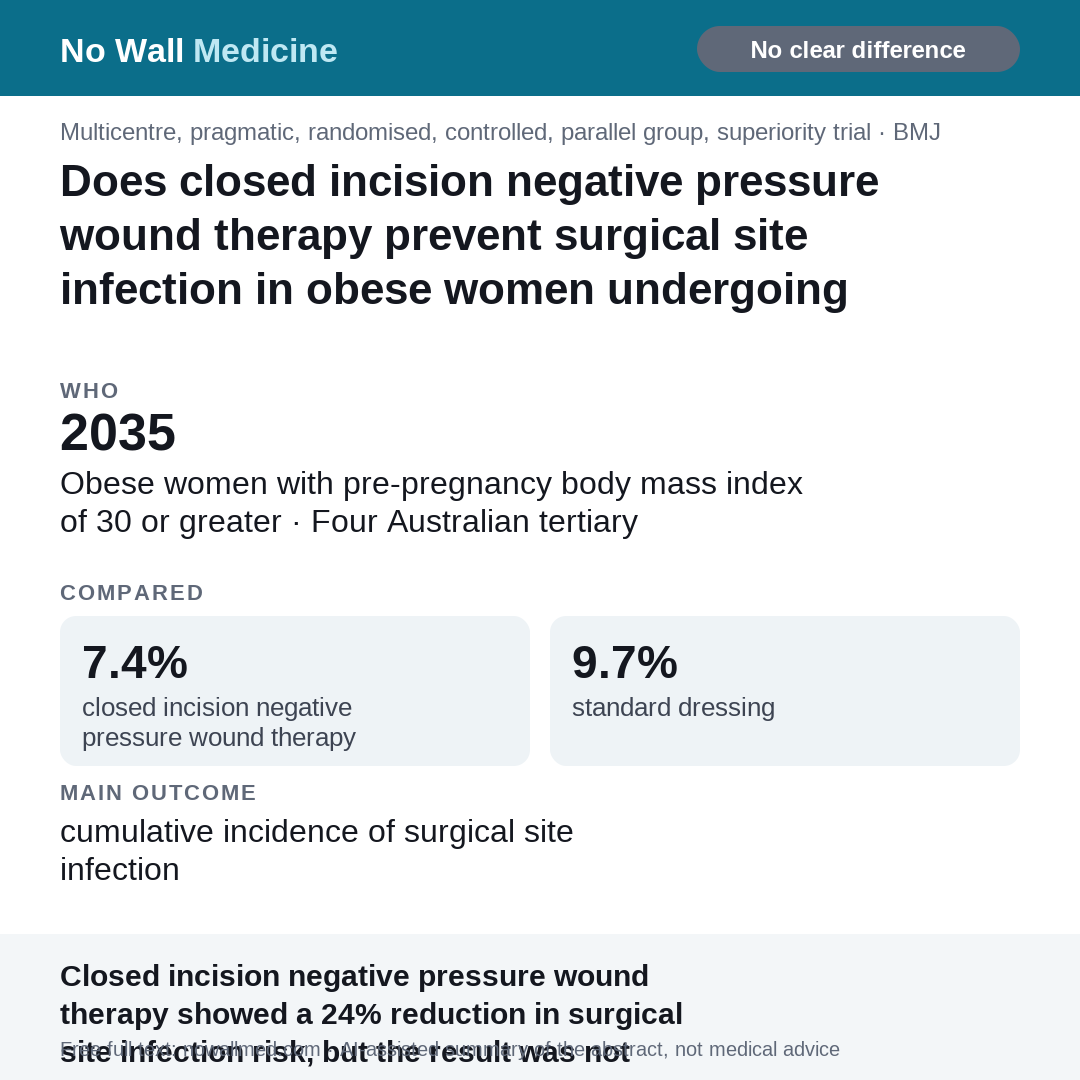
Does closed incision negative pressure wound therapy prevent surgical site infection in obese women undergoing caesarean section?
Who
2035
Obese women with pre-pregnancy body mass index of 30 or greater · Four Australian tertiary hospitals
Compared
7.4%closed incision negative pressure wound therapy
9.7%standard dressing
Main outcome
cumulative incidence of surgical site infection
Result: risk ratio 0.76 (95% confidence interval 0.57 to 1.01)
Bottom line: Closed incision negative pressure wound therapy showed a 24% reduction in surgical site infection risk, but the result was not statistically significant.
BMJ · 2021-05-05Download image
Key points
- The trial studied 2035 women with a pre-pregnancy body mass index of 30 or greater who underwent caesarean section and compared negative pressure wound therapy to standard dressings.
- Surgical site infection occurred in 7.4% of women using negative pressure wound therapy and 9.7% of women using standard dressings, which was not a statistically significant difference.
- Skin blistering occurred in 4.0% of women in the negative pressure wound therapy group compared to 2.3% in the standard dressing group.
Discussion prompts
- Would these patients look like yours? Who was left out?
- Is the main outcome one that matters to patients?
- Is the difference large enough to change what you do?
Cite: Gillespie BM, Webster J, Ellwood D, et al. Closed incision negative pressure wound therapy versus standard dressings in obese women undergoing caesarean section: multicentre parallel group randomised controlled trial. BMJ. 2021. doi:10.1136/bmj.n893
Free full text: PubMed Central · Summary and visual abstract: nowallmed.com/a/closed-incision-negative-pressure-wound-therapy-versus-standard-1wlljgl/ (AI-assisted from the abstract; check the paper before relying on it).