Long-term home-based cycling is being tested for patients with chronic obstructive pulmonary disease
Cluster randomised controlled trial on the effects of long-term home-based exercise for patients with chronic obstructive pulmonary disease with recent exacerbation: research protocol of the COPDtoParis Project
Cluster randomised controlled trialUnclear result
Does long-term home-based cycling improve outcomes for patients with chronic obstructive pulmonary disease?
Who
50
Hospitalised patients with chronic obstructive pulmonary disease following exacerbation · Denmark
Compared
home-based cycling
standard care
Main outcome
physical performance
Bottom line: This study protocol aims to investigate long-term home-based cycling for patients with chronic obstructive pulmonary disease.
BMJ Open Respir Res · 2025-01-19Download image
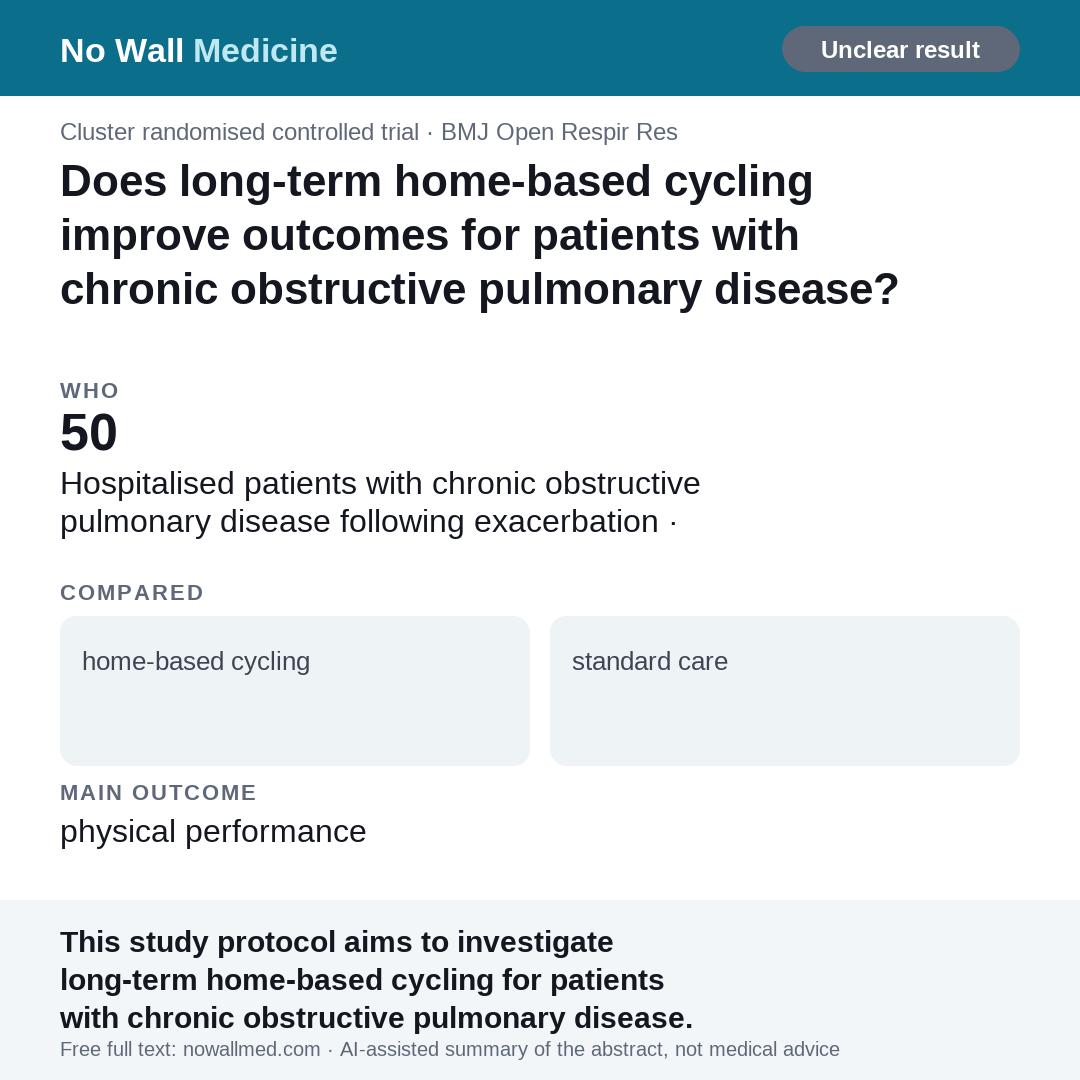
Clinical question: Does long-term home-based cycling improve outcomes for patients with chronic obstructive pulmonary disease?
Why it matters: It is unclear if long-term adherence to home-based exercise is effective for patients with chronic obstructive pulmonary disease after a recent exacerbation.
Key points
- The study will recruit 50 patients with chronic obstructive pulmonary disease following a hospital stay for an exacerbation, or a sudden worsening of symptoms.
- Participants will be randomized into groups to receive either 1 year of home-based cycling or standard care to measure physical performance and other health outcomes.
- Researchers will also use a qualitative substudy to understand the experiences and acceptability of the home-based cycling program for these patients.
Headline and key points written with AI from the paper’s abstract, with every number checked against it. Read the paper before relying on them.
Was this summary helpful?
Abstract
Background
Chronic obstructive pulmonary disease (COPD) is a highly prevalent respiratory disease associated with significant health decline and economic burdens. Pulmonary rehabilitation is an effective intervention, but securing adherence to exercise is difficult, particularly for frail and disabled patients, challenged by leaving their home. Home-based exercise is an emerging alternative for persons with COPD, but long-term adherence is unclear. This study aims to investigate the effects, experiences and acceptability of long-term home-based cycling for patients with COPD post exacerbation. Methods and analyses
This cluster randomised controlled trial will recruit hospitalised patients with COPD following hospitalisation following exacerbation of COPD. Participants will be referred to acute rehabilitation for 8 weeks at discharge. After rehabilitation, participants are randomised in clusters of five into 1 year of home-based cycling with the goal of cycling from Aalborg to Paris, or into the control group, who will receive standard care. Data will be collected at baseline, postrehabilitation/intervention initiation, at 6 and 12 months. Primary outcome is physical performance, while secondary outcomes include daily activity levels, lung function, mobility, frailty, symptom severity, health-related quality of life, survival rates and readmissions. A qualitative substudy will uncover experiences from participants. Daily activity levels will be measured using leg-mounted triaxial accelerometers. Other parameters will be tested with physical tests, questionnaires and interviews. The study aims to include 50 patients, with 25 participants in each group. A cost-effectiveness analysis will assess the impact on disease prevention and hospitalisation. Ethics and dissemination
This study, approved by The North Denmark Region Committee on Health Research Ethics (N-20230008) and compliant with the Helsinki Declaration, includes annual safety and progress reporting of potential adverse events. Results will be disseminated through peer-reviewed publications, conference presentations and community outreach to ensure accessibility to participants, healthcare professionals and the public. Trial registration number
NCT06235502 and Northern Jutland trial register (F2023-066).
Abstract reproduced under the article’s CC BY NC licence.
Subject terms
Cite this article
Stoustrup AL, Thomsen LP, Andreasen J, Palsson TS, Weinreich UM. Cluster randomised controlled trial on the effects of long-term home-based exercise for patients with chronic obstructive pulmonary disease with recent exacerbation: research protocol of the COPDtoParis Project. BMJ Open Respir Res. 2025. doi:10.1136/bmjresp-2024-002573
Spotted a mistake? Suggest a correction
Top studies every Monday
The week’s key trials and guidelines in your specialties, plus any topics you follow. By email, free.
Get the weekly digest