Feasibility study shows home high-flow therapy is possible for patients recovering from severe COPD exacerbations
Home high-flow therapy during recovery from severe chronic obstructive pulmonary disease (COPD) exacerbation: a mixed-methods feasibility randomised control trial
Mixed-methods feasibility randomised controlled trialBenefit found
Is home high-flow therapy feasible for patients recovering from severe chronic obstructive pulmonary disease exacerbation?
Who
18
Non-obese patients hospitalised with severe chronic obstructive pulmonary disease exacerbation
Compared
Usual care
Usual care and home high-flow therapy: 2.7±2.2 hours in week 1
Main outcome
Feasibility of conducting a phase 3 trial
Bottom line: The feasibility study supports progressing to a phase 3 trial investigating home high-flow therapy in chronic obstructive pulmonary disease.
BMJ Open Respir Res · 2025-01-06Download image
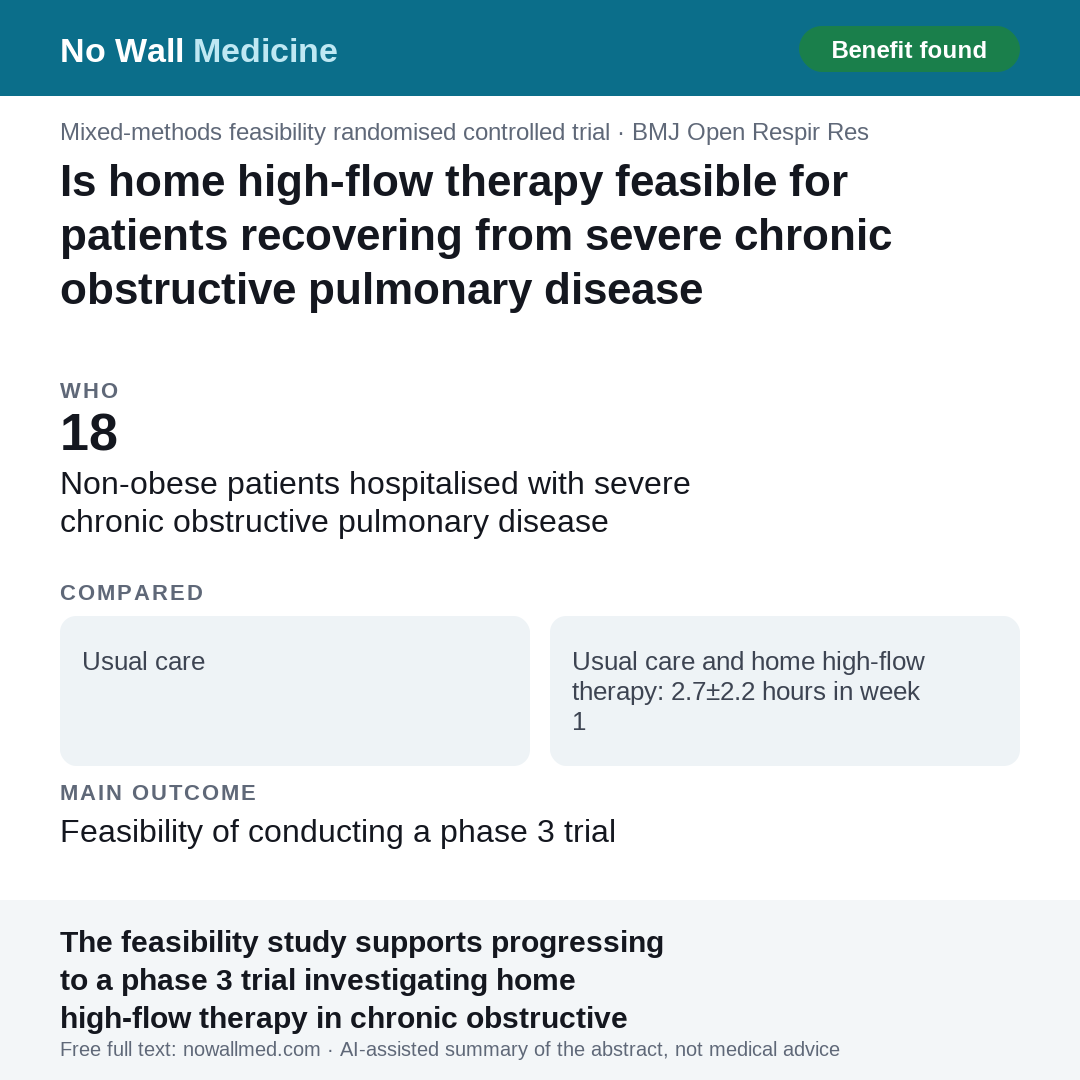
Clinical question: Is home high-flow therapy feasible for patients recovering from severe chronic obstructive pulmonary disease exacerbation?
Why it matters: It is unknown if home high-flow therapy is feasible to implement for patients recovering from severe chronic obstructive pulmonary disease exacerbations to support a larger phase 3 trial.
Key points
- Researchers studied 18 patients recovering from severe chronic obstructive pulmonary disease exacerbations who were randomized to receive either usual care or usual care plus home high-flow therapy.
- The study met feasibility criteria with over 90% complete data collected and no device-related serious adverse events reported.
- Higher usage of high-flow therapy was associated with lower symptom burden as measured by the COPD Assessment Test.
Headline and key points written with AI from the paper’s abstract, with every number checked against it. Read the paper before relying on them.
Abstract
Introduction
Patients recovering from severe acute exacerbations of chronic obstructive pulmonary disease (AECOPD) have a 30-day readmission rate of 20%. This study evaluated the feasibility of conducting a randomised controlled trial to evaluate clinical, patient-reported and physiological effects of home high-flow therapy (HFT) in addition to usual medical therapy, in eucapnic patients recovering from AECOPD to support the design of a phase 3 trial. Methods
A mixed-methods feasibility randomised controlled trial (quantitative primacy, concurrently embedded qualitative evaluation) (ISRCTN15949009) recruiting consecutive non-obese patients hospitalised with AECOPD not requiring acute non-invasive ventilation. Participants were randomised to receive usual care or usual care and home HFT (37°C, 30 L/min) with weekly home-based follow-up for 4 weeks to collect data on: device usage, breathlessness (modified Borg scale, visual analogue scale, Multidimensional Dyspnoea Profile), health-related quality of life (COPD Assessment Test (CAT), Clinical COPD Questionnaire), pulse oximetry, spirometry and inspiratory capacity, parasternal electromyography and actigraphy. Semistructured interviews were conducted in week 4. Trial progression criteria were: ≥40% of eligible patients randomised, ≤20% attrition, ≥70% complete data, and no device-related serious adverse events (SAE). Results
18 of 45 eligible patients were randomised (age 69±5 years, 44% female, body mass index 23±5 kg/m2, forced expiratory volume in 1 second 32±12%). One withdrew following non-respiratory hospitalisation. Complete outcome measures were collected in >90% of home assessments. There were no device-related SAE. Daily HFT usage was 2.7±2.2 hours in week 1, falling to 2.3±1.4 hours by week 4. Temperature and flow settings were modified for comfort in 6 cases. Higher HFT usage was associated with lower symptom burden (CAT p=0.01). Interviews highlighted ease of device use, reduced salbutamol usage, and improved sputum production and clearance. Conclusions
The data from this feasibility study support the progression to a phase 3 randomised clinical trial investigating the effect of home (HFT) on admission-free survival in COPD patients recovering from a severe exacerbation. Trial registration number
The study received ethical approval (REC19/LO/0194) and was prospectively registered (ISRCTN15949009).
Abstract reproduced under the article’s CC BY licence.
Topics
Cite this article
D'Cruz RF, Rossel A, Kaltsakas G, Suh ES, Douiri A, Rose L. Home high-flow therapy during recovery from severe chronic obstructive pulmonary disease (COPD) exacerbation: a mixed-methods feasibility randomised control trial. BMJ Open Respir Res. 2025. doi:10.1136/bmjresp-2024-002698
Spotted a mistake? Suggest a correction
Top studies every Monday
The week’s key trials and guidelines in your specialties, plus any topics you follow. By email, free.
Get the weekly digest