3D animated blood clot visualization improved accuracy and speed of coagulation therapy in simulations
Coagulation Management of Critically Bleeding Patients With Viscoelastic Testing Presented as a 3D-Animated Blood Clot (The Visual Clot): Randomized Controlled High-Fidelity Simulation Study
Randomized, high-fidelity simulation studyBenefit found
Does Visual Clot improve coagulation management performance compared to conventional rotational thrombelastometry temograms?
Who
59
Anesthesia teams in critical bleeding scenarios
Compared
Visual Clot: more likely to deliver overall targeted coagulation therapy correctly
Rotational thrombelastometry temograms
Main outcome
Correct targeted coagulation therapy
Result: rate ratio 1.56 (95% CI 1.00-2.47)
Bottom line: Visual Clot led to more accurate and faster-targeted coagulation therapy than conventional rotational thrombelastometry temograms.
J Med Internet Res · 2023-10-12Download image
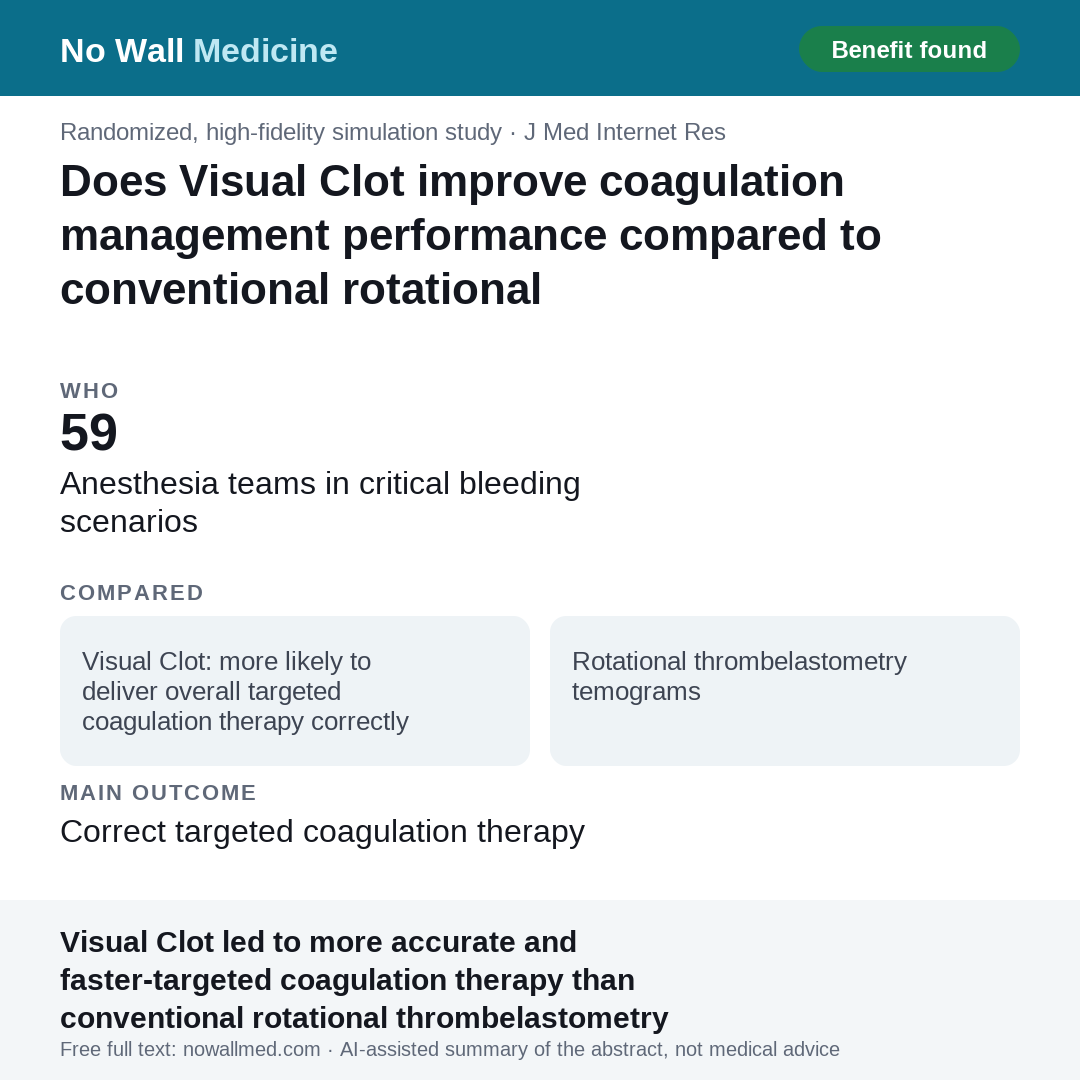
Clinical question: Does Visual Clot improve coagulation management performance compared to conventional rotational thrombelastometry temograms?
Why it matters: Interpreting results from viscoelastic coagulation tests, which measure how blood clots, remains challenging for medical teams during critical bleeding.
Key points
- Anesthesia teams consisting of a senior anesthesiologist, a resident, and a nurse were studied using high-fidelity simulations of bleeding scenarios.
- Teams using the 3D animated Visual Clot were more likely to deliver correct targeted coagulation therapy compared to those using rotational thrombelastometry temograms.
- The Visual Clot group administered the first targeted coagulation product faster and reported higher decision confidence, though workload showed no difference.
Headline and key points written with AI from the paper’s abstract, with every number checked against it. Read the paper before relying on them.
Was this summary helpful?
Subject terms
Cite this article
Castellucci C, Malorgio A, Budowski AD, Akbas S, Kolbe M, Grande B. Coagulation Management of Critically Bleeding Patients With Viscoelastic Testing Presented as a 3D-Animated Blood Clot (The Visual Clot): Randomized Controlled High-Fidelity Simulation Study. J Med Internet Res. 2023. doi:10.2196/43895
Spotted a mistake? Suggest a correction
Top studies every Monday
The week’s key trials and guidelines in your specialties, plus any topics you follow. By email, free.
Get the weekly digest