Rotational thromboelastometry guidance did not significantly change red blood cell transfusion needs in postpartum hemorrhage
Thromboelastometry-guided treatment algorithm in postpartum haemorrhage: a randomised, controlled pilot trial
Randomised, controlled pilot trialNo clear difference
Does rotational thromboelastometry-guided treatment decrease red blood cell transfusion in postpartum haemorrhage?
Who
54
Parturients with postpartum haemorrhage of more than 1500 ml
Compared
Rotational thromboelastometry-guided group: median 2 (1-4) red blood cell units transfused
Conventional treatment group: median 3 (2-4) red blood cell units transfused
Main outcome
Consumption of blood products
Bottom line: Rotational thromboelastometry-guided treatment showed no significant difference in red blood cell transfusion compared to conventional treatment.
Br J Anaesth · 2022-12-07Download image
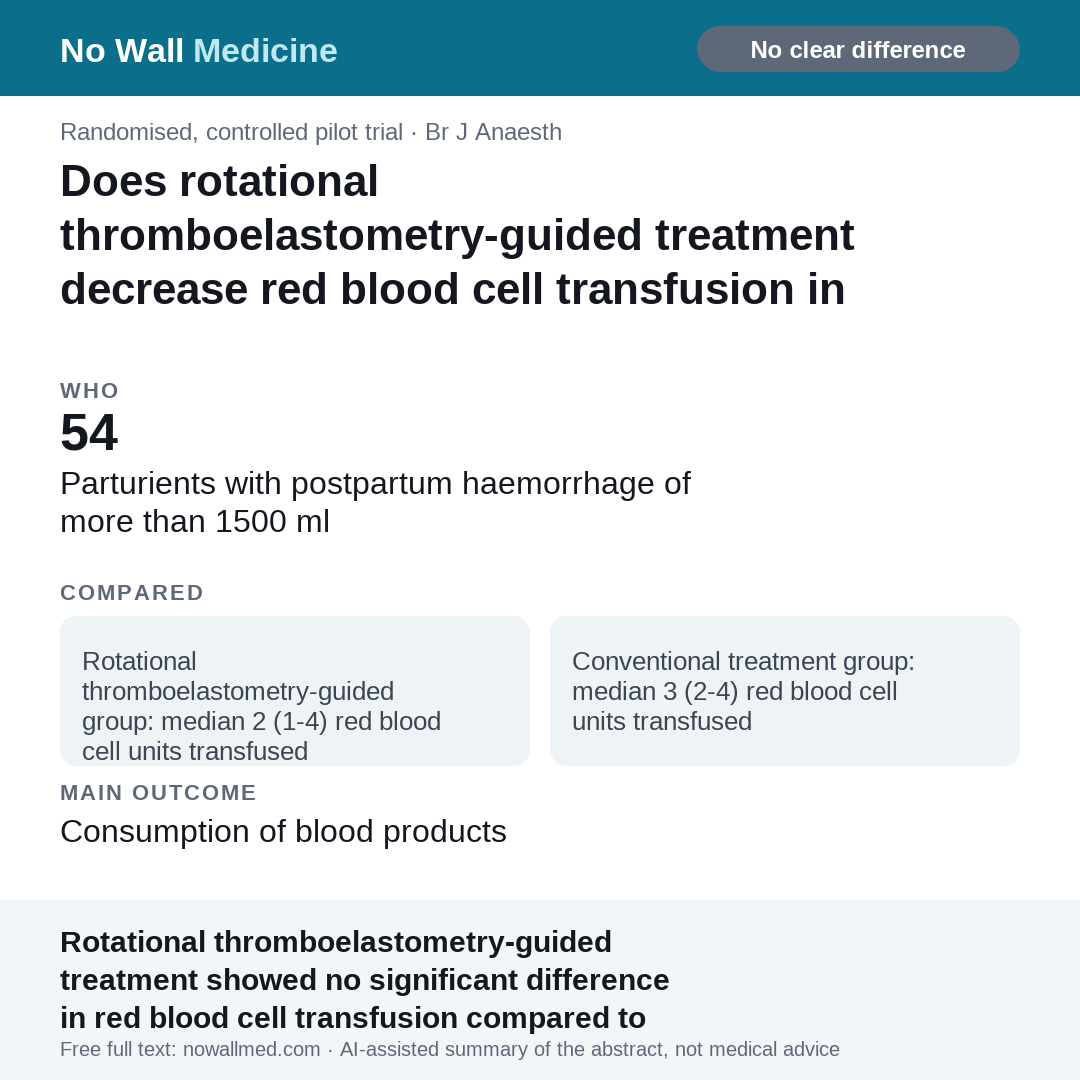
Clinical question: Does rotational thromboelastometry-guided treatment decrease red blood cell transfusion in postpartum haemorrhage?
Why it matters: It is unknown if using rotational thromboelastometry, a tool to monitor blood clotting, provides better goal-directed therapy than conventional testing for managing postpartum hemorrhage.
Key points
- Researchers randomized 60 patients with postpartum hemorrhage of more than 1500 ml to receive either rotational thromboelastometry-guided treatment or conventional treatment.
- The median number of red blood cell units transfused was 2 (1-4) in the rotational thromboelastometry group and 3 (2-4) in the control group (P=0.399).
- The median total estimated blood loss was 2500 ml (2100-3000) in the rotational thromboelastometry group and 3000 ml (2200-3100) in the control group (P=0.033).
Headline and key points written with AI from the paper’s abstract, with every number checked against it. Read the paper before relying on them.
Was this summary helpful?
Subject terms
Cite this article
Jokinen S, Kuitunen A, Uotila J, Yli-Hankala A. Thromboelastometry-guided treatment algorithm in postpartum haemorrhage: a randomised, controlled pilot trial. Br J Anaesth. 2022. doi:10.1016/j.bja.2022.10.031
Spotted a mistake? Suggest a correction
Top studies every Monday
The week’s key trials and guidelines in your specialties, plus any topics you follow. By email, free.
Get the weekly digest