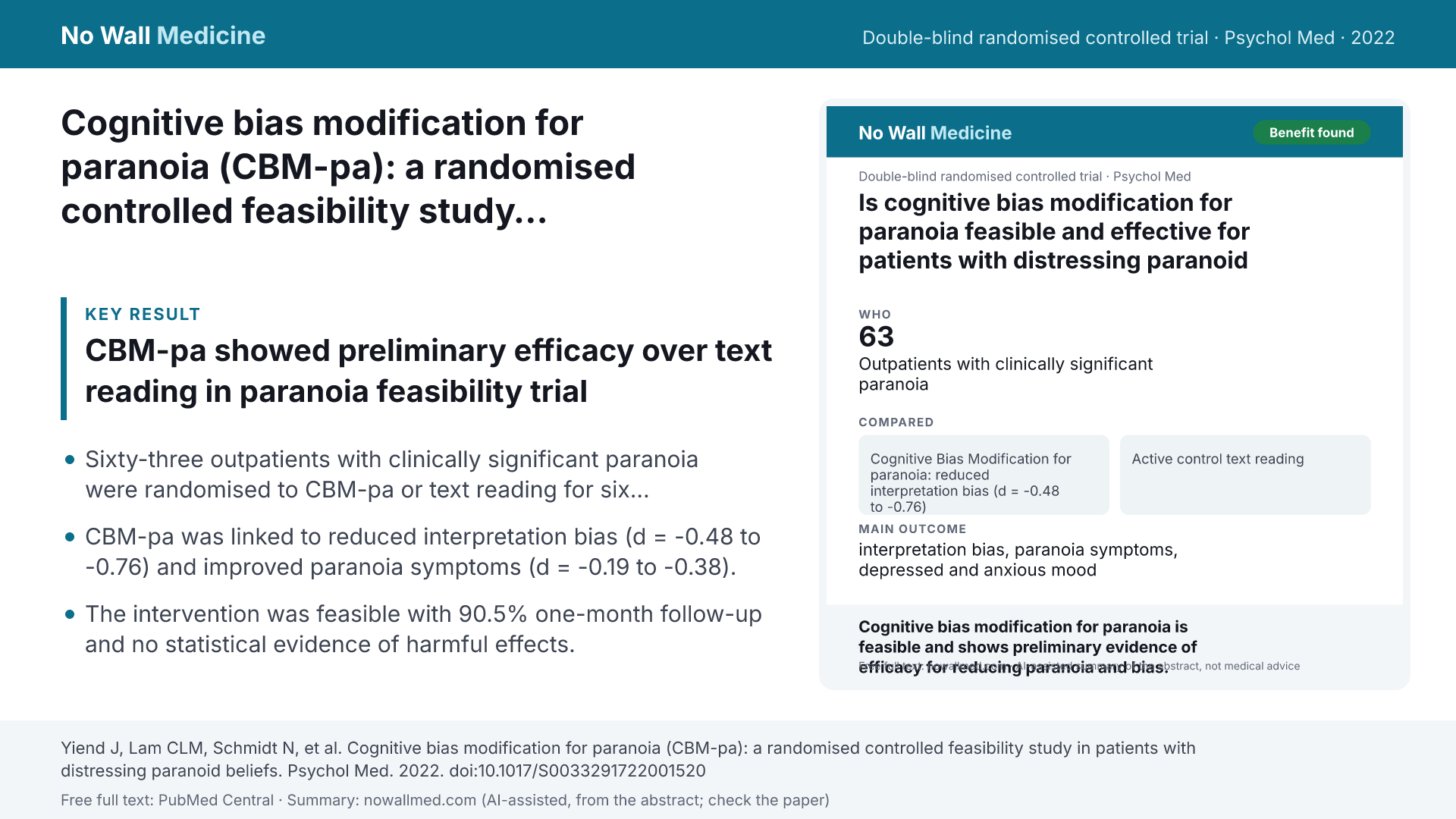
Cognitive bias modification for paranoia (CBM-pa): a randomised controlled feasibility study in patients with distressing paranoid beliefs
Key result: CBM-pa showed preliminary efficacy over text reading in paranoia feasibility trial
Key points
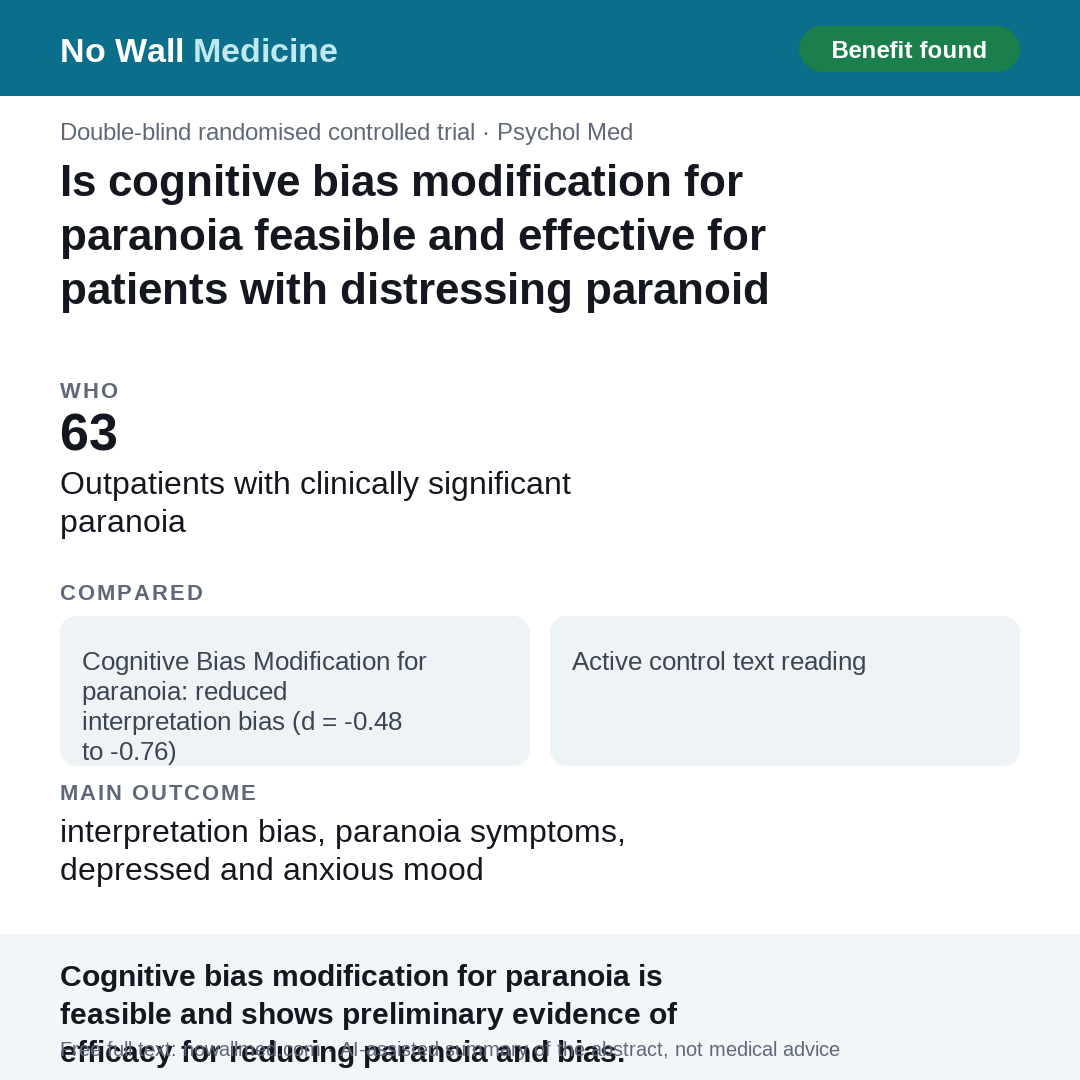
- Sixty-three outpatients with clinically significant paranoia were randomised to CBM-pa or text reading for six weekly sessions.
- CBM-pa was linked to reduced interpretation bias (d = -0.48 to -0.76) and improved paranoia symptoms (d = -0.19 to -0.38).
- The intervention was feasible with 90.5% one-month follow-up and no statistical evidence of harmful effects.
Why it matters: It was unknown whether a computerised intervention targeting interpretation bias was feasible and effective for patients with distressing paranoid beliefs.
Limitation the authors note: The study was a feasibility trial designed to provide effect size estimates rather than definitive proof of efficacy.
Discussion prompts
- Would these patients look like yours? Who was left out?
- Is the main outcome one that matters to patients?
- Is the difference large enough to change what you do?
Cite: Yiend J, Lam CLM, Schmidt N, et al. Cognitive bias modification for paranoia (CBM-pa): a randomised controlled feasibility study in patients with distressing paranoid beliefs. Psychol Med. 2022. doi:10.1017/S0033291722001520
Free full text: PubMed Central · Summary and visual abstract: nowallmed.com/a/cognitive-bias-modification-for-paranoia-cbm-pa-a-randomised-1ys5mhu/ (AI-assisted from the abstract; check the paper before relying on it).