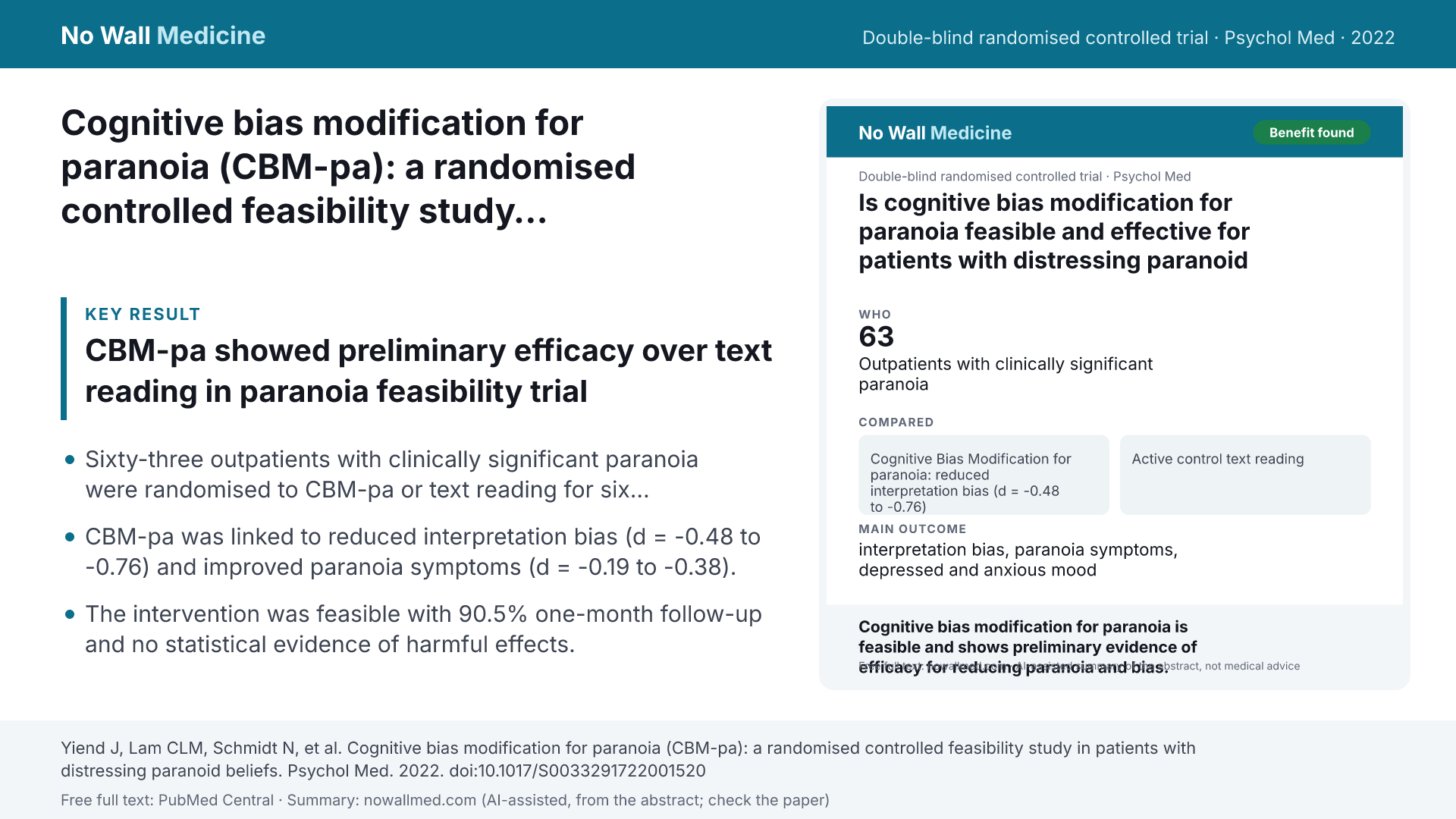
CBM-pa showed preliminary efficacy over text reading in paranoia feasibility trial
Cognitive bias modification for paranoia (CBM-pa): a randomised controlled feasibility study in patients with distressing paranoid beliefs
Double-blind randomised controlled trialBenefit found
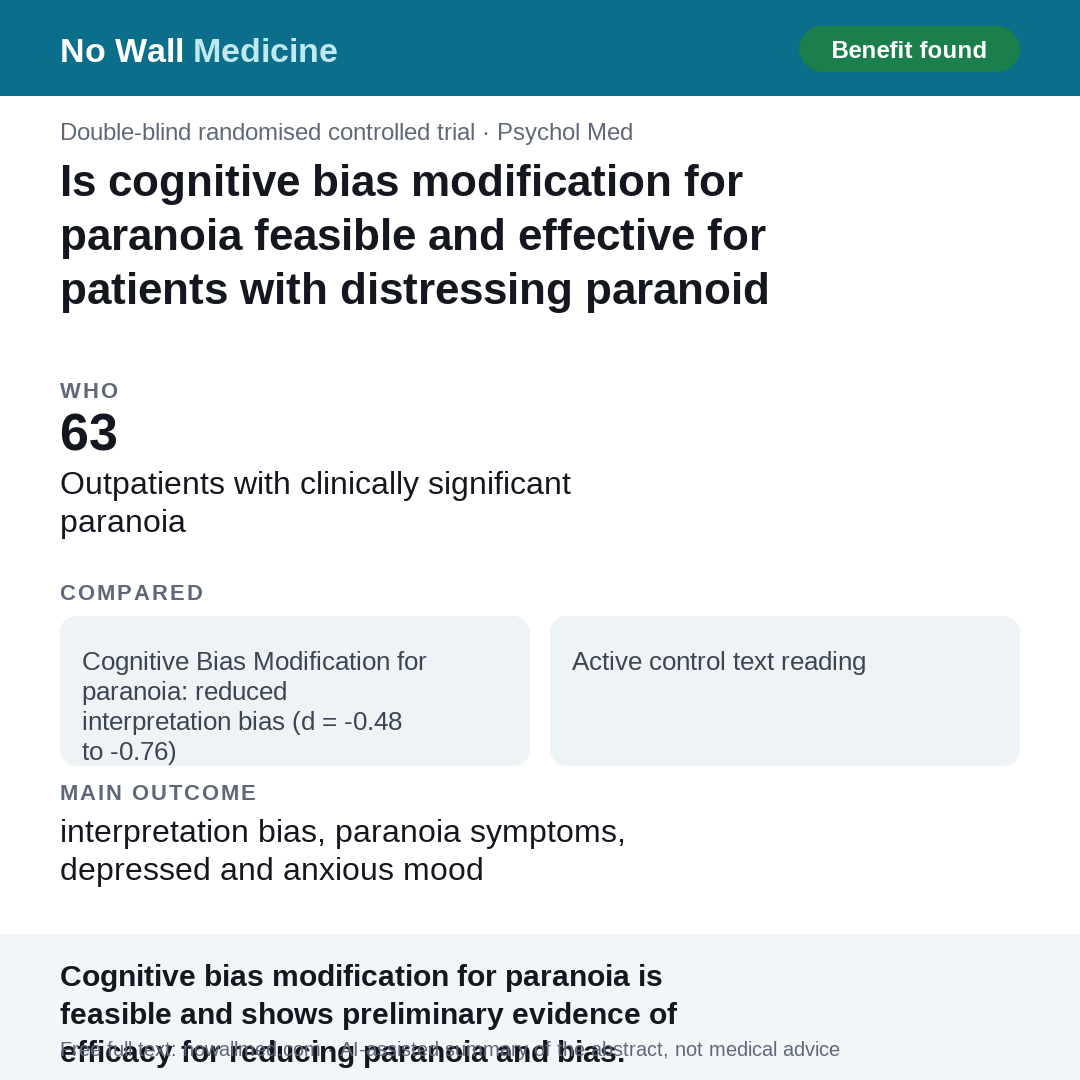
Is cognitive bias modification for paranoia feasible and effective for patients with distressing paranoid beliefs?
Who
63
Outpatients with clinically significant paranoia
Compared
Cognitive Bias Modification for paranoia: reduced interpretation bias (d = -0.48 to -0.76)
Active control text reading
Main outcome
interpretation bias, paranoia symptoms, depressed and anxious mood
Bottom line: Cognitive bias modification for paranoia is feasible and shows preliminary evidence of efficacy for reducing paranoia and bias.
Limitation: A fully powered randomised control trial is warranted.
Psychol Med · 2022-06-14Download image
Clinical question: Is cognitive bias modification for paranoia feasible and effective for patients with distressing paranoid beliefs?
Why it matters: It was unknown whether a computerised intervention targeting interpretation bias was feasible and effective for patients with distressing paranoid beliefs.
Key points
- Sixty-three outpatients with clinically significant paranoia were randomised to CBM-pa or text reading for six weekly sessions.
- CBM-pa was linked to reduced interpretation bias (d = -0.48 to -0.76) and improved paranoia symptoms (d = -0.19 to -0.38).
- The intervention was feasible with 90.5% one-month follow-up and no statistical evidence of harmful effects.
Limitation the authors note: The study was a feasibility trial designed to provide effect size estimates rather than definitive proof of efficacy.
Headline and key points written with AI from the paper’s abstract, with every number checked against it. Read the paper before relying on them.
Was this summary helpful?
Subject terms
Cite this article
Yiend J, Lam CLM, Schmidt N, et al. Cognitive bias modification for paranoia (CBM-pa): a randomised controlled feasibility study in patients with distressing paranoid beliefs. Psychol Med. 2022. doi:10.1017/S0033291722001520
Spotted a mistake? Suggest a correction