Virtual reality cognitive behavior therapy showed greater reductions in momentary paranoia than standard therapy
Virtual-reality cognitive behavior therapy versus cognitive behavior therapy for paranoid ideation: A pragmatic, single-blind, multicenter randomized clinical superiority trial
Pragmatic, single-blind, multicenter randomized clinical trialBenefit found
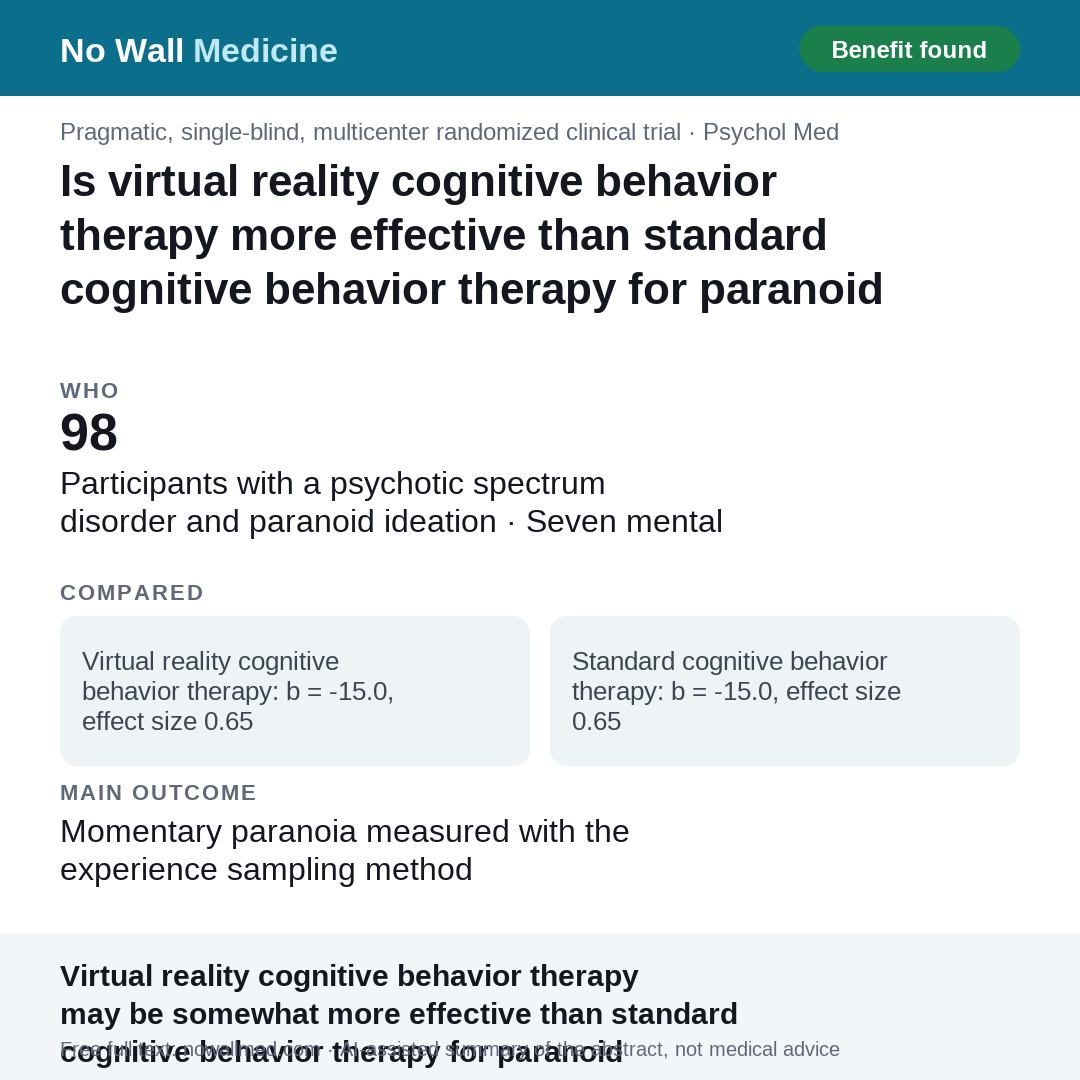
Is virtual reality cognitive behavior therapy more effective than standard cognitive behavior therapy for paranoid ideation?
Who
98
Participants with a psychotic spectrum disorder and paranoid ideation · Seven mental health centers in the Netherlands and Belgium
Compared
Virtual reality cognitive behavior therapy: b = -15.0, effect size 0.65
Standard cognitive behavior therapy: b = -15.0, effect size 0.65
Main outcome
Momentary paranoia measured with the experience sampling method
Result: interaction b = 8.3, ES = 0.62
Bottom line: Virtual reality cognitive behavior therapy may be somewhat more effective than standard cognitive behavior therapy for paranoid ideation.
Limitation: Limited experience sampling method compliance and a lower sample size than anticipated.
Psychol Med · 2025-07-07Download image
Clinical question: Is virtual reality cognitive behavior therapy more effective than standard cognitive behavior therapy for paranoid ideation?
Why it matters: It is unclear if adding virtual reality to cognitive behavior therapy for paranoid ideation provides better results than standard cognitive behavior therapy alone.
Key points
- Researchers studied 98 participants with psychotic spectrum disorders and paranoid ideation across seven mental health centers in the Netherlands and Belgium.
- Virtual reality cognitive behavior therapy showed greater reductions in momentary paranoia at posttreatment compared to standard cognitive behavior therapy (ES = 0.62).
- While both groups improved in symptoms and social functioning, 37.5% of the virtual reality group did not complete treatment compared to 24.0% in the standard group.
Limitation the authors note: The study was limited by missing primary outcome data and a lower sample size than anticipated.
Headline and key points written with AI from the paper’s abstract, with every number checked against it. Read the paper before relying on them.
Topics
Cite this article
van der Stouwe ECD, Geraets CNW, Berkhof M, Hidding M, van Amstel S, van den Berg D. Virtual-reality cognitive behavior therapy versus cognitive behavior therapy for paranoid ideation: A pragmatic, single-blind, multicenter randomized clinical superiority trial. Psychol Med. 2025. doi:10.1017/S0033291725100949
Spotted a mistake? Suggest a correction