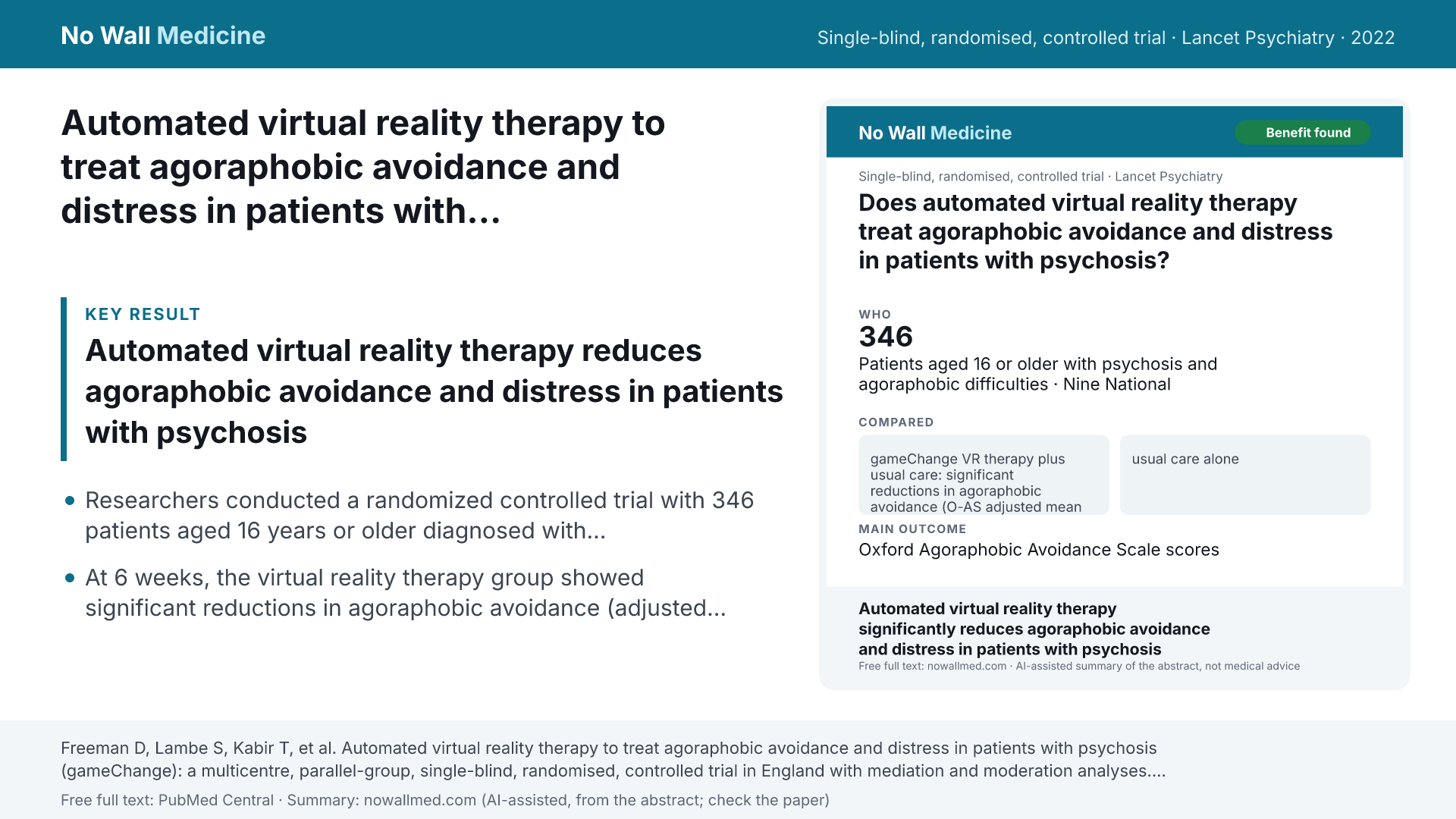
Automated virtual reality therapy reduces agoraphobic avoidance and distress in patients with psychosis
Automated virtual reality therapy to treat agoraphobic avoidance and distress in patients with psychosis (gameChange): a multicentre, parallel-group, single-blind, randomised, controlled trial in England with mediation and moderation analyses
Single-blind, randomised, controlled trialBenefit found
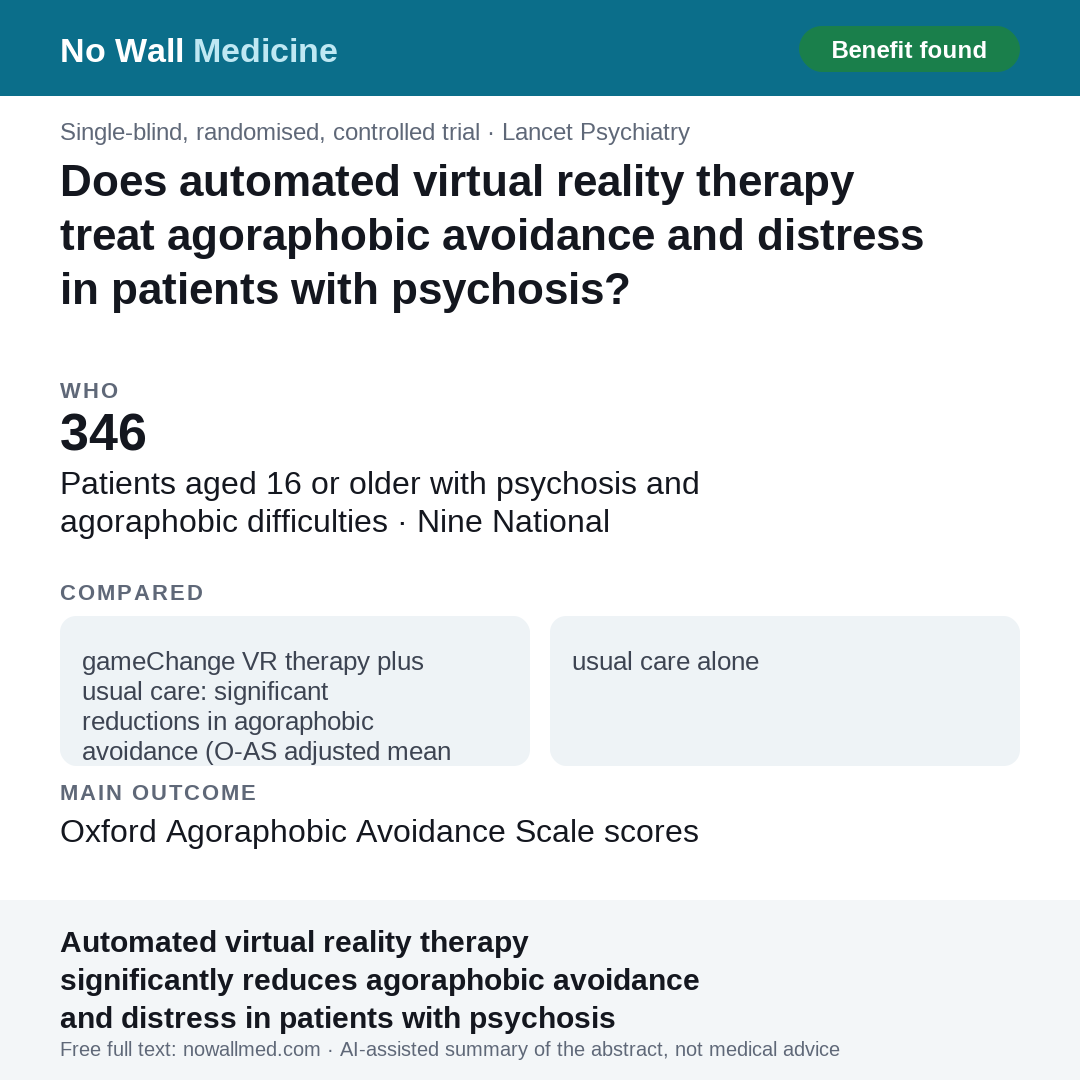
Does automated virtual reality therapy treat agoraphobic avoidance and distress in patients with psychosis?
Who
346
Patients aged 16 or older with psychosis and agoraphobic difficulties · Nine National Health Service trusts in England
Compared
gameChange VR therapy plus usual care: significant reductions in agoraphobic avoidance (O-AS adjusted mean difference -0·47)
usual care alone
Main outcome
Oxford Agoraphobic Avoidance Scale scores
Result: adjusted mean difference -0·47 (95% CI -0·88 to -0·06)
Bottom line: Automated virtual reality therapy significantly reduces agoraphobic avoidance and distress in patients with psychosis compared to usual care.
Funded by: National Institute of Health Research
Lancet Psychiatry · 2022-04-05Download image
Clinical question: Does automated virtual reality therapy treat agoraphobic avoidance and distress in patients with psychosis?
Why it matters: It is unknown if automated virtual reality cognitive therapy can effectively treat avoidance and distress in patients with psychosis who have difficulty leaving their homes.
Key points
- Researchers conducted a randomized controlled trial with 346 patients aged 16 years or older diagnosed with schizophrenia spectrum or affective disorders with psychotic symptoms.
- At 6 weeks, the virtual reality therapy group showed significant reductions in agoraphobic avoidance (adjusted mean difference -0.47) and distress (adjusted mean difference -4.33) compared to usual care.
- The occurrence of serious adverse events was not significantly different between the virtual reality therapy group and the usual care group (p=0.37).
Headline and key points written with AI from the paper’s abstract, with every number checked against it. Read the paper before relying on them.
Was this summary helpful?
Abstract
Background
Automated delivery of psychological therapy using immersive technologies such as virtual reality (VR) might greatly increase the availability of effective help for patients. We aimed to evaluate the efficacy of an automated VR cognitive therapy (gameChange) to treat avoidance and distress in patients with psychosis, and to analyse how and in whom it might work. Methods
We did a parallel-group, single-blind, randomised, controlled trial across nine National Health Service trusts in England. Eligible patients were aged 16 years or older, with a clinical diagnosis of a schizophrenia spectrum disorder or an affective diagnosis with psychotic symptoms, and had self-reported difficulties going outside due to anxiety. Patients were randomly assigned (1:1) to either gameChange VR therapy plus usual care or usual care alone, using a permuted blocks algorithm with randomly varying block size, stratified by study site and service type. gameChange VR therapy was provided in approximately six sessions over 6 weeks. Trial assessors were masked to group allocation. Outcomes were assessed at 0, 6 (primary endpoint), and 26 weeks after randomisation. The primary outcome was avoidance of, and distress in, everyday situations, assessed using the self-reported Oxford Agoraphobic Avoidance Scale (O-AS). Outcome analyses were done in the intention-to-treat population (ie, all participants who were assigned to a study group for whom data were available). We performed planned mediation and moderation analyses to test the effects of gameChange VR therapy when added to usual care. This trial is registered with the ISRCTN registry, 17308399. Findings
Between July 25, 2019, and May 7, 2021 (with a pause in recruitment from March 16, 2020, to Sept 14, 2020, due to COVID-19 pandemic restrictions), 551 patients were assessed for eligibility and 346 were enrolled. 231 (67%) patients were men and 111 (32%) were women, 294 (85%) were White, and the mean age was 37·2 years (SD 12·5). 174 patients were randomly assigned to the gameChange VR therapy group and 172 to the usual care alone group. Compared with the usual care alone group, the gameChange VR therapy group had significant reductions in agoraphobic avoidance (O-AS adjusted mean difference -0·47, 95% CI -0·88 to -0·06; n=320; Cohen's d -0·18; p=0·026) and distress (-4·33, -7·78 to -0·87; n=322; -0·26; p=0·014) at 6 weeks. Reductions in threat cognitions and within-situation defence behaviours mediated treatment outcomes. The greater the severity of anxious fears and avoidance, the greater the treatment benefits. There was no significant difference in the occurrence of serious adverse events between the gameChange VR therapy group (12 events in nine patients) and the usual care alone group (eight events in seven patients; p=0·37). Interpretation
Automated VR therapy led to significant reductions in anxious avoidance of, and distress in, everyday situations compared with usual care alone. The mediation analysis indicated that the VR therapy worked in accordance with the cognitive model by reducing anxious thoughts and associated protective behaviours. The moderation analysis indicated that the VR therapy particularly benefited patients with severe agoraphobic avoidance, such as not being able to leave the home unaccompanied. gameChange VR therapy has the potential to increase the provision of effective psychological therapy for psychosis, particularly for patients who find it difficult to leave their home, visit local amenities, or use public transport. Funding
National Institute of Health Research Invention for Innovation programme, National Institute of Health Research Oxford Health Biomedical Research Centre.
Abstract reproduced under the article’s CC BY licence.
Subject terms
Cite this article
Freeman D, Lambe S, Kabir T, Petit A, Rosebrock L, Yu LM. Automated virtual reality therapy to treat agoraphobic avoidance and distress in patients with psychosis (gameChange): a multicentre, parallel-group, single-blind, randomised, controlled trial in England with mediation and moderation analyses. Lancet Psychiatry. 2022. doi:10.1016/S2215-0366(22)00060-8
Spotted a mistake? Suggest a correction