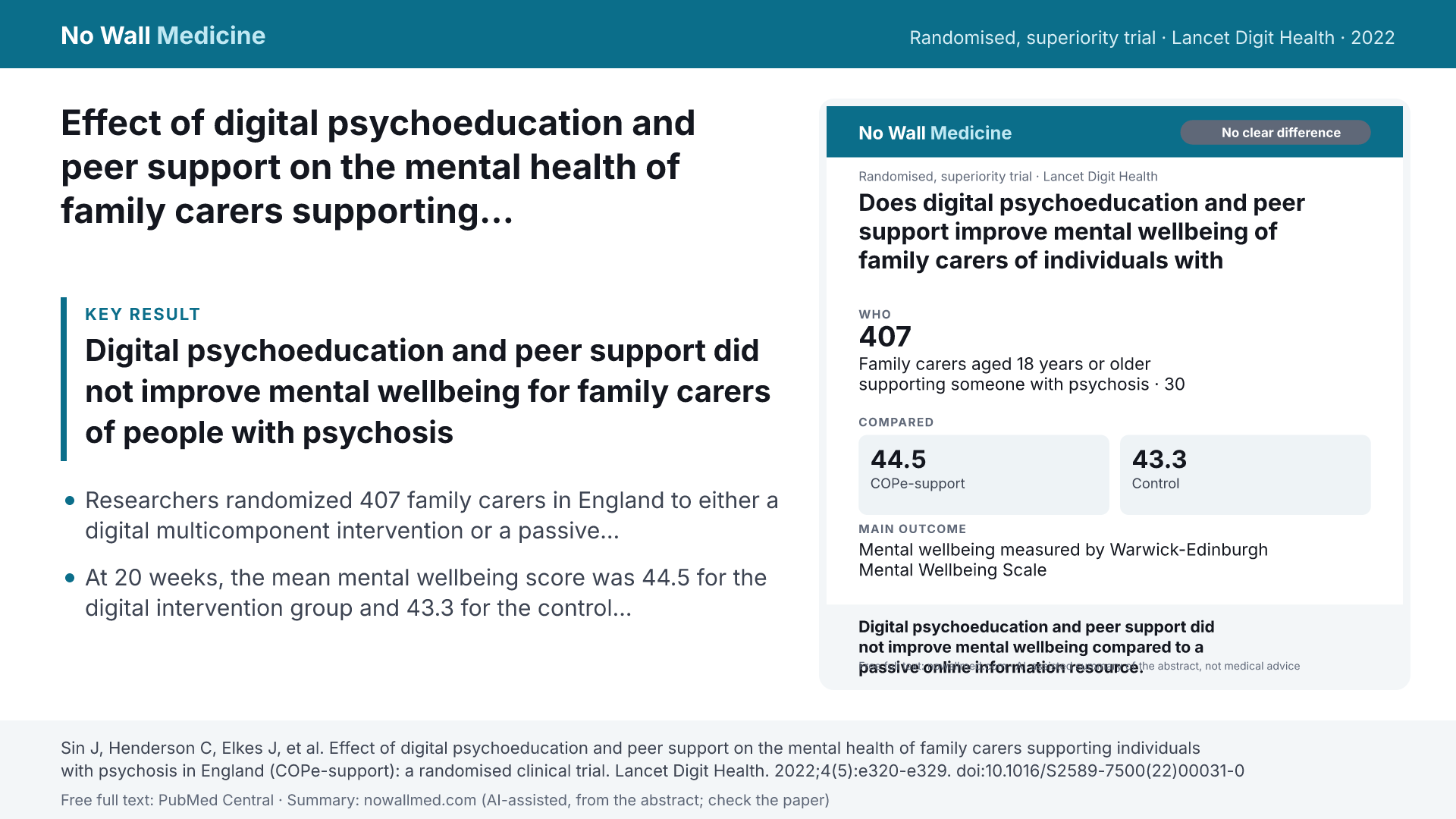
Digital psychoeducation and peer support did not improve mental wellbeing for family carers of people with psychosis
Effect of digital psychoeducation and peer support on the mental health of family carers supporting individuals with psychosis in England (COPe-support): a randomised clinical trial
Randomised, superiority trialNo clear difference
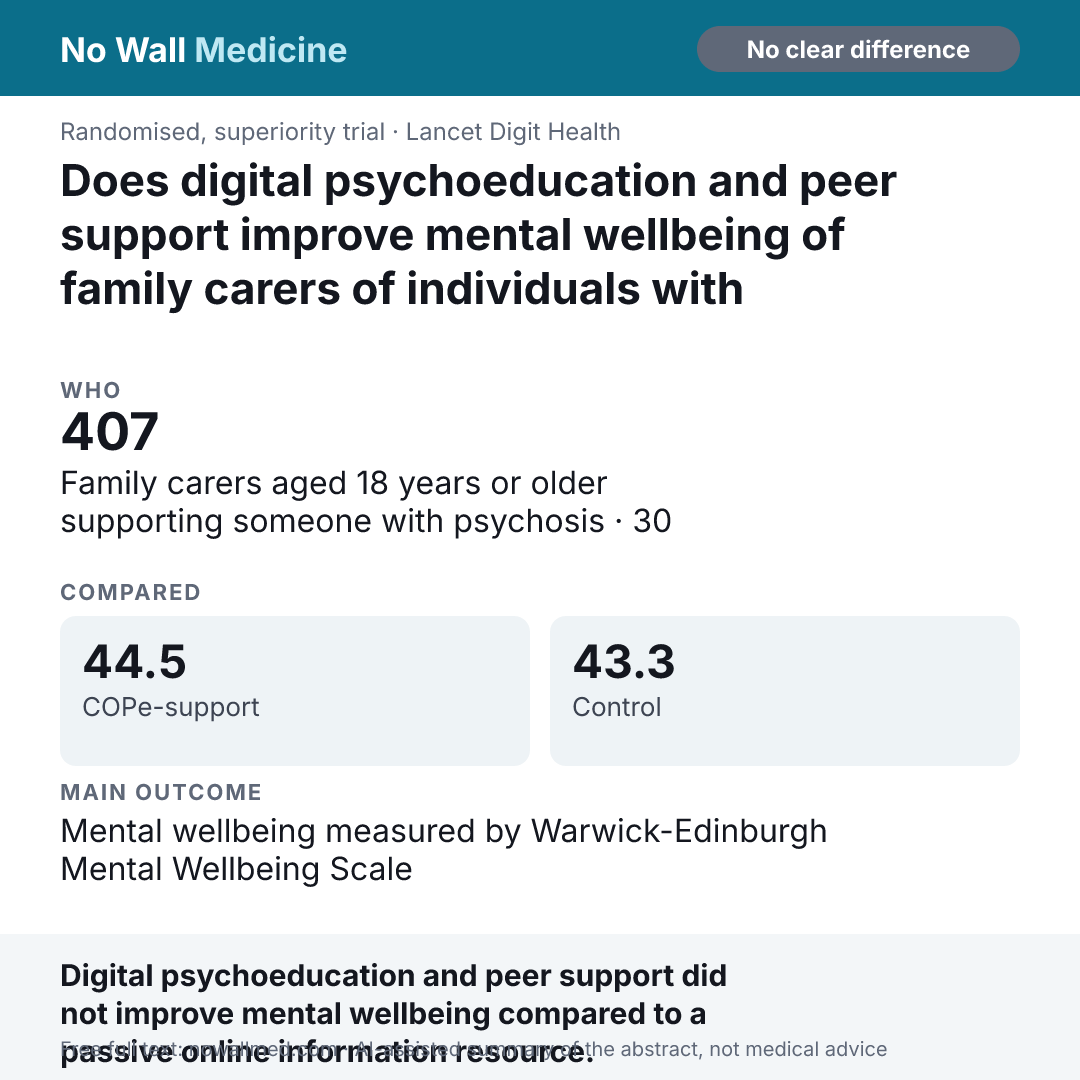
Does digital psychoeducation and peer support improve mental wellbeing of family carers of individuals with psychosis?
Who
407
Family carers aged 18 years or older supporting someone with psychosis · 30 National Health Service trusts in England
Compared
44.5COPe-support (SD 8.31)
43.3Control (9.19)
Main outcome
Mental wellbeing measured by Warwick-Edinburgh Mental Wellbeing Scale
Result: adjusted mean difference 0.37, 95% CI -1.14 to 1.88
Bottom line: Digital psychoeducation and peer support did not improve mental wellbeing compared to a passive online information resource.
Limitation: It was not feasible to mask participants or the online facilitator to intervention allocation.
Funded by: National Institute for Health Research
Lancet Digit Health · 2022-04-01 · Save PNG
Clinical question: Does digital psychoeducation and peer support improve mental wellbeing of family carers of individuals with psychosis?
Key points
- Researchers randomized 407 family carers in England to either a digital multicomponent intervention or a passive online information resource.
- At 20 weeks, the mean mental wellbeing score was 44.5 for the digital intervention group and 43.3 for the control group, showing no significant difference.
- Even when analyzing only those who met a minimum login requirement, the difference in wellbeing scores remained below the minimally clinically important difference of 3.
Headline and key points written with AI from the paper’s abstract, with every number checked against it. Read the paper before relying on them.
Was this summary helpful?
Abstract
Background
Psychoeducation delivered face-to-face is effective in alleviating mental health morbidities in family carers of individuals with psychosis. However, research in such interventions delivered online is scarce. We evaluated the effectiveness of a digital multicomponent intervention-COPe-support-in improving carers' mental wellbeing and caregiving-related outcomes. Methods
In this two-arm, individually randomised, superiority trial, people aged 18 years or older who provided at least weekly support in any format for a relative or close friend affected by psychosis across England were randomly assigned (1:1) to either COPe-support or a passive online information resource using an independent online system. Participants were recruited through 30 mental health UK National Health Service trusts. The study team were masked to allocation and assessment of outcomes as all data collection took place online. Participants had access to either condition for 40 weeks and were advised to spend at least half an hour per week over the initial 20 weeks to go through materials at their own pace and to allow time to integrate knowledge and skills learned into practice. It was not feasible to mask participants or the online facilitator to intervention allocation. COPe-support provided psychoeducation on psychosis-related caregiving strategies and forums with professionals and other carers, and the control intervention comprised a passive online information resource. The primary outcome at 20 weeks was mental wellbeing measured by the Warwick-Edinburgh Mental Wellbeing Scale (WEMWBS; minimally clinically important difference [MCID] 3). This trial is registered with ISRCTN, 89563420. Findings
Between March 1, 2018, and Feb 14, 2020, 407 participants were randomly assigned, with 204 allocated to COPe-support and 203 allocated to control. The participants (mean age 53·1 years, SD 13·2) were mostly female (330 [81%] of 407 participants) and White (359 [88%] of 407 participants). 346 (85%) of 407 participants provided primary endpoint data, 174 (85%) of 204 participants in the COPe-support group and 172 (85%) of 203 participants in the control group. The mean WEMWBS score at 20 weeks was 44·5 (SD 8·31) for the COPe-support group and 43·3 (9·19) for the control group. We found no evidence of a difference in wellbeing between the two groups (adjusted mean difference 0·37, 95% CI -1·14 to 1·88; p=0·63). In the COPe-support group, 106 (52%) of 204 participants met the complier definition of a minimum of two logins in separate weeks. The complier average causal effect analysis increased the difference in WEMWBS scores (adjusted difference 0·83, 95% CI -1·45 to 3·11; p=0·47), but this was lower than the MCID. There were no adverse events. Interpretation
Our findings did not support the use of COPe-support over a passive online information resource. However, further research to optimise digital interventions adjunctive to face-to-face support for carers remains important. Funding
National Institute for Health Research.
Abstract reproduced under the article’s CC BY licence.
Subject terms
Headline, design, result, key points, caveat and citation as plain text.
Cite this article
Sin J, Henderson C, Elkes J, et al. Effect of digital psychoeducation and peer support on the mental health of family carers supporting individuals with psychosis in England (COPe-support): a randomised clinical trial. Lancet Digit Health. 2022. doi:10.1016/S2589-7500(22)00031-0
Spotted a mistake? Suggest a correction