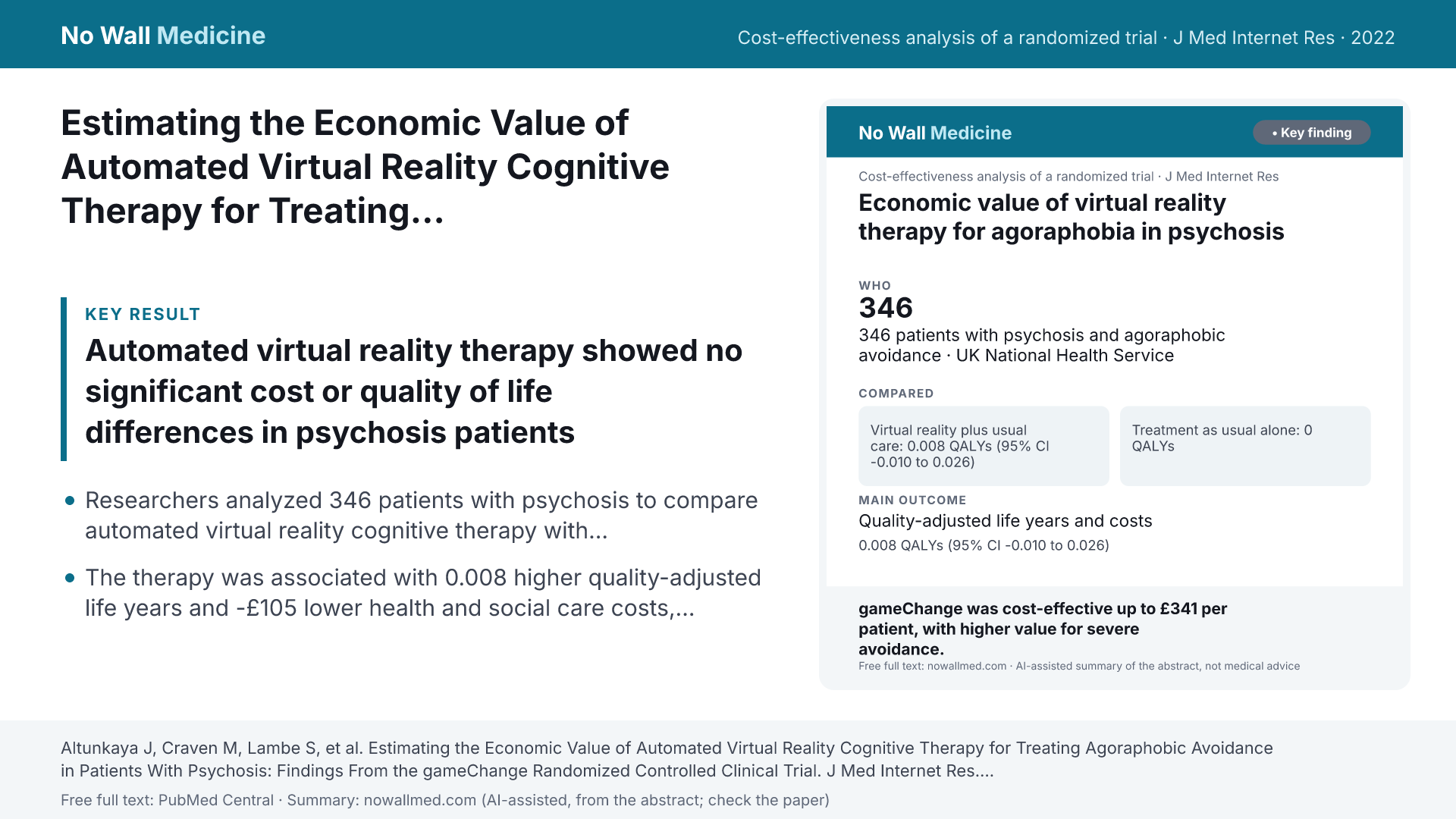
Automated virtual reality therapy showed no significant cost or quality of life differences in psychosis patients
Estimating the Economic Value of Automated Virtual Reality Cognitive Therapy for Treating Agoraphobic Avoidance in Patients With Psychosis: Findings From the gameChange Randomized Controlled Clinical Trial
Randomized controlled trialBenefit found
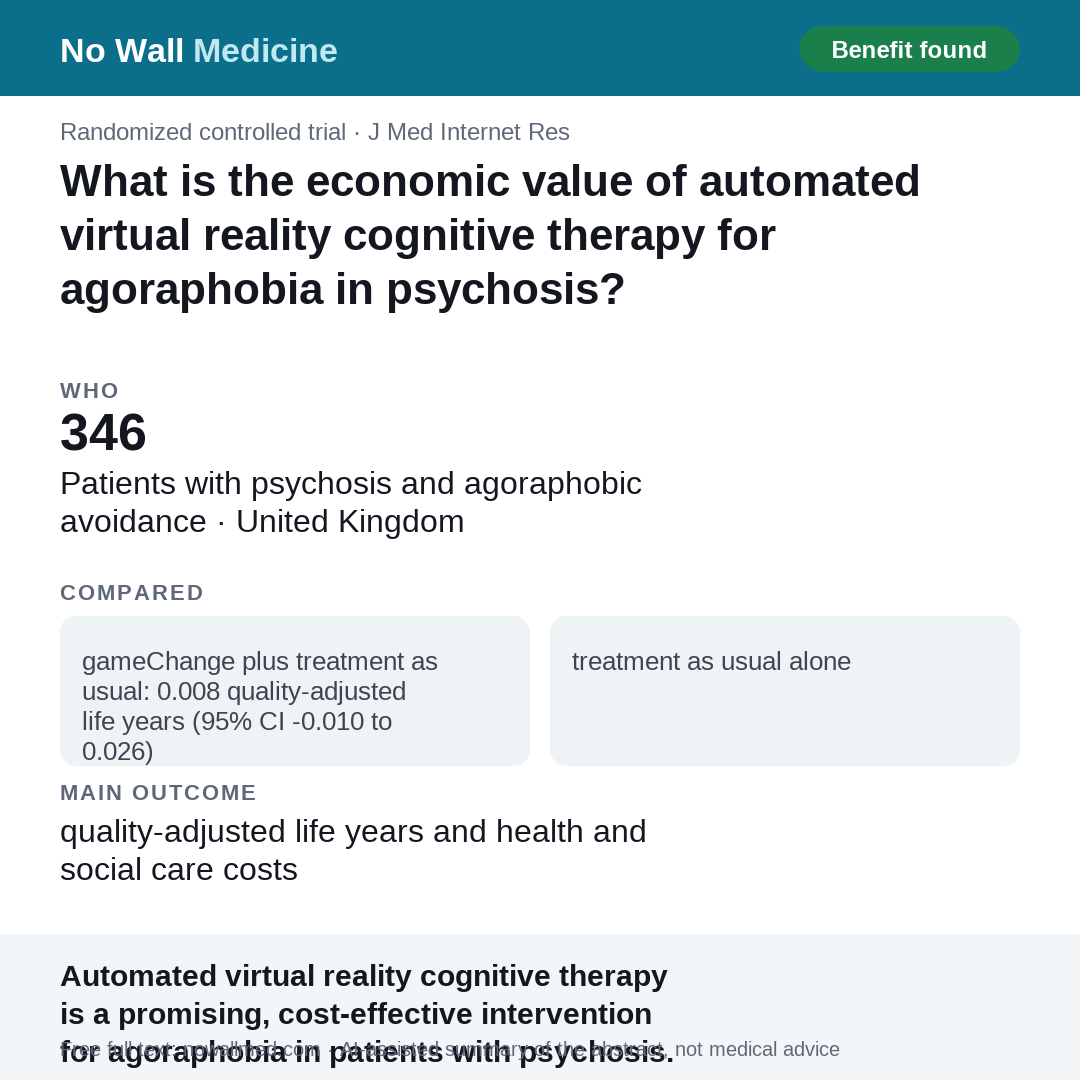
What is the economic value of automated virtual reality cognitive therapy for agoraphobia in psychosis?
Who
346
Patients with psychosis and agoraphobic avoidance · United Kingdom
Compared
gameChange plus treatment as usual: 0.008 quality-adjusted life years (95% CI -0.010 to 0.026)
treatment as usual alone
Main outcome
quality-adjusted life years and health and social care costs
Bottom line: Automated virtual reality cognitive therapy is a promising, cost-effective intervention for agoraphobia in patients with psychosis.
Limitation: differences in quality-adjusted life years and costs were not statistically significant
J Med Internet Res · 2022-11-18Download image
Clinical question: What is the economic value of automated virtual reality cognitive therapy for agoraphobia in psychosis?
Why it matters: The economic value of automated virtual reality cognitive therapy for treating agoraphobic avoidance in patients with psychosis was not yet established.
Key points
- Researchers analyzed 346 patients with psychosis to compare automated virtual reality cognitive therapy with standard treatment alone.
- The therapy was associated with 0.008 higher quality-adjusted life years and -£105 lower health and social care costs, but these differences were not statistically significant.
- Maximum cost-effective prices were estimated at up to £341 from an NHS perspective and £1967 from a wider societal perspective.
Headline and key points written with AI from the paper’s abstract, with every number checked against it. Read the paper before relying on them.
Was this summary helpful?
Subject terms
Cite this article
Altunkaya J, Craven M, Lambe S, et al. Estimating the Economic Value of Automated Virtual Reality Cognitive Therapy for Treating Agoraphobic Avoidance in Patients With Psychosis: Findings From the gameChange Randomized Controlled Clinical Trial. J Med Internet Res. 2022. doi:10.2196/39248
Spotted a mistake? Suggest a correction