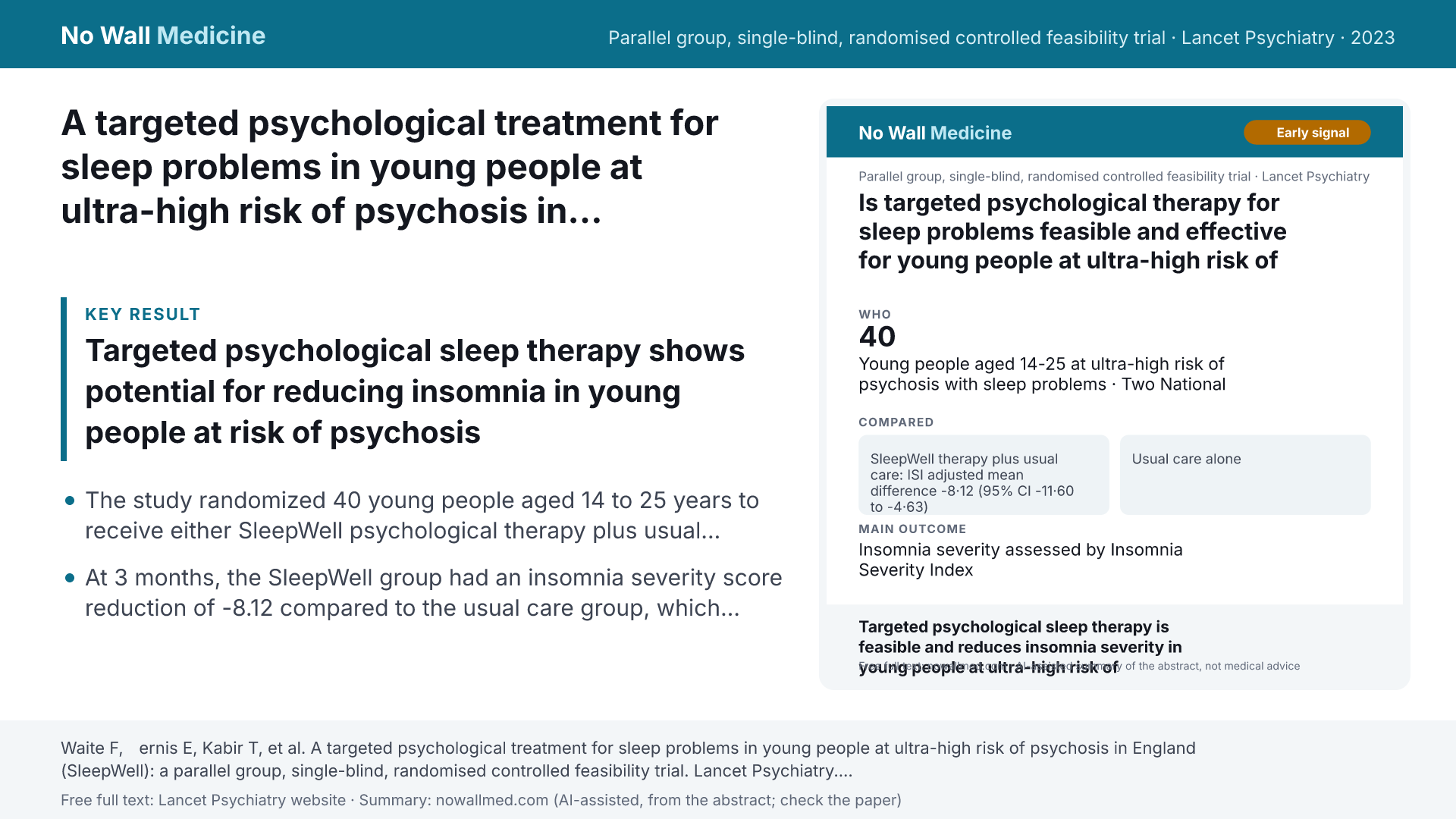
Targeted psychological sleep therapy shows potential for reducing insomnia in young people at risk of psychosis
A targeted psychological treatment for sleep problems in young people at ultra-high risk of psychosis in England (SleepWell): a parallel group, single-blind, randomised controlled feasibility trial
Parallel group, single-blind, randomised controlled feasibility trialEarly signal
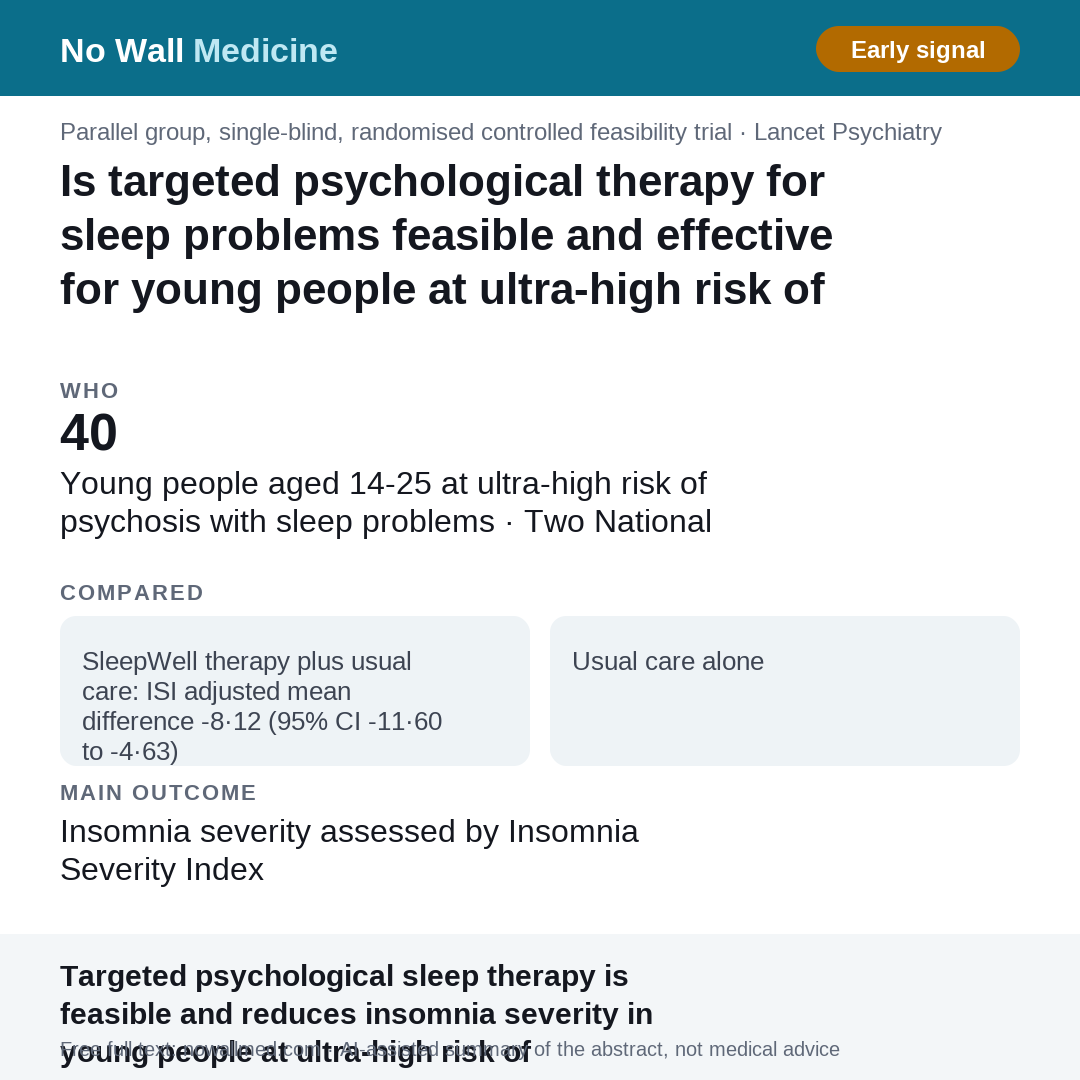
Is targeted psychological therapy for sleep problems feasible and effective for young people at ultra-high risk of psychosis?
Who
40
Young people aged 14-25 at ultra-high risk of psychosis with sleep problems · Two National Health Service trusts in England
Compared
SleepWell therapy plus usual care: ISI adjusted mean difference -8·12 (95% CI -11·60 to -4·63)
Usual care alone
Main outcome
Insomnia severity assessed by Insomnia Severity Index
Result: ISI adjusted mean difference -8·12 (95% CI -11·60 to -4·63)
Bottom line: Targeted psychological sleep therapy is feasible and reduces insomnia severity in young people at ultra-high risk of psychosis.
Lancet Psychiatry · 2023-08-07Download image
Clinical question: Is targeted psychological therapy for sleep problems feasible and effective for young people at ultra-high risk of psychosis?
Key points
- The study randomized 40 young people aged 14 to 25 years to receive either SleepWell psychological therapy plus usual care or usual care alone.
- At 3 months, the SleepWell group had an insomnia severity score reduction of -8.12 compared to the usual care group, which was sustained at 9 months with a difference of -5.83.
- The trial was feasible with 98% of participants completing primary outcome assessments at 3 and 9 months and a median treatment acceptability score of 48.
Headline and key points written with AI from the paper’s abstract, with every number checked against it. Read the paper before relying on them.
Was this summary helpful?
Abstract
Background
Sleep disturbance is common and problematic for young people at ultra-high risk of psychosis. Sleep disruption is a contributory causal factor in the occurrence of mental health problems, including psychotic experiences, anxiety, and depression. The implication is that treating sleep problems might have additional benefits on mental health outcomes in individuals at high risk. The present study had two aims: first, to establish the feasibility and acceptability of a randomised controlled trial to treat sleep problems with the aim of reducing psychotic experiences in young people at ultra-high risk of psychosis; and second, to provide proof of concept of the clinical efficacy of the treatment. Methods
We did a parallel group, single-blind, randomised controlled feasibility trial in two National Health Service trusts in England. Eligible participants were aged 14-25 years, a patient of mental health services, assessed as being at ultra-high risk of psychosis on the Comprehensive Assessment of At-Risk Mental States, and having current sleep problems (score of ≥15 on the self-report Insomnia Severity Index [ISI]). Participants were randomly assigned (1:1) to either a targeted psychological therapy for sleep problems (SleepWell) plus usual care or usual care alone via an automated online system, with non-deterministic minimisation that balanced participants for ISI score and referring service. The SleepWell therapy was delivered on an individual basis in approximately eight 1-h sessions over 12 weeks. Assessments were done at 0, 3, and 9 months, with trial assessors masked to treatment allocation. The key feasibility outcomes were the numbers of patients identified, recruited, and retained, treatment uptake, and data completion. Treatment acceptability was measured with the Abbreviated Acceptability Rating Profile (AARP). In preliminary clinical assessments, the primary clinical outcome was insomnia at 3 and 9 months assessed with the ISI, reported by randomised group (intention-to-treat analysis). Safety was assessed in all randomly assigned participants. The trial was prospectively registered on ISRCTN, 85601537, and is completed. Findings
From Nov 18, 2020, to Jan 26, 2022, 67 young people were screened, of whom 40 (60%) at ultra-high risk of psychosis were recruited. Mean age was 16·9 years (SD 2·5; range 14-23), and most participants identified as female (n=19 [48%]) or male (n=19 [48%]) and as White (n=32 [80%]). 21 participants were randomly assigned to SleepWell therapy plus usual care and 19 to usual care alone. All participants provided data on at least one follow-up visit. 39 (98%) of 40 participants completed the primary outcome assessment at 3 and 9 months. 20 (95%) of 21 participants assigned to SleepWell therapy received the prespecified minimum treatment dose of at least four sessions. The median treatment acceptability score on the AARP was 48 (IQR 46 to 48; n=17; maximum possible score 48). At the post-intervention follow-up (3 months), compared with the usual care alone group, the SleepWell therapy group had a reduction in insomnia severity (ISI adjusted mean difference -8·12 [95% CI -11·60 to -4·63]; Cohen's d=-2·67 [95% CI -3·81 to -1·52]), which was sustained at 9 months (ISI adjusted mean difference -5·83 [-9·31 to -2·35]; Cohen's d=-1·91 [-3·06 to -0·77]). Among the 40 participants, eight adverse events were reported in six participants (two [11%] participants in the usual care group and four [19%] participants in the SleepWell therapy group). One serious adverse event involving hospital admission for a physical health problem was reported in the SleepWell therapy group, and one patient in the usual care alone group transitioned to psychosis. None of these events were classed as being related to trial treatment or procedures. Interpretation
A randomised controlled trial of a targeted psychological sleep therapy for young people at ultra-high risk of psychosis is feasible. Patients can be retained in the trial and assessments done by masked assessors. Uptake of the sleep therapy was high, and we found preliminary evidence of sustained reductions in sleep problems. A definitive multicentre trial is now needed. Funding
NIHR Research for Patient Benefit and NIHR Oxford Health Biomedical Research Centre.
Abstract reproduced under the article’s CC BY licence.
Subject terms
Headline, design, result, key points, caveat and citation as plain text.
Cite this article
Waite F, Černis E, Kabir T, et al. A targeted psychological treatment for sleep problems in young people at ultra-high risk of psychosis in England (SleepWell): a parallel group, single-blind, randomised controlled feasibility trial. Lancet Psychiatry. 2023;10(9):706-718. doi:10.1016/S2215-0366(23)00203-1
Spotted a mistake? Suggest a correction