Internet-delivered cognitive therapy for PTSD was more cost-effective than stress management programs
Cost-effectiveness of therapist-assisted internet-delivered psychological therapies for PTSD differing in trauma focus in England: an economic evaluation based on the STOP-PTSD trial
Single-blind, randomised controlled trialBenefit found
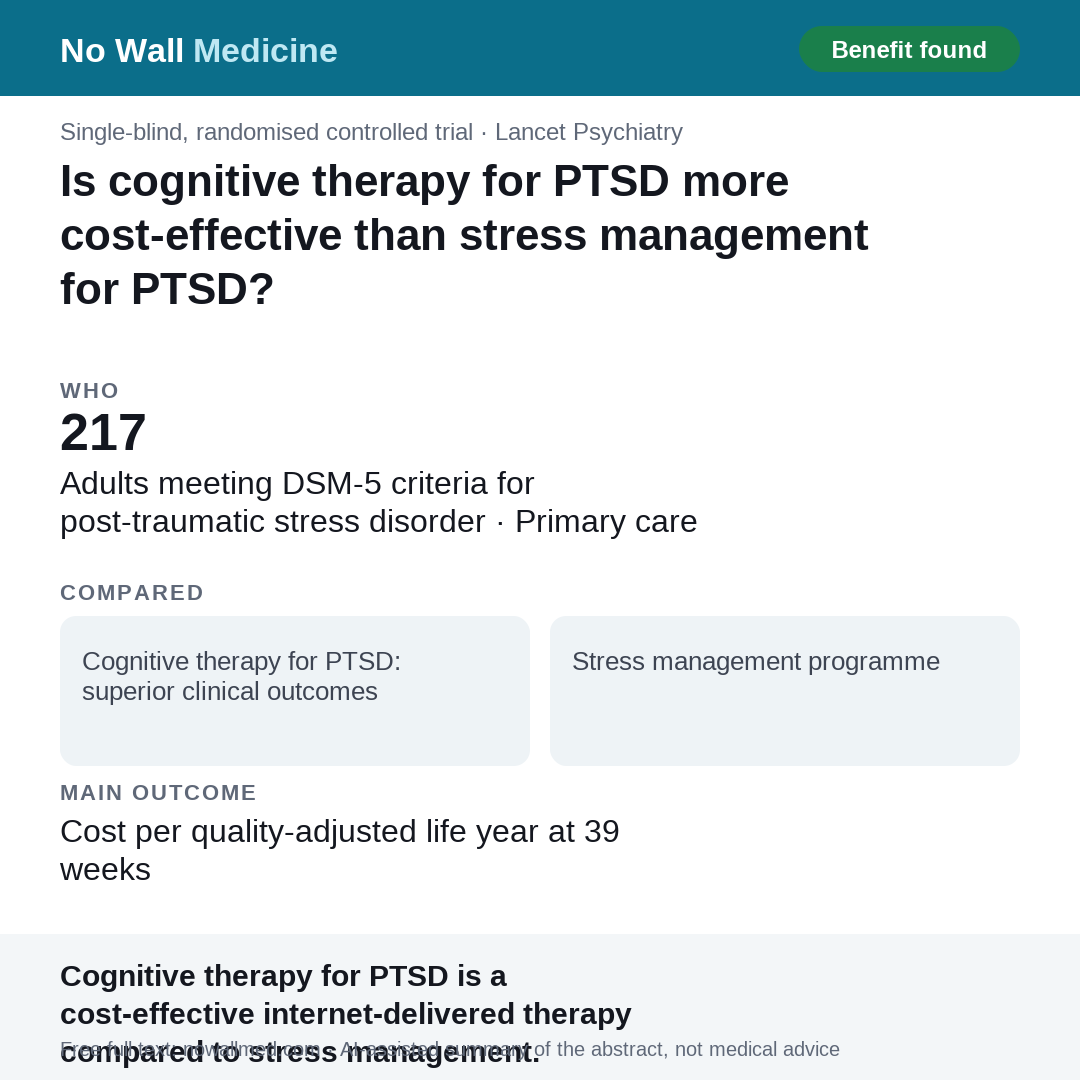
Is cognitive therapy for PTSD more cost-effective than stress management for PTSD?
Who
217
Adults meeting DSM-5 criteria for post-traumatic stress disorder · Primary care therapy services in South East England
Compared
Cognitive therapy for PTSD: superior clinical outcomes
Stress management programme
Main outcome
Cost per quality-adjusted life year at 39 weeks
Result: incremental cost-effectiveness ratio £1921 per QALY
Bottom line: Cognitive therapy for PTSD is a cost-effective internet-delivered therapy compared to stress management.
Funded by: Wellcome Trust and National Institute of Health Research
Lancet Psychiatry · 2024-03-27Download image
Clinical question: Is cognitive therapy for PTSD more cost-effective than stress management for PTSD?
Why it matters: It is unknown which forms of therapist-assisted, internet-delivered psychological therapies are most cost-effective for treating post-traumatic stress disorder.
Key points
- Researchers analyzed data from 217 adults with post-traumatic stress disorder who received either internet-delivered cognitive therapy or an internet-delivered stress management program.
- Cognitive therapy for PTSD had a 91.6% chance of being cost-effective at the £20,000 per quality-adjusted life year threshold.
- While National Health Service costs were similar between groups, cognitive therapy resulted in superior clinical outcomes compared to the stress management program.
Headline and key points written with AI from the paper’s abstract, with every number checked against it. Read the paper before relying on them.
Was this summary helpful?
Abstract
Background
Although there are effective psychological treatments for post-traumatic stress disorder (PTSD), they remain inaccessible for many people. Digitally enabled therapy is a way to overcome this problem; however, there is little evidence on which forms of these therapies are most cost effective in PTSD. We aimed to assess the cost-effectiveness of the STOP-PTSD trial, which evaluated two therapist-assisted, internet-delivered cognitive behavioural therapies: cognitive therapy for PTSD (iCT-PTSD) and a programme focusing on stress management (iStress-PTSD). Methods
In this health economic evaluation, we used data from the STOP-PTSD trial (n=217), a single-blind, randomised controlled trial, to compare iCT-PTSD and iStress-PTSD in terms of resource use and health outcomes. In the trial, participants (aged ≥18 years) who met DSM-5 criteria for PTSD were recruited from primary care therapy services in South East England. The interventions were delivered online with therapist support for the first 12 weeks, and three telephone calls over the next 3 months. Participants completed questionnaires on symptoms, wellbeing, quality of life, and resource use at baseline, 13 weeks, 26 weeks, and 39 weeks after randomisation. We used a cost-effectiveness analysis to assess cost per quality-adjusted life year (QALY) at 39 weeks post-randomisation, from the perspective of the English National Health Service (NHS) and personal social services and on the basis of intention-to-treat for complete cases. Treatment modules and the platform design were developed with extensive input from service users: service users also advised on the trial protocol and methods, including the health economic measures. This is a pre-planned analysis of the STOP-PTSD trial; the trial was registered prospectively on the ISRCTN Registry (ISRCTN16806208). Findings
NHS costs were similar across treatment groups, but clinical outcomes were superior for iCT-PTSD compared with iStress-PTSD. The incremental cost-effectiveness ratio for NHS costs and personal social services was estimated as £1921 per QALY. iCT-PTSD had an estimated 91·6% chance of being cost effective at the £20 000 per QALY threshold. From the societal perspective, iCT-PTSD was cost saving compared with iStress-PTSD. Interpretation
iCT-PTSD is a cost-effective form of therapist-assisted, internet-delivered psychological therapy relative to iStress-PTSD, and it could be considered for clinical implementation. Funding
Wellcome Trust and National Institute of Health Research Oxford Health Biomedical Research Centre.
Abstract reproduced under the article’s CC BY licence.
Subject terms
Cite this article
Penington E, Wild J, Warnock-Parkes E, Grey N, Murray H, Kerr A. Cost-effectiveness of therapist-assisted internet-delivered psychological therapies for PTSD differing in trauma focus in England: an economic evaluation based on the STOP-PTSD trial. Lancet Psychiatry. 2024. doi:10.1016/S2215-0366(24)00055-5
Spotted a mistake? Suggest a correction
Top studies every Monday
The week’s key trials and guidelines in your specialties, plus any topics you follow. By email, free.
Get the weekly digest