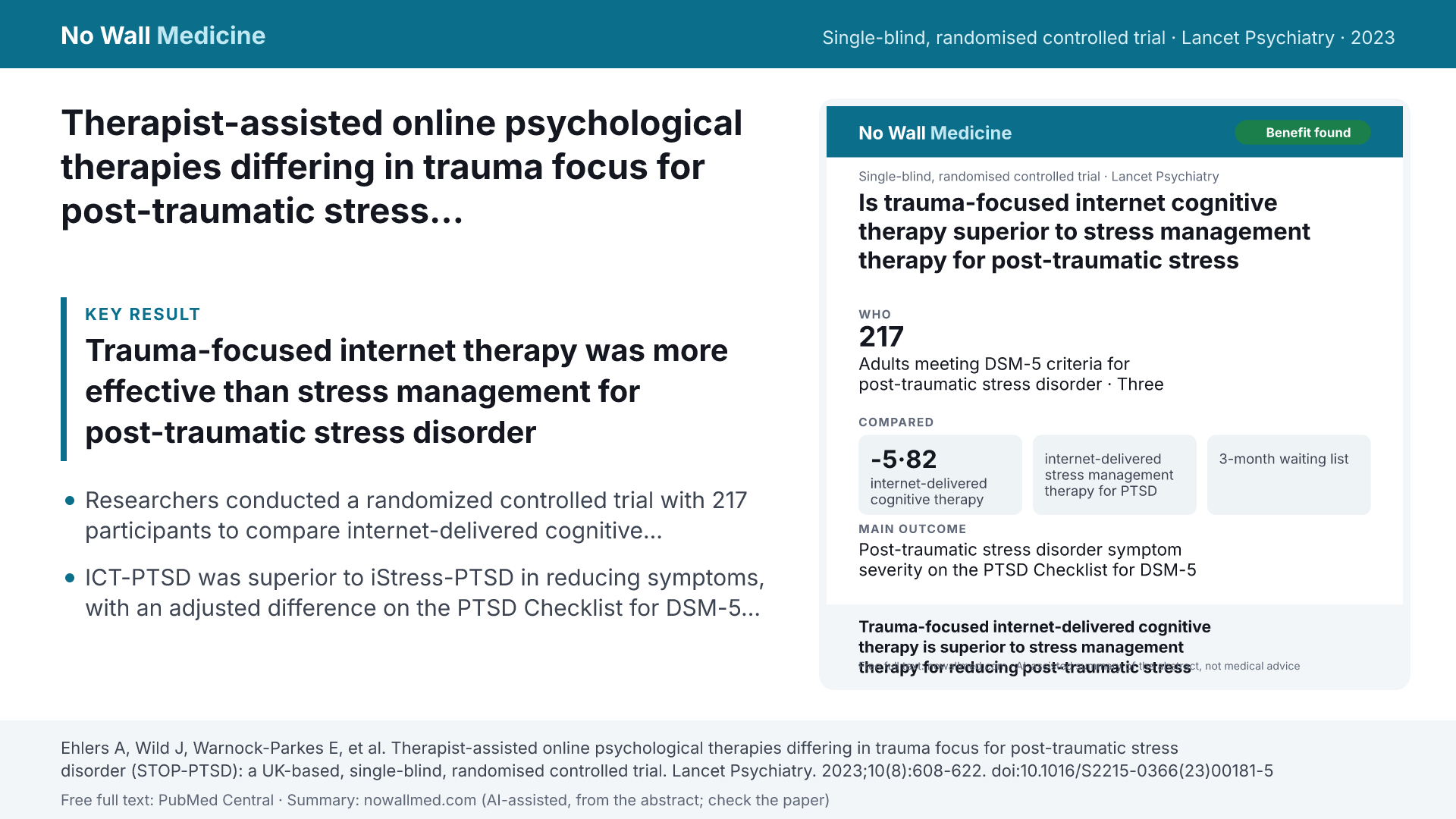
Trauma-focused internet therapy was more effective than stress management for post-traumatic stress disorder
Therapist-assisted online psychological therapies differing in trauma focus for post-traumatic stress disorder (STOP-PTSD): a UK-based, single-blind, randomised controlled trial
Single-blind, randomised controlled trialBenefit found
Is trauma-focused internet cognitive therapy superior to stress management therapy for post-traumatic stress disorder?
Who
217
Adults meeting DSM-5 criteria for post-traumatic stress disorder · Three locations in the United Kingdom
Compared
-5·82internet-delivered cognitive therapy for PTSD (-9·59 to -2·04)
internet-delivered stress management therapy for PTSD
3-month waiting list
Main outcome
Post-traumatic stress disorder symptom severity on the PTSD Checklist for DSM-5
Result: adjusted difference -5·82 (95% CI -9·59 to -2·04)
Bottom line: Trauma-focused internet-delivered cognitive therapy is superior to stress management therapy for reducing post-traumatic stress disorder symptoms.
Funded by: Wellcome Trust and National Institute for Health and Care Research
Lancet Psychiatry · 2023-07-22Download image
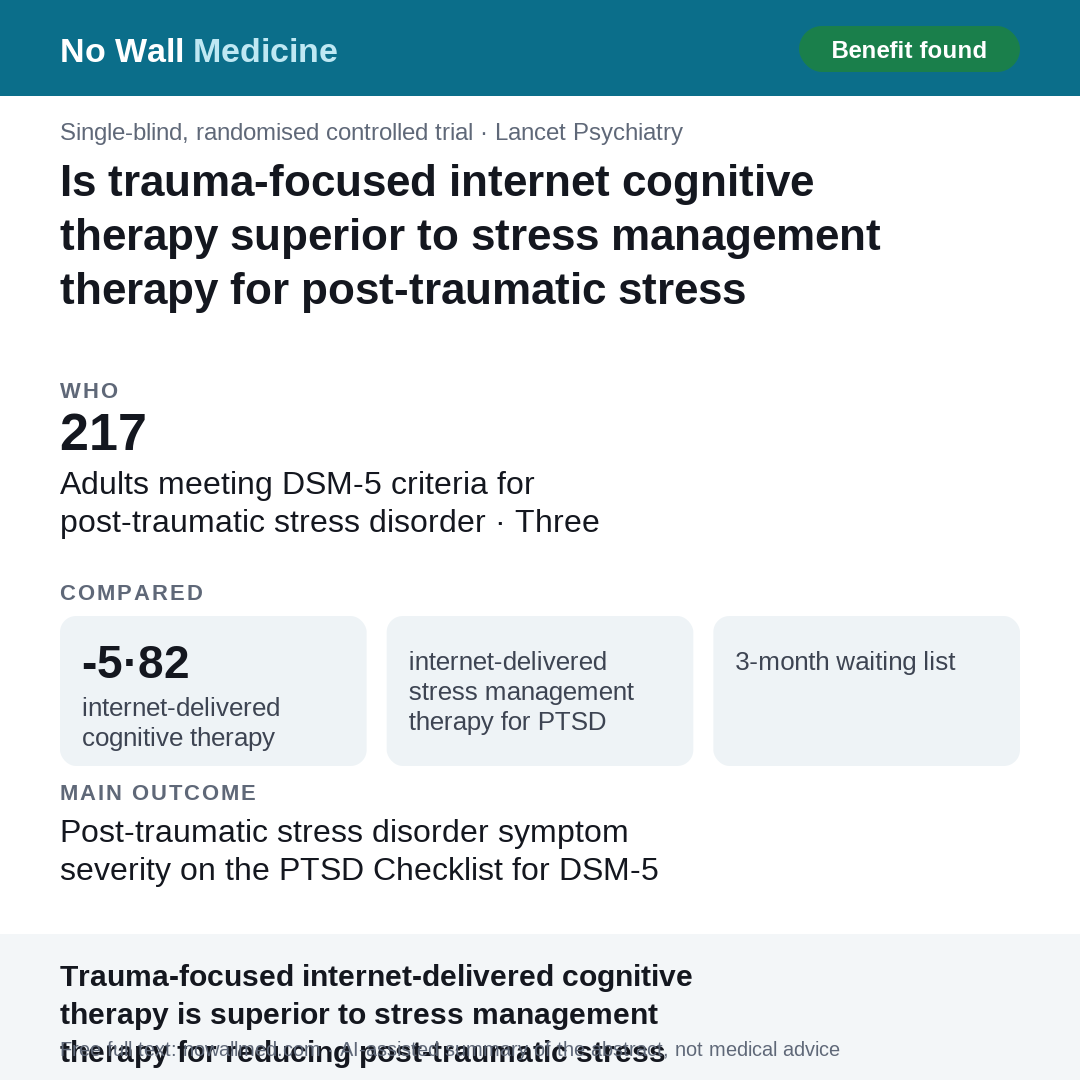
Clinical question: Is trauma-focused internet cognitive therapy superior to stress management therapy for post-traumatic stress disorder?
Why it matters: It is unclear which types of therapist-assisted internet-based treatments work best for patients with post-traumatic stress disorder.
Key points
- Researchers conducted a randomized controlled trial with 217 participants to compare internet-delivered cognitive therapy for post-traumatic stress disorder (iCT-PTSD) against internet-delivered stress management therapy (iStress-PTSD).
- ICT-PTSD was superior to iStress-PTSD in reducing symptoms, with an adjusted difference on the PTSD Checklist for DSM-5 of -4.92 for immediate allocations and -5.82 for all treatment allocations.
- Both internet-based treatments were superior to a 3-month waiting list, with effect sizes of 1.67 for iCT-PTSD and 1.29 for iStress-PTSD at 13 weeks.
Headline and key points written with AI from the paper’s abstract, with every number checked against it. Read the paper before relying on them.
Was this summary helpful?
Abstract
Background
Many patients are currently unable to access psychological treatments for post-traumatic stress disorder (PTSD), and it is unclear which types of therapist-assisted internet-based treatments work best. We aimed to investigate whether a novel internet-delivered cognitive therapy for PTSD (iCT-PTSD), which implements all procedures of a first-line, trauma-focused intervention recommended by the UK National Institute for Health and Care Excellence (NICE) for PTSD, is superior to internet-delivered stress management therapy for PTSD (iStress-PTSD), a comprehensive cognitive behavioural treatment programme focusing on a wide range of coping skills. Methods
We did a single-blind, randomised controlled trial in three locations in the UK. Participants (≥18 years) were recruited from UK National Health Service (NHS) Improving Access to Psychological Therapies (IAPT) services or by self-referral and met DSM-5 criteria for PTSD to single or multiple events. Participants were randomly allocated by a computer programme (3:3:1) to iCT-PTSD, iStress-PTSD, or a 3-month waiting list with usual NHS care, after which patients who still met PTSD criteria were randomly allocated (1:1) to iCT-PTSD or iStress-PTSD. Randomisation was stratified by location, duration of PTSD (<18 months or ≥18 months), and severity of PTSD symptoms (high vs low). iCT-PTSD and iStress-PTSD were delivered online with therapist support by messages and short weekly phone calls over the first 12 weeks (weekly treatment phase), and three phone calls over the next 3 months (booster phase). The primary outcome was the severity of PTSD symptoms at 13 weeks after random assignment, measured by self-report on the PTSD Checklist for DSM-5 (PCL-5), and analysed by intention-to-treat. Safety was assessed in all participants who started treatment. Process analyses investigated acceptability and compliance with treatment, and candidate moderators and mediators of outcome. The trial was prospectively registered with the ISRCTN registry, ISRCTN16806208. Findings
Of the 217 participants, 158 (73%) self-reported as female, 57 (26%) as male, and two (1%) as other; 170 (78%) were White British, 20 (9%) were other White, six (3%) were Asian, ten (5%) were Black, eight (4%) had a mixed ethnic background, and three (1%) had other ethnic backgrounds. Mean age was 36·36 years (SD 12·11; range 18-71 years). 52 (24%) participants met self-reported criteria for ICD-11 complex PTSD. Fewer than 10% of participants dropped out of each treatment group. iCT-PTSD was superior to iStress-PTSD in reducing PTSD symptoms, showing an adjusted difference on the PCL-5 of -4·92 (95% CI -8·92 to -0·92; p=0·016; standardised effect size d=0·38 [0·07 to 0·69]) for immediate allocations and -5·82 (-9·59 to -2·04; p=0·0027; d=0·44 [0·15 to 0·72]) for all treatment allocations. Both treatments were superior to the waiting list for PCL-5 at 13 weeks (d=1·67 [1·23 to 2·10] for iCT-PTSD and 1·29 [0·85 to 1·72] for iStress-PTSD). The advantages in outcome for iCT-PTSD were greater for participants with high dissociation or complex PTSD symptoms, and mediation analyses showed both treatments worked by changing negative meanings of the trauma, unhelpful coping, and flashback memories. No serious adverse events were reported. Interpretation
Trauma-focused iCT-PTSD is effective and acceptable to patients with PTSD, and superior to a non-trauma-focused cognitive behavioural stress management therapy, suggesting that iCT-PTSD is an effective way of delivering the contents of CT-PTSD, one of the NICE-recommended first-line treatments for PTSD, while reducing therapist time compared with face-to-face therapy. Funding
Wellcome Trust, UK National Institute for Health and Care Research Oxford Health Biomedical Research Centre.
Abstract reproduced under the article’s CC BY licence.
Subject terms
Cite this article
Ehlers A, Wild J, Warnock-Parkes E, et al. Therapist-assisted online psychological therapies differing in trauma focus for post-traumatic stress disorder (STOP-PTSD): a UK-based, single-blind, randomised controlled trial. Lancet Psychiatry. 2023. doi:10.1016/S2215-0366(23)00181-5
Spotted a mistake? Suggest a correction