Cognitive therapy for persecutory delusions showed greater reductions in conviction than befriending
Comparison of a theoretically driven cognitive therapy (the Feeling Safe Programme) with befriending for the treatment of persistent persecutory delusions: a parallel, single-blind, randomised controlled trial
Parallel, single-blind, randomised controlled trialBenefit found
Does the Feeling Safe Programme reduce persistent persecutory delusions more than befriending?
Who
130
Patients with persistent persecutory delusions and non-affective psychosis · Three United Kingdom National Health Service trusts
Compared
Feeling Safe Programme: -10·69 [95% CI -19·75 to -1·63]
Befriending
Main outcome
Persecutory delusion conviction assessed by Psychotic Symptoms Rating Scale
Result: -10·69 [95% CI -19·75 to -1·63]
Bottom line: The Feeling Safe Programme significantly reduced persecutory delusion conviction and severity compared to befriending.
Limitation: Relatively small sample size when comparing two active treatments, reducing precision and power.
Funded by: NIHR Research Professorship and NIHR Oxford Health Biomedical Research Centre
Lancet Psychiatry · 2021-07-08Download image
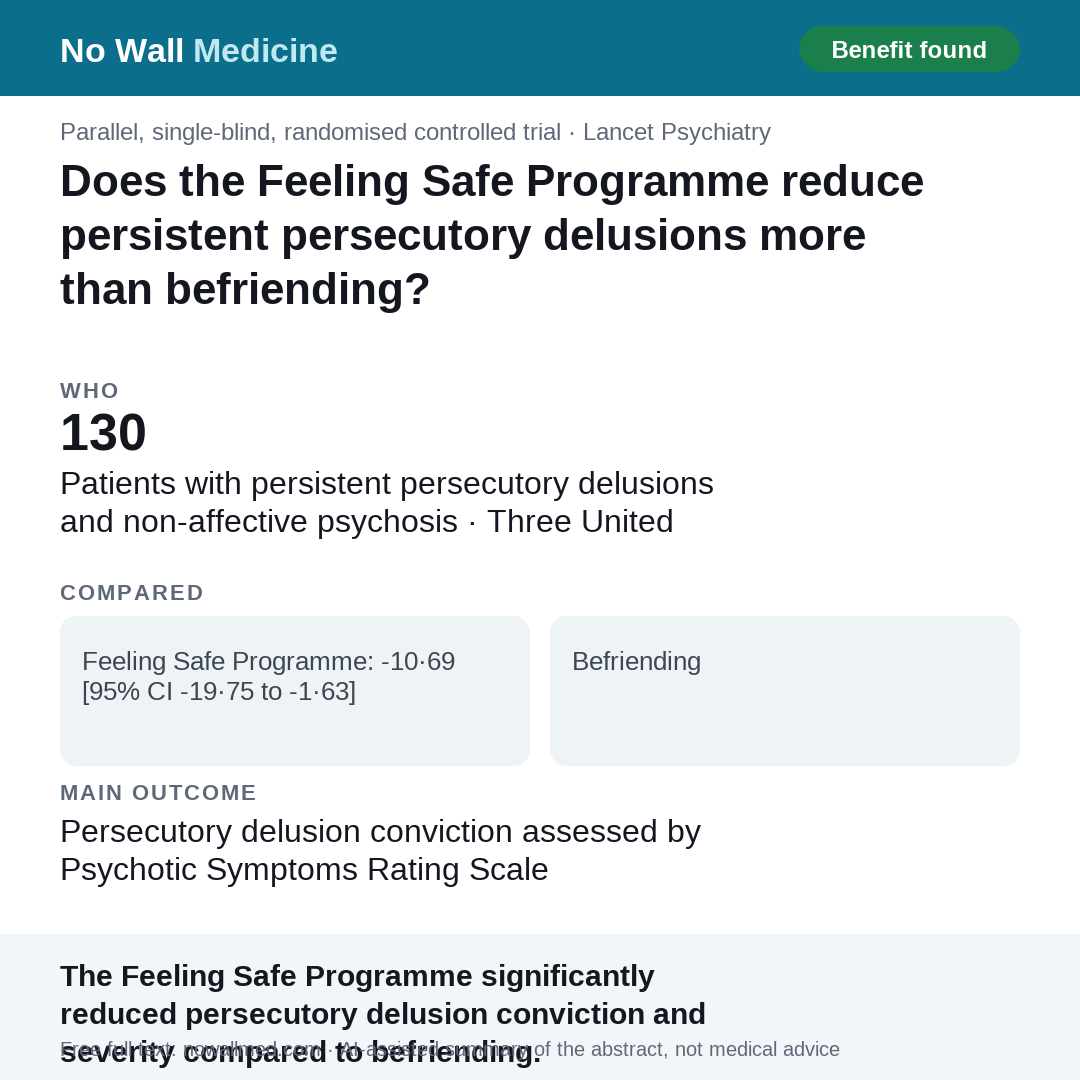
Clinical question: Does the Feeling Safe Programme reduce persistent persecutory delusions more than befriending?
Why it matters: It was unknown if a theoretically driven cognitive therapy could provide larger reductions in persecutory delusions compared to non-specific social support like befriending.
Key points
- The study randomized 130 patients with persistent persecutory delusions to receive either the Feeling Safe Programme or a befriending programme over 6 months.
- Compared to befriending, the Feeling Safe Programme led to significant reductions in delusional conviction (-10.69 [95% CI -19.75 to -1.63], p=0.021) and delusion severity (-2.94 [-4.58 to -1.31], p<0.0001).
- Unrelated adverse events were reported in 25% of the Feeling Safe group and 30% of the befriending group.
Limitation the authors note: The authors stated the relatively small sample size when comparing two active treatments resulted in less precision in effect size estimates.
Headline and key points written with AI from the paper’s abstract, with every number checked against it. Read the paper before relying on them.
Was this summary helpful?
Abstract
Background
There is a large clinical need for improved treatments for patients with persecutory delusions. We aimed to test whether a new theoretically driven cognitive therapy (the Feeling Safe Programme) would lead to large reductions in persecutory delusions, above non-specific effects of therapy. We also aimed to test treatment effect mechanisms. Methods
We did a parallel, single-blind, randomised controlled trial to test the Feeling Safe Programme against befriending with the same therapists for patients with persistent persecutory delusions in the context of non-affective psychosis diagnoses. Usual care continued throughout the duration of the trial. The trial took place in community mental health services in three UK National Health Service trusts. Participants were included if they were 16 years or older, had persecutory delusions (as defined by Freeman and Garety) for at least 3 months and held with at least 60% conviction, and had a primary diagnosis of non-affective psychosis from the referring clinical team. Patients were randomly assigned to either the Feeling Safe Programme or the befriending programme, using a permuted blocks algorithm with randomly varying block size, stratified by therapist. Trial assessors were masked to group allocation. If an allocation was unmasked then the unmasked assessor was replaced with a new masked assessor. Outcomes were assessed at 0 months, 6 months (primary endpoint), and 12 months. The primary outcome was persecutory delusion conviction, assessed within the Psychotic Symptoms Rating Scale (PSYRATS; rated 0-100%). Outcome analyses were done in the intention-to-treat population. Each intervention was provided individually over 6 months. This trial is registered with the ISRCTN registry, ISRCTN18705064. Findings
From Feb 8, 2016, to July 26, 2019, 130 patients with persecutory delusions (78 [60%] men; 52 [40%] women, mean age 42 years [SD 12·1, range 17-71]; 86% White, 9% Black, 2% Indian; 2·3% Pakistani; 2% other) were recruited. 64 patients were randomly allocated to the Feeling Safe Programme and 66 patients to befriending. Compared with befriending, the Feeling Safe Programme led to significant end of treatment reductions in delusional conviction (-10·69 [95% CI -19·75 to -1·63], p=0·021, Cohen's d=-0·86) and delusion severity (PSYRATS, -2·94 [-4·58 to -1·31], p<0·0001, Cohen's d=-1·20). More adverse events occurred in the befriending group (68 unrelated adverse events reported in 20 [30%] participants) compared with the Feeling Safe group (53 unrelated adverse events reported in 16 [25%] participants). Interpretation
The Feeling Safe Programme led to a significant reduction in persistent persecutory delusions compared with befriending. To our knowledge, these are the largest treatment effects seen for patients with persistent delusions. The principal limitation of our trial was the relatively small sample size when comparing two active treatments, meaning less precision in effect size estimates and lower power to detect moderate treatment differences in secondary outcomes. Further research could be done to determine whether greater effects could be possible by reducing the hypothesised delusion maintenance mechanisms further. The Feeling Safe Programme could become the recommended psychological treatment in clinical services for persecutory delusions. Funding
NIHR Research Professorship and NIHR Oxford Health Biomedical Research Centre.
Abstract reproduced under the article’s CC BY licence.
Subject terms
Cite this article
Freeman D, Emsley R, Diamond R, Collett N, Bold E, Chadwick E. Comparison of a theoretically driven cognitive therapy (the Feeling Safe Programme) with befriending for the treatment of persistent persecutory delusions: a parallel, single-blind, randomised controlled trial. Lancet Psychiatry. 2021. doi:10.1016/S2215-0366(21)00158-9
Spotted a mistake? Suggest a correction
Top studies every Monday
The week’s key trials and guidelines in your specialties, plus any topics you follow. By email, free.
Get the weekly digest