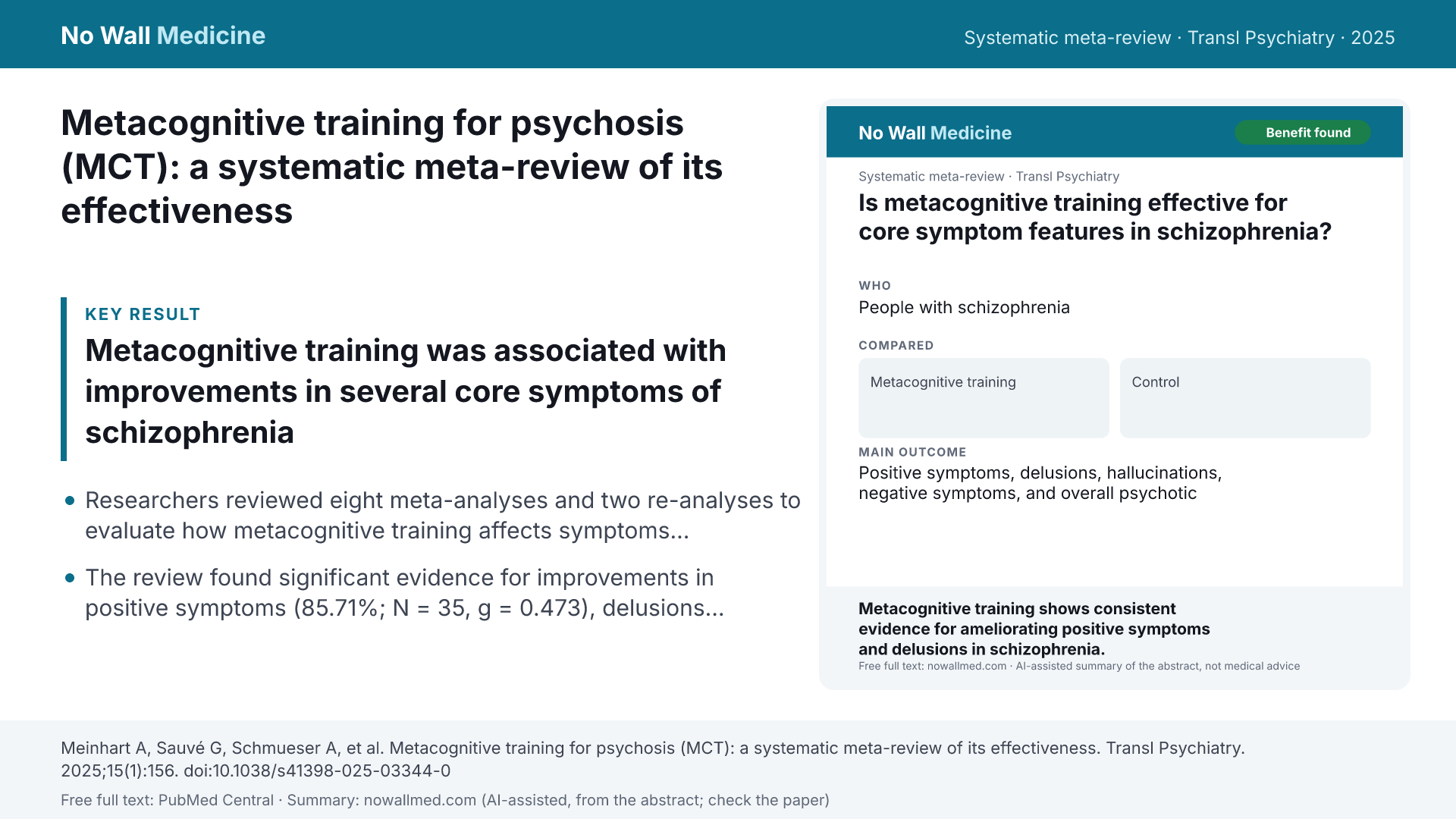
Metacognitive training was associated with improvements in several core symptoms of schizophrenia
Metacognitive training for psychosis (MCT): a systematic meta-review of its effectiveness
Systematic meta-reviewBenefit found
Is metacognitive training effective for core symptom features in schizophrenia?
Who
People with schizophrenia
Compared
Metacognitive training
Control
Main outcome
Positive symptoms, delusions, hallucinations, negative symptoms, and overall psychotic symptoms
Bottom line: Metacognitive training shows consistent evidence for ameliorating positive symptoms and delusions in schizophrenia.
Limitation: None of the meta-analyses met criteria for suggestive or convincing evidence or moderate to high methodological quality.
Transl Psychiatry · 2025-04-22 · Save PNG

Clinical question: Is metacognitive training effective for core symptom features in schizophrenia?
Why it matters: The effectiveness of metacognitive training, which targets cognitive biases like jumping to conclusions, for core symptom features in schizophrenia needed systematic evaluation.
Key points
- Researchers reviewed eight meta-analyses and two re-analyses to evaluate how metacognitive training affects symptoms like delusions, hallucinations, and negative symptoms in schizophrenia.
- The review found significant evidence for improvements in positive symptoms (85.71%; N = 35, g = 0.473), delusions (60%; N = 24, g = 0.639), hallucinations (100%; N = 9, g = 0.265), and negative symptoms (100%; N = 17, g = 0.233).
- Overall psychotic symptoms showed significant results in 50% of the analyses (N = 37, g = 0.392).
Headline and key points written with AI from the paper’s abstract, with every number checked against it. Read the paper before relying on them.
Was this summary helpful?
Subject terms
Headline, design, result, key points, caveat and citation as plain text.
Cite this article
Meinhart A, Sauvé G, Schmueser A, et al. Metacognitive training for psychosis (MCT): a systematic meta-review of its effectiveness. Transl Psychiatry. 2025;15(1):156. doi:10.1038/s41398-025-03344-0
Spotted a mistake? Suggest a correction