Trauma-related beliefs did not show greater predictability for psychosis symptoms than other PTSD symptoms
Symptom networks of therapy-seeking individuals with comorbid psychosis and PTSD
Network analysis using a Bayesian Gaussian graphical modelMixed results
How do psychosis, posttraumatic stress, and complex posttraumatic symptoms interact in a network?
Who
305
People with schizophrenia-spectrum disorder, distressing delusions or hallucinations, and comorbid posttraumatic stress disorder · Study of Trauma and Recovery
Compared
Psychosis symptoms
Posttraumatic stress symptoms
Complex posttraumatic stress symptoms
Trauma-related beliefs
Main outcome
Interactions between psychosis, posttraumatic stress, and complex posttraumatic symptoms
Bottom line: Affective dysregulation may predict voices and self-blame may be associated with delusions in this symptom network.
Limitation: Future research should identify symptom presentation subgroups to improve network reliability.
Psychol Med · 2026-07-28 · Save PNG
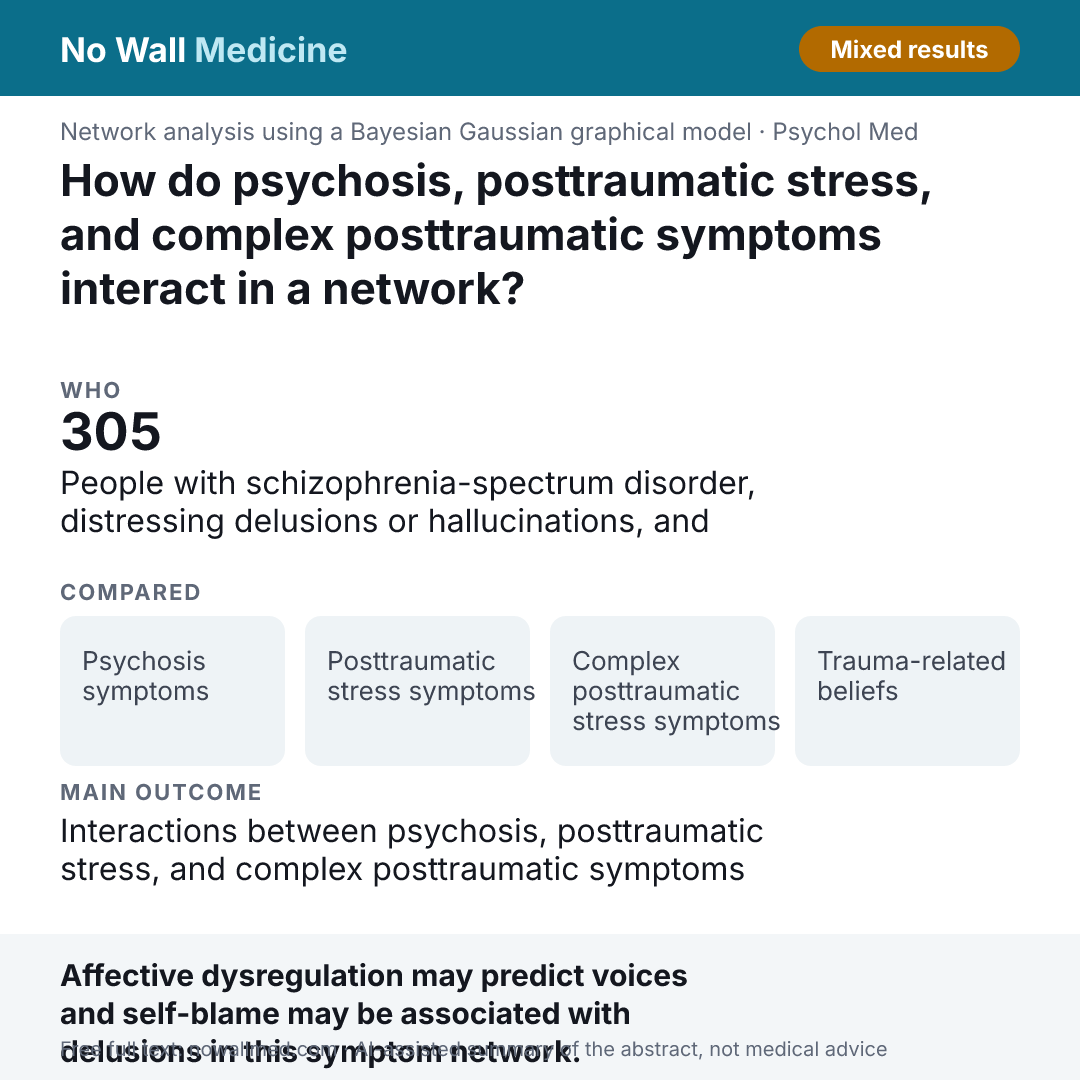
Clinical question: How do psychosis, posttraumatic stress, and complex posttraumatic symptoms interact in a network?
Why it matters: The relative contribution of core post-traumatic stress disorder symptoms and complex post-traumatic stress symptoms to psychosis is currently understudied.
Key points
- Researchers analyzed 305 people with schizophrenia-spectrum disorder and comorbid post-traumatic stress disorder using network analysis.
- The study found that all symptoms had similar predictability scores and did not support the hypothesis that trauma-related beliefs were the most predictive.
- Self-blame was associated with delusions, while affective dysregulation, or difficulty managing emotions, was found to predict hearing voices.
Headline and key points written with AI from the paper’s abstract, with every number checked against it. Read the paper before relying on them.
Was this summary helpful?
Subject terms
Headline, design, result, key points, caveat and citation as plain text.
Cite this article
Frost R, O'Driscoll C, Peters E, et al. Symptom networks of therapy-seeking individuals with comorbid psychosis and PTSD. Psychol Med. 2026;56:e239. doi:10.1017/S0033291726104978
Spotted a mistake? Suggest a correction