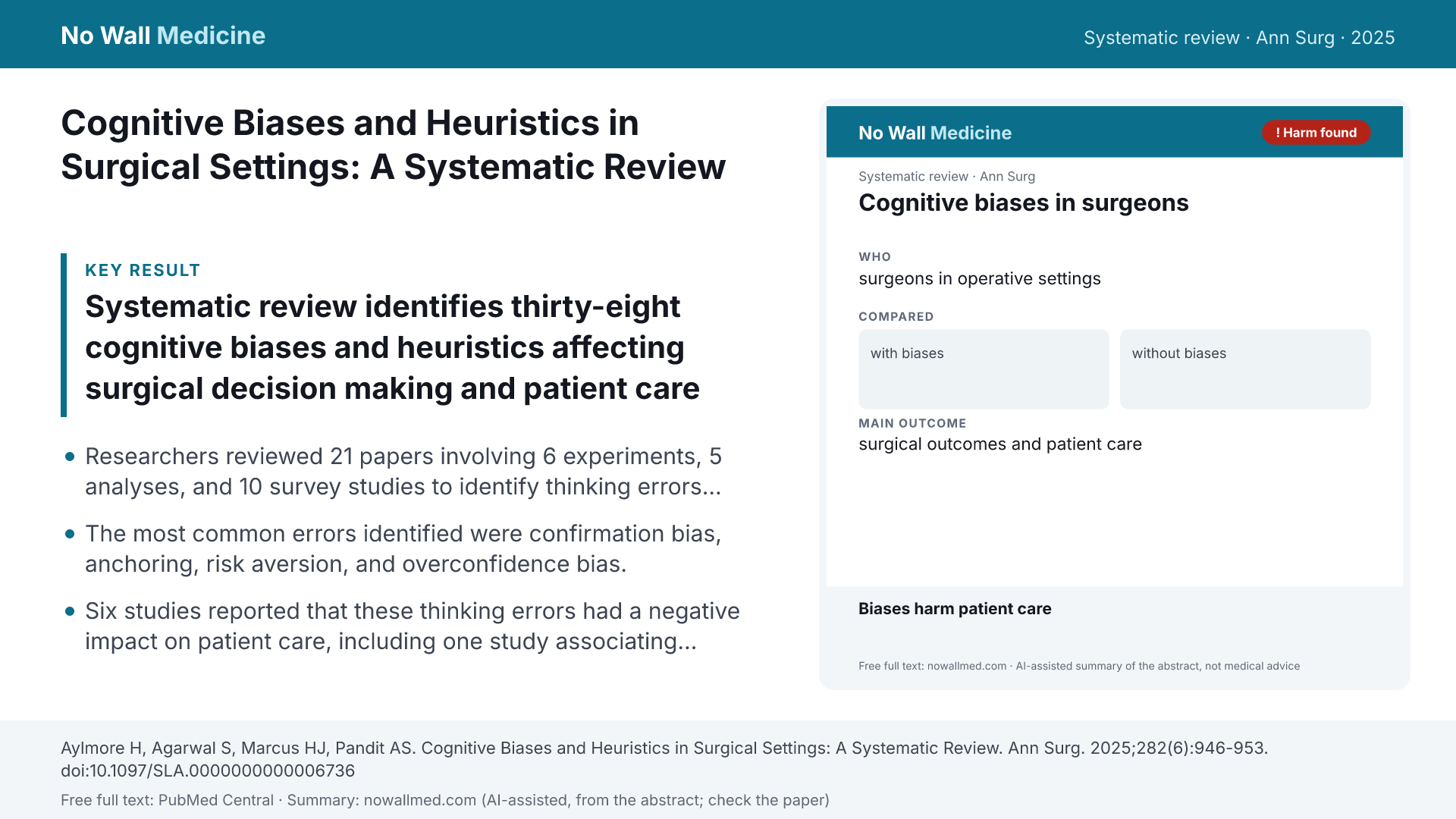
Cognitive Biases and Heuristics in Surgical Settings: A Systematic Review
Key result: Systematic review identifies thirty-eight cognitive biases and heuristics affecting surgical decision making and patient care
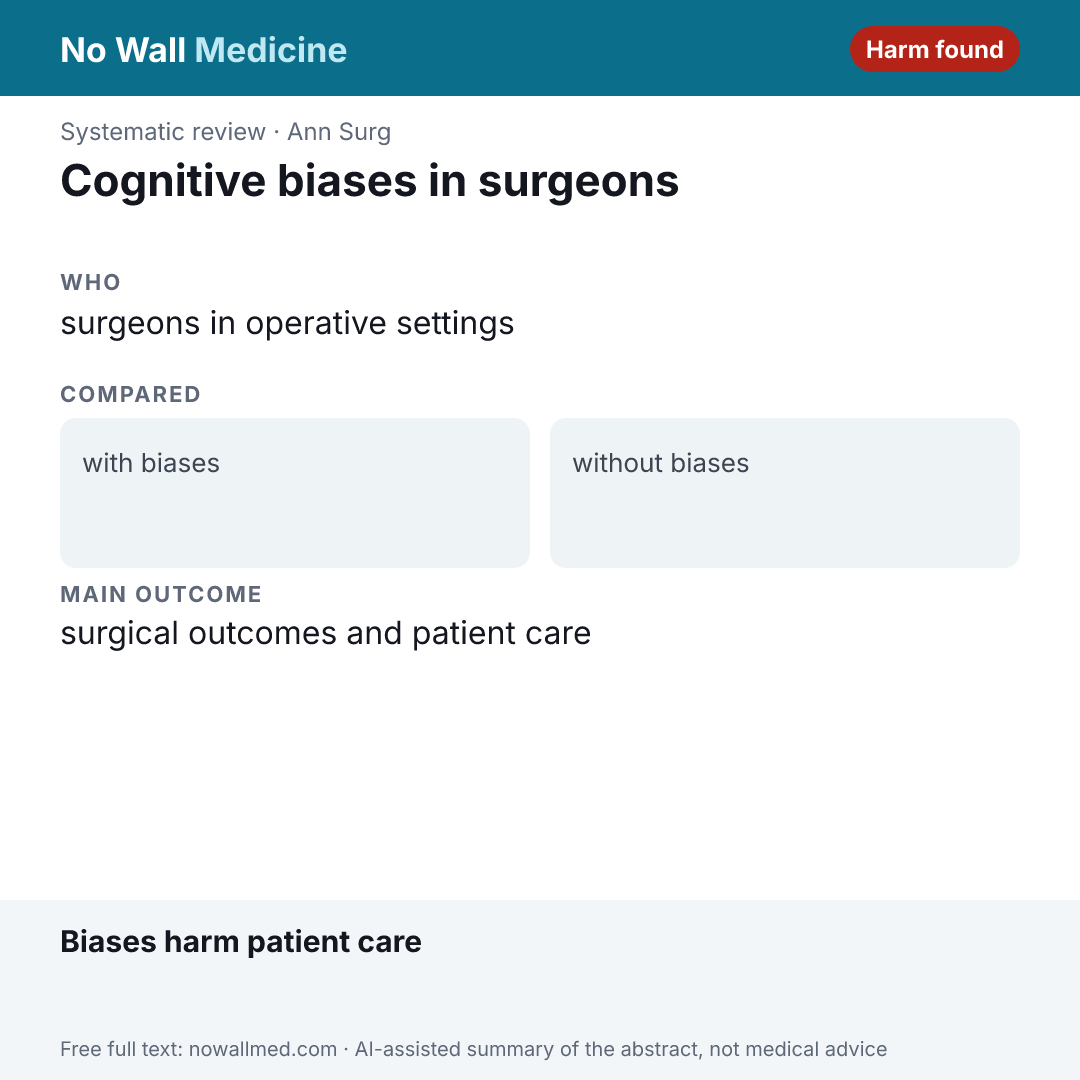
Systematic reviewHarm found
Cognitive biases in surgeons
Who
surgeons in operative settings
Compared
with biases
without biases
Main outcome
surgical outcomes and patient care
Bottom line: Biases harm patient care
Limitation: moderate risk of bias
Ann Surg · 2025-04-21 · Save PNG
Key points
- Researchers reviewed 21 papers involving 6 experiments, 5 analyses, and 10 survey studies to identify thinking errors in surgical settings.
- The most common errors identified were confirmation bias, anchoring, risk aversion, and overconfidence bias.
- Six studies reported that these thinking errors had a negative impact on patient care, including one study associating them with fatal outcomes.
Limitation the authors note: The risk of bias was moderate across most included studies.
Discussion prompts
- Would these patients look like yours? Who was left out?
- Is the main outcome one that matters to patients?
- Is the difference large enough to change what you do?
Cite: Aylmore H, Agarwal S, Marcus HJ, Pandit AS. Cognitive Biases and Heuristics in Surgical Settings: A Systematic Review. Ann Surg. 2025;282(6):946-953. doi:10.1097/SLA.0000000000006736
Free full text: PubMed Central · Summary and visual abstract: nowallmed.com/a/cognitive-biases-and-heuristics-in-surgical-settings-a-systematic-1di75hu/ (AI-assisted from the abstract; check the paper before relying on it).