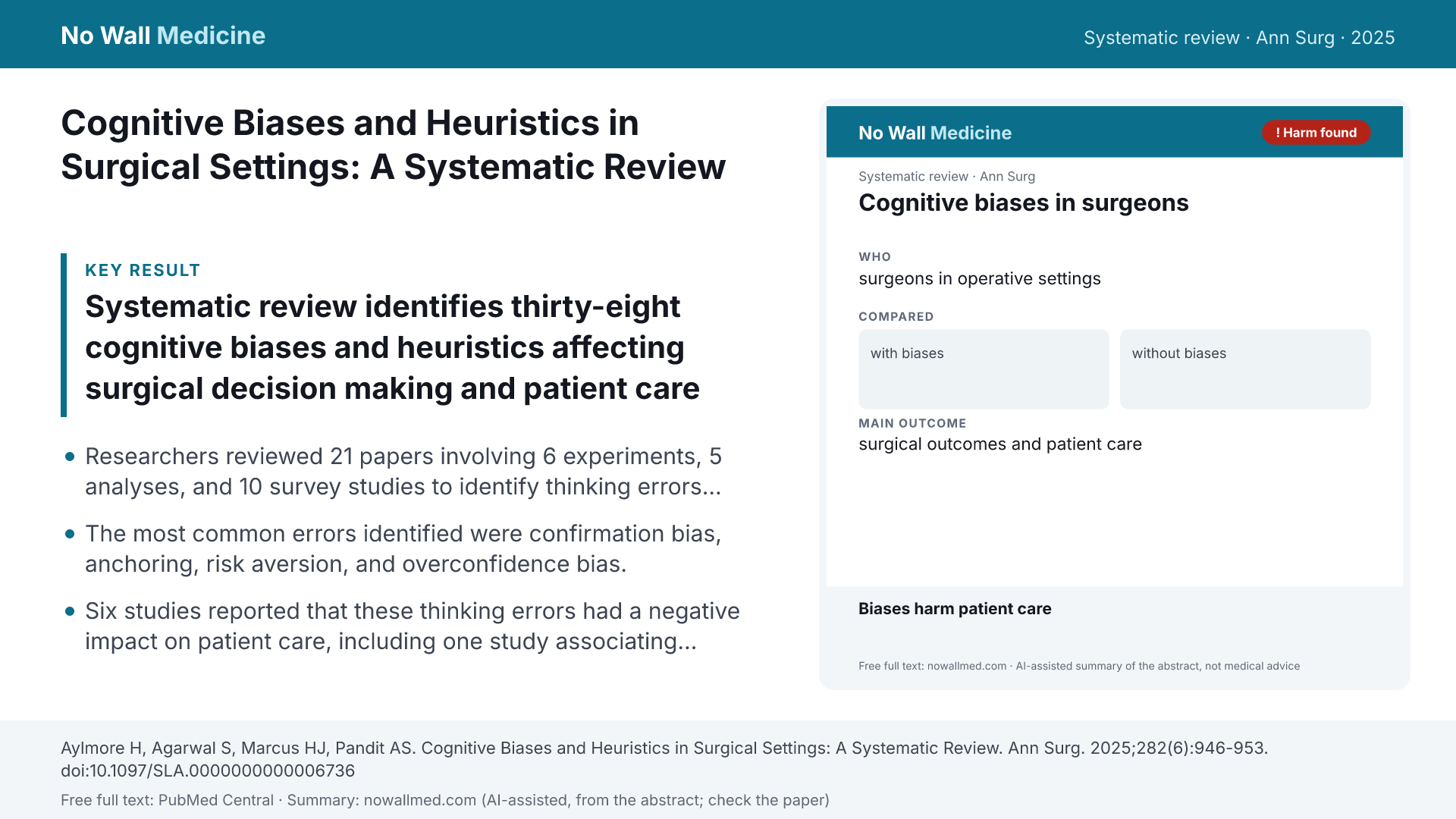
Systematic review identifies thirty-eight cognitive biases and heuristics affecting surgical decision making and patient care
Cognitive Biases and Heuristics in Surgical Settings: A Systematic Review
Systematic reviewHarm found
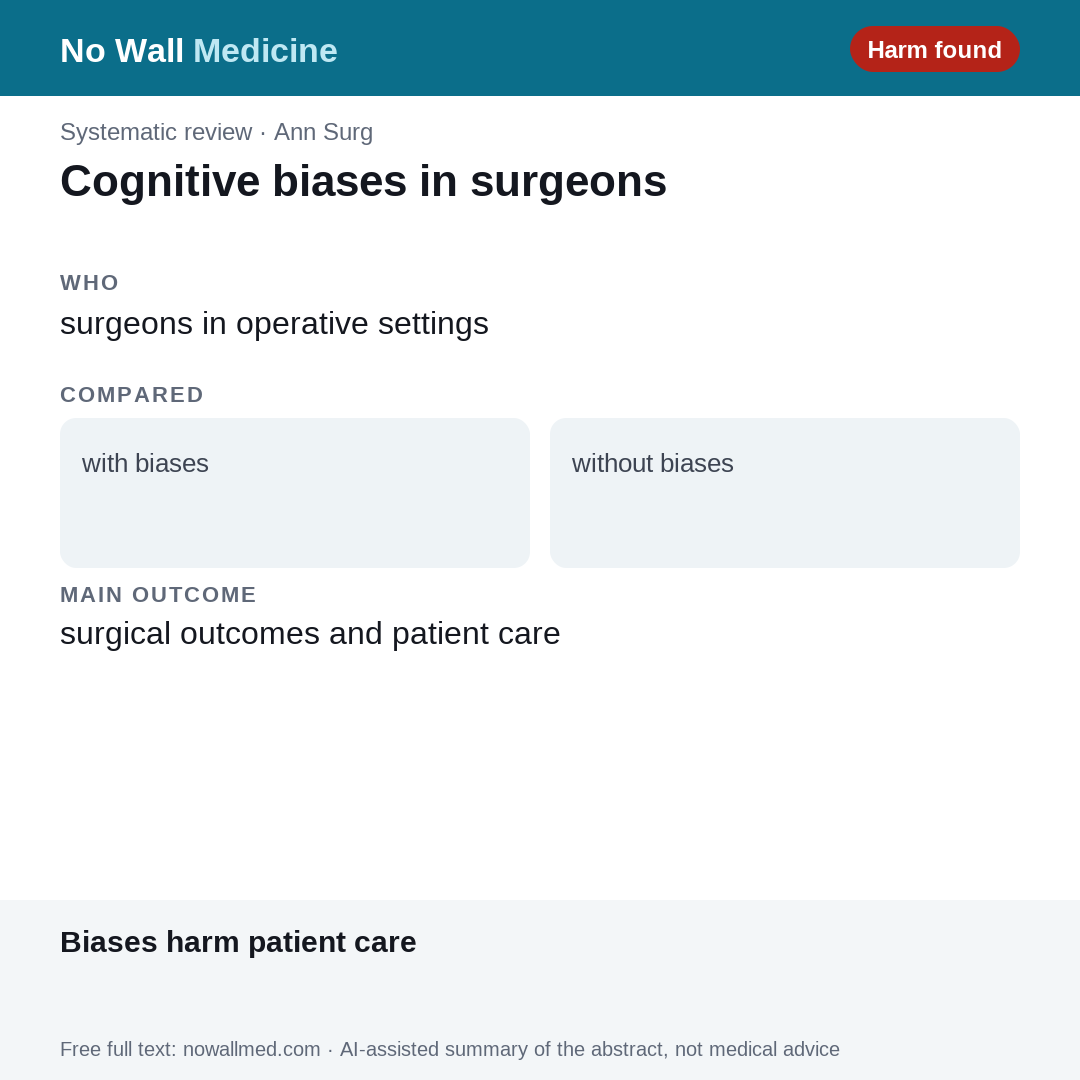
Cognitive biases in surgeons
Who
surgeons in operative settings
Compared
with biases
without biases
Main outcome
surgical outcomes and patient care
Bottom line: Biases harm patient care
Limitation: moderate risk of bias
Ann Surg · 2025-04-21Download image
Why it matters: It is unknown how specific cognitive biases and mental shortcuts influence surgical outcomes and patient safety in the operating room.
Key points
- Researchers reviewed 21 papers involving 6 experiments, 5 analyses, and 10 survey studies to identify thinking errors in surgical settings.
- The most common errors identified were confirmation bias, anchoring, risk aversion, and overconfidence bias.
- Six studies reported that these thinking errors had a negative impact on patient care, including one study associating them with fatal outcomes.
Limitation the authors note: The risk of bias was moderate across most included studies.
Headline and key points written with AI from the paper’s abstract, with every number checked against it. Read the paper before relying on them.
Was this summary helpful?
Subject terms
Cite this article
Aylmore H, Agarwal S, Marcus HJ, Pandit AS. Cognitive Biases and Heuristics in Surgical Settings: A Systematic Review. Ann Surg. 2025. doi:10.1097/SLA.0000000000006736
Spotted a mistake? Suggest a correction