Review of technologies for measuring mental effort in surgeons shows varying accuracy and sensitivity
Objective Assessment of Cognitive Workload in Surgery: A Systematic Review
Systematic reviewMixed results
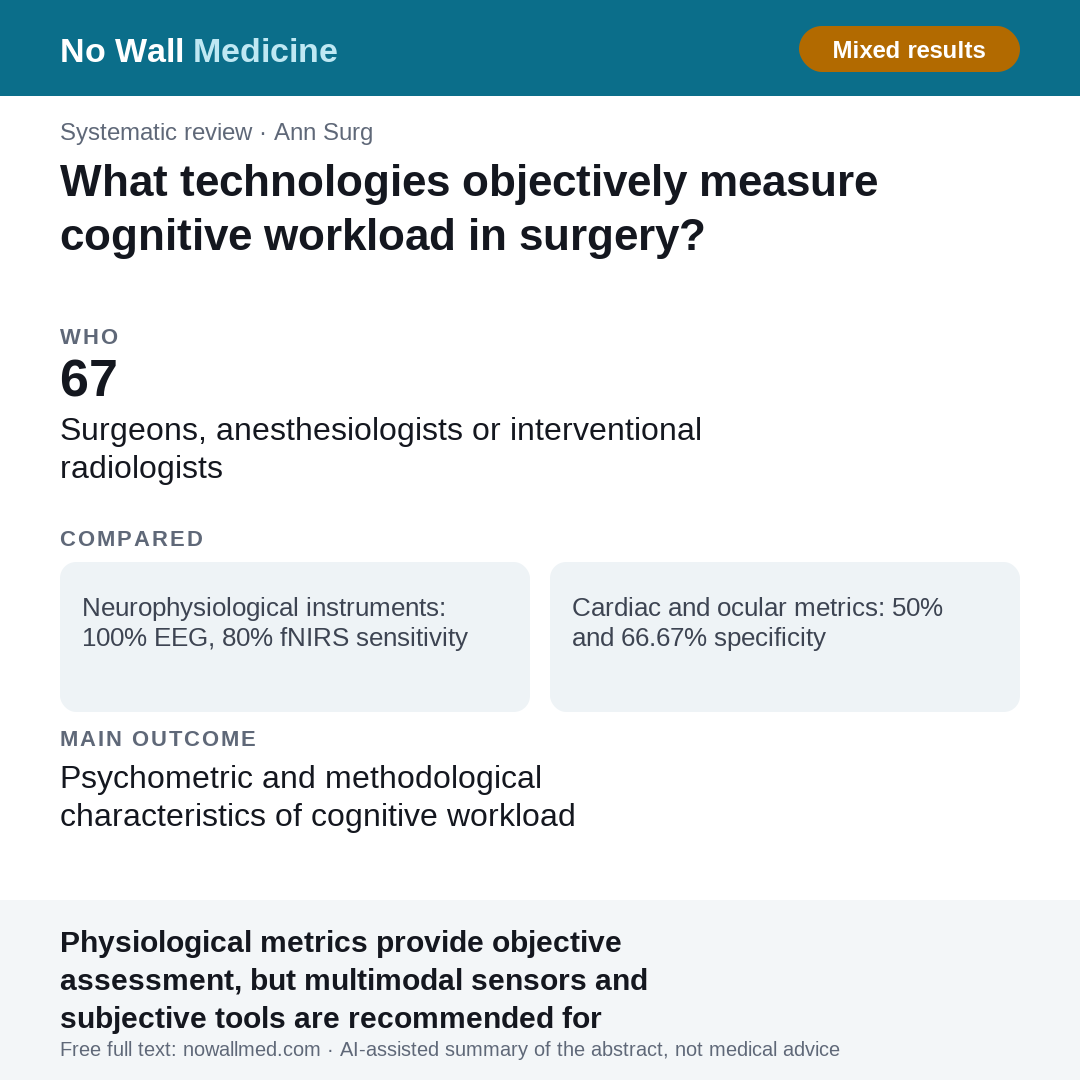
What technologies objectively measure cognitive workload in surgery?
Who
67
Surgeons, anesthesiologists or interventional radiologists
Compared
Neurophysiological instruments: 100% EEG, 80% fNIRS sensitivity
Cardiac and ocular metrics: 50% and 66.67% specificity
Main outcome
Psychometric and methodological characteristics of cognitive workload assessment tools
Bottom line: Physiological metrics provide objective assessment, but multimodal sensors and subjective tools are recommended for cross-validation.
Limitation: Lacking an objective gold standard at present.
Ann Surg · 2024-06-07Download image
Clinical question: What technologies objectively measure cognitive workload in surgery?
Why it matters: It is unknown which technologies provide the most accurate and reliable objective measurements of the mental demand placed on surgical teams.
Key points
- Researchers reviewed 67 studies involving surgeons, anesthesiologists, or interventional radiologists to evaluate tools that objectively measure cognitive workload, which is the mental demand of a task.
- Neurophysiological tools like electroencephalography (brain wave monitoring) showed 100% sensitivity, while cardiac and eye-tracking metrics had suboptimal specificity at 50% and 66.67%.
- Cardiac sensors were the least intrusive, and 54.2% of the studies were conducted in naturalistic clinical environments.
Limitation the authors note: An objective gold standard for measuring cognitive workload is currently lacking.
Headline and key points written with AI from the paper’s abstract, with every number checked against it. Read the paper before relying on them.
Was this summary helpful?
Subject terms
Cite this article
Almukhtar A, Caddick V, Naik R, Goble M, Mylonas G, Darzi A. Objective Assessment of Cognitive Workload in Surgery: A Systematic Review. Ann Surg. 2024. doi:10.1097/SLA.0000000000006370
Spotted a mistake? Suggest a correction
Top studies every Monday
The week’s key trials and guidelines in your specialties, plus any topics you follow. By email, free.
Get the weekly digest