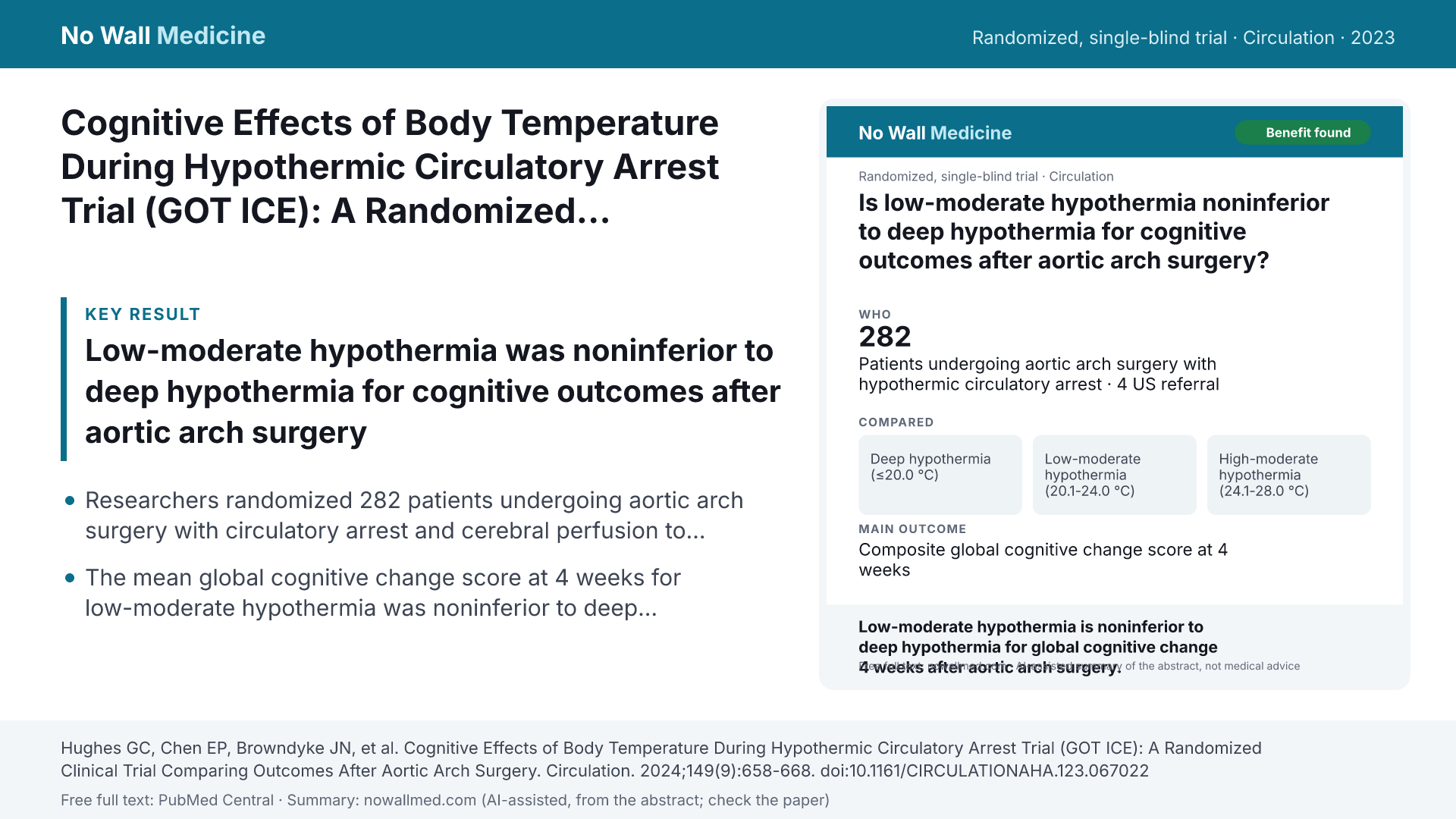
Low-moderate hypothermia was noninferior to deep hypothermia for cognitive outcomes after aortic arch surgery
Cognitive Effects of Body Temperature During Hypothermic Circulatory Arrest Trial (GOT ICE): A Randomized Clinical Trial Comparing Outcomes After Aortic Arch Surgery
Randomized, single-blind trialBenefit found
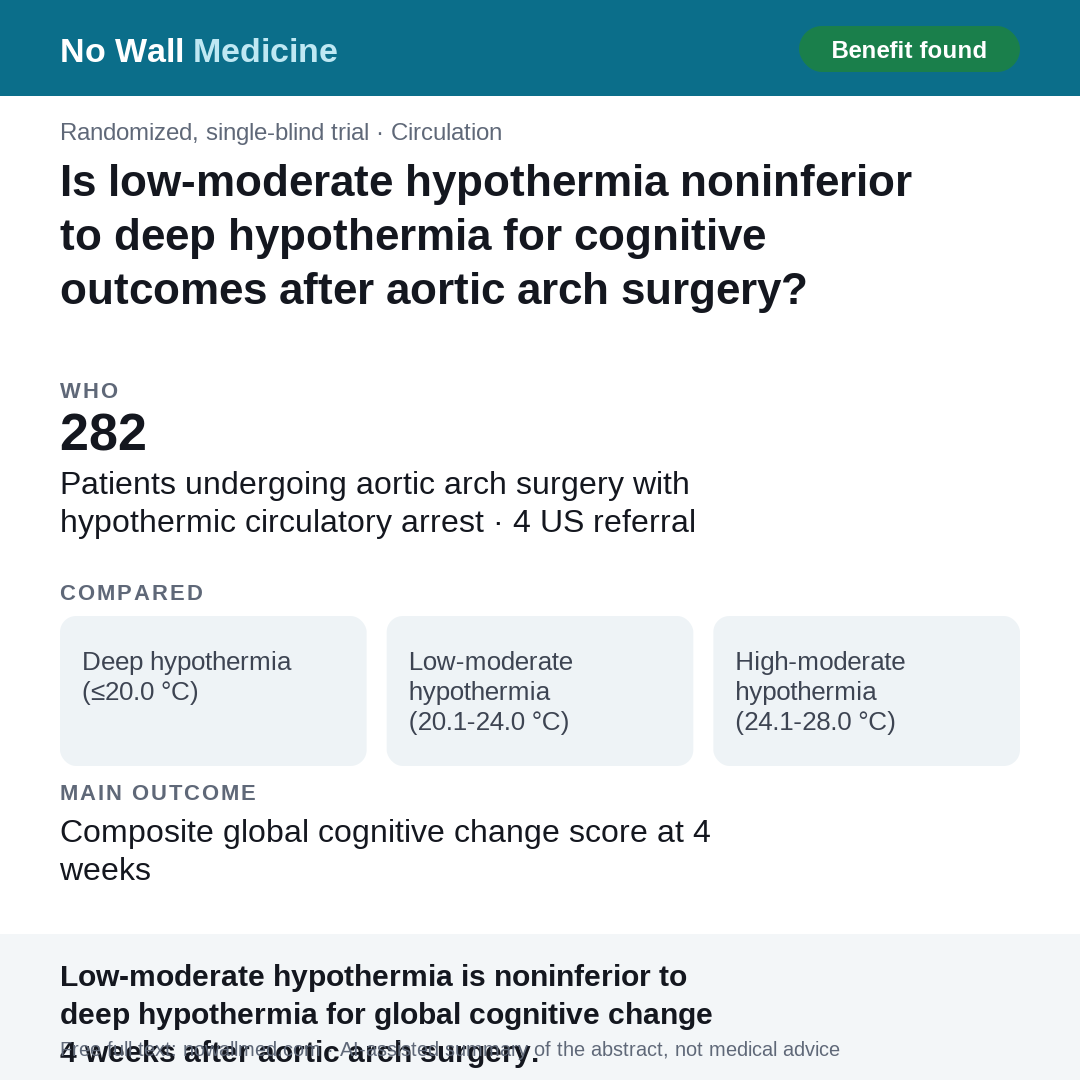
Is low-moderate hypothermia noninferior to deep hypothermia for cognitive outcomes after aortic arch surgery?
Who
282
Patients undergoing aortic arch surgery with hypothermic circulatory arrest · 4 US referral aortic centers
Compared
Deep hypothermia (≤20.0 °C)
Low-moderate hypothermia (20.1-24.0 °C)
High-moderate hypothermia (24.1-28.0 °C)
Main outcome
Composite global cognitive change score at 4 weeks
Bottom line: Low-moderate hypothermia is noninferior to deep hypothermia for global cognitive change 4 weeks after aortic arch surgery.
Limitation: Structured verbal memory was better preserved in the deep group and low-moderate noninferiority was not established.
Circulation · 2023-12-12Download image
Clinical question: Is low-moderate hypothermia noninferior to deep hypothermia for cognitive outcomes after aortic arch surgery?
Why it matters: It was unknown whether moderate hypothermia is as safe as traditional deep hypothermia for preserving cognitive function during aortic arch surgery.
Key points
- Researchers randomized 282 patients undergoing aortic arch surgery with circulatory arrest and cerebral perfusion to deep, low-moderate, or high-moderate hypothermia groups.
- The mean global cognitive change score at 4 weeks for low-moderate hypothermia was noninferior to deep hypothermia, and no significant difference was found between deep and high-moderate groups.
- Patients in all temperature groups showed significant reductions in cerebral gray matter volume, cortical thickness, and regional brain functional connectivity after circulatory arrest.
Headline and key points written with AI from the paper’s abstract, with every number checked against it. Read the paper before relying on them.
Was this summary helpful?
Subject terms
Cite this article
Hughes GC, Chen EP, Browndyke JN, Szeto WY, DiMaio JM, Brinkman WT. Cognitive Effects of Body Temperature During Hypothermic Circulatory Arrest Trial (GOT ICE): A Randomized Clinical Trial Comparing Outcomes After Aortic Arch Surgery. Circulation. 2023. doi:10.1161/CIRCULATIONAHA.123.067022
Spotted a mistake? Suggest a correction