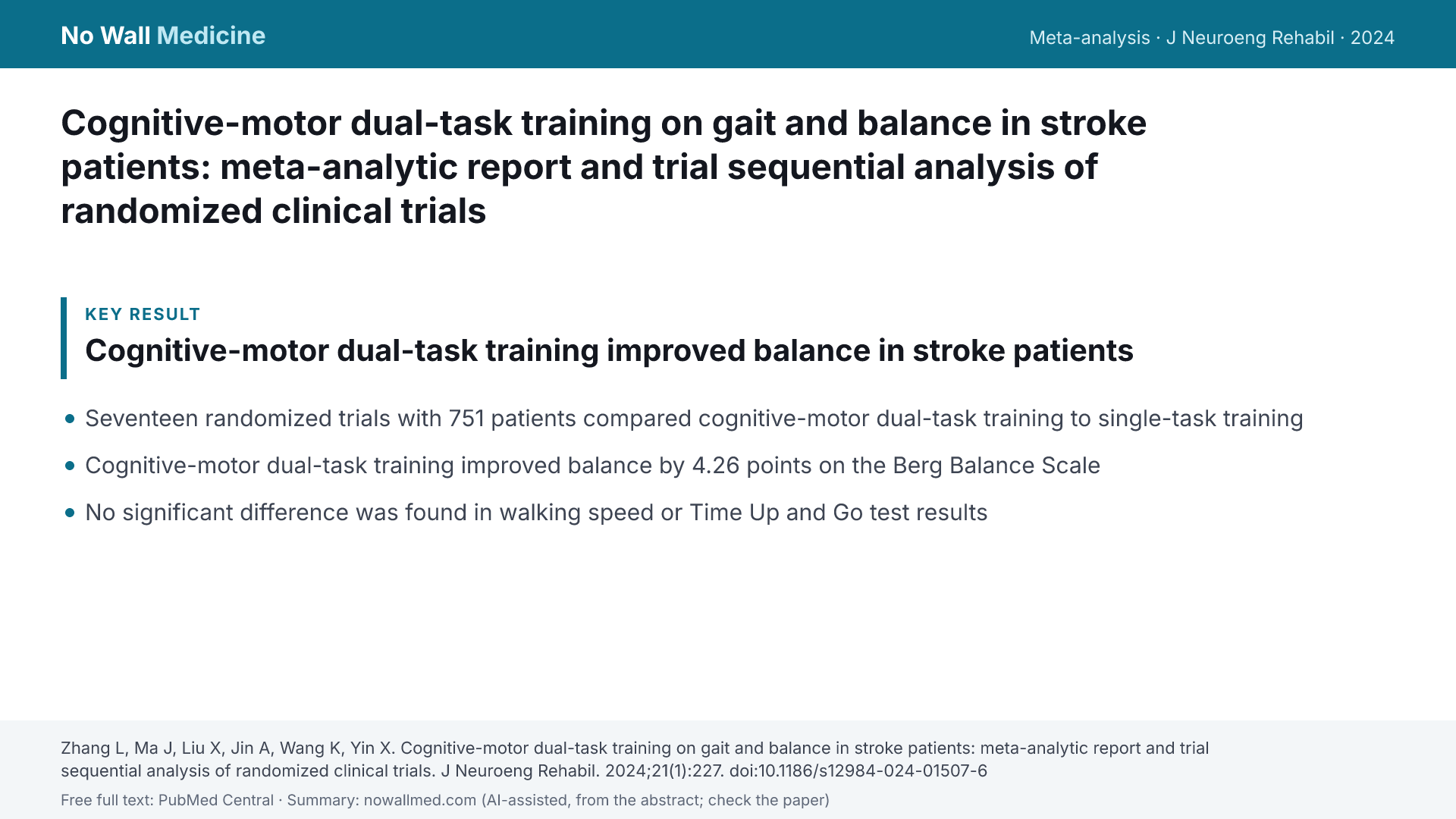
Cognitive-motor dual-task training improved balance in stroke patients
Cognitive-motor dual-task training on gait and balance in stroke patients: meta-analytic report and trial sequential analysis of randomized clinical trials
Why it matters: It was unknown whether cognitive-motor dual-task training is more effective than conventional single-task training for stroke patients
Key points
- Seventeen randomized trials with 751 patients compared cognitive-motor dual-task training to single-task training.
- Cognitive-motor dual-task training improved balance by 4.26 points on the Berg Balance Scale.
- No significant difference was found in walking speed or Time Up and Go test results.
Limitation the authors note: The findings had low certainty due to heterogeneity and potential biases, and larger sample sizes are required to confirm the results
Headline and key points written with AI from the paper’s abstract, with every number checked against it. Read the paper before relying on them.
Was this summary helpful?
Subject terms
Cite this article
Zhang L, Ma J, Liu X, Jin A, Wang K, Yin X. Cognitive-motor dual-task training on gait and balance in stroke patients: meta-analytic report and trial sequential analysis of randomized clinical trials. J Neuroeng Rehabil. 2024. doi:10.1186/s12984-024-01507-6
Spotted a mistake? Suggest a correction