Neuromuscular electrical stimulation was associated with changes in walking speed and cadence after stroke
Implications of neuromuscular electrical stimulation on gait ability, balance and kinematic parameters after stroke: a systematic review and meta-analysis
Systematic review and meta-analysisBenefit found
Does neuromuscular electrical stimulation improve gait, balance, and kinematics after stroke?
Who
1711
Stroke survivors
Compared
Neuromuscular electrical stimulation
Conventional rehabilitation
Main outcome
Gait assessment through scales or quantitative parameters
Result: Six-Minute Walk Test WMD 14.83 (95% CI 13.55 to 16.11)
Bottom line: Neuromuscular electrical stimulation may improve gait speed, cadence, step length, ankle dorsiflexion, and six-minute walk test distance.
J Neuroeng Rehabil · 2024-09-18Download image
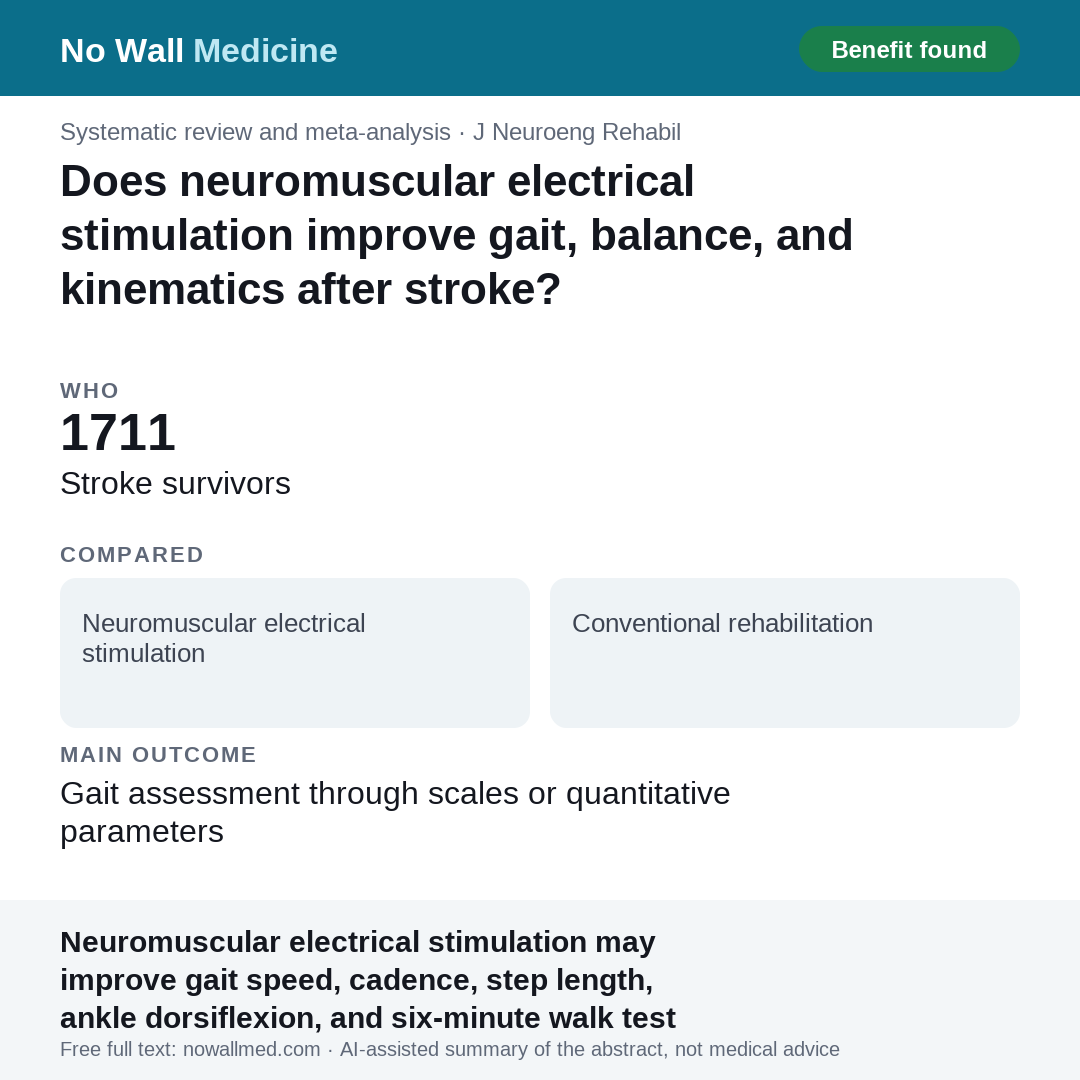
Clinical question: Does neuromuscular electrical stimulation improve gait, balance, and kinematics after stroke?
Why it matters: It is unclear how neuromuscular electrical stimulation affects gait patterns, balance, and movement mechanics in people recovering from a stroke.
Key points
- Researchers analyzed 29 randomized controlled trials involving 1711 stroke survivors comparing neuromuscular electrical stimulation to conventional rehabilitation.
- Neuromuscular electrical stimulation was associated with changes in walking speed (SMD = 0.53), cadence (SMD = 0.76), and Six-Minute Walk Test (WMD = 14.83).
- No significant differences were found between groups for the Ten-meter walk test, Fugl-Meyer assessment lower extremity, Modified Ashworth Assessment, or asymmetry.
Headline and key points written with AI from the paper’s abstract, with every number checked against it. Read the paper before relying on them.
Was this summary helpful?
Subject terms
Cite this article
Chen S, Gao J, Zhou Y, Zheng B, Liu Y, Cao M. Implications of neuromuscular electrical stimulation on gait ability, balance and kinematic parameters after stroke: a systematic review and meta-analysis. J Neuroeng Rehabil. 2024. doi:10.1186/s12984-024-01462-2
Spotted a mistake? Suggest a correction
Top studies every Monday
The week’s key trials and guidelines in your specialties, plus any topics you follow. By email, free.
Get the weekly digest