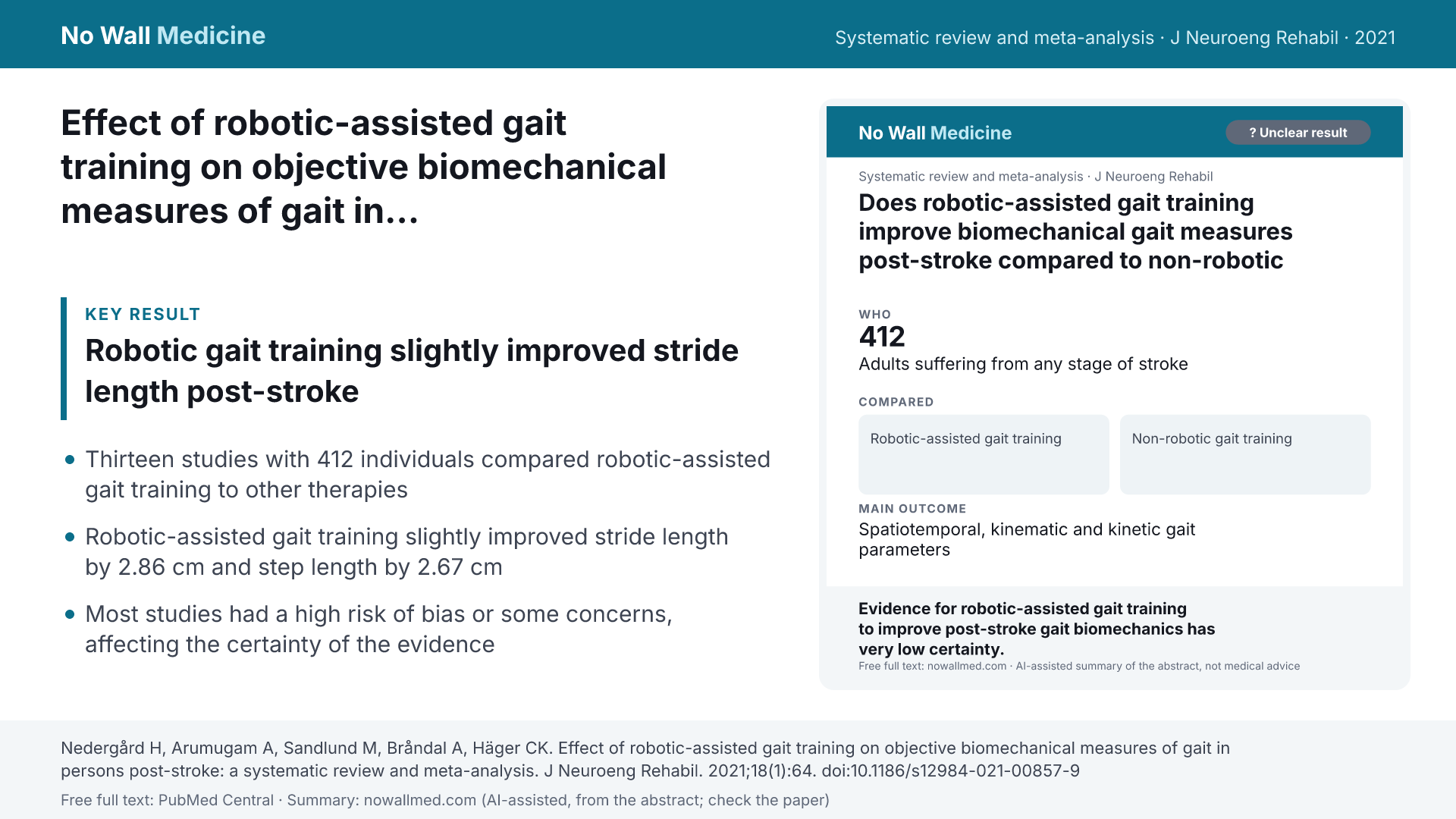
Robotic gait training slightly improved stride length post-stroke
Effect of robotic-assisted gait training on objective biomechanical measures of gait in persons post-stroke: a systematic review and meta-analysis
Systematic review and meta-analysisUnclear result
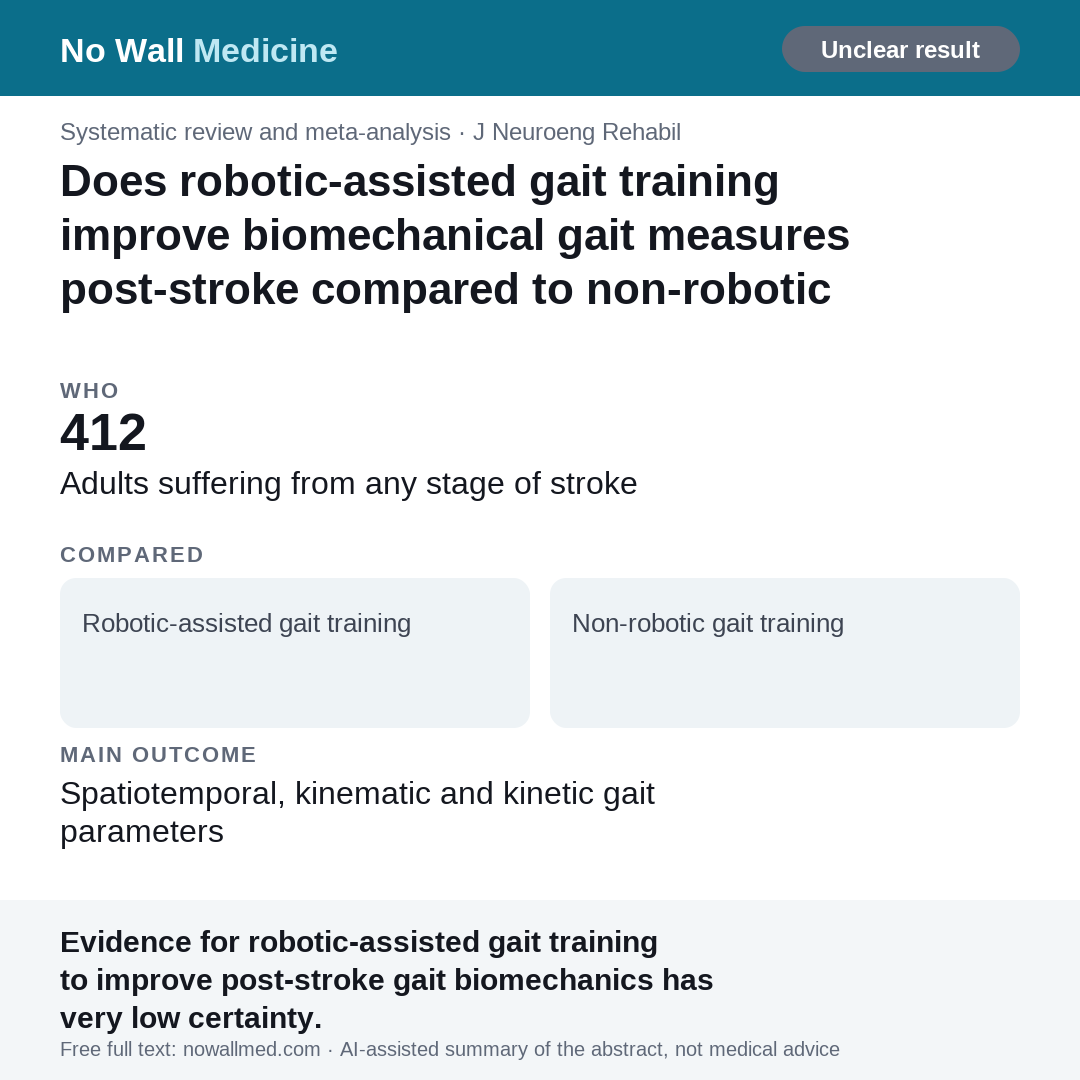
Does robotic-assisted gait training improve biomechanical gait measures post-stroke compared to non-robotic training?
Who
412
Adults suffering from any stage of stroke
Compared
Robotic-assisted gait training
Non-robotic gait training
Main outcome
Spatiotemporal, kinematic and kinetic gait parameters
Bottom line: Evidence for robotic-assisted gait training to improve post-stroke gait biomechanics has very low certainty.
Limitation: Serious weaknesses in risk of bias, consistency, directness, or precision and no kinetic parameters reported.
J Neuroeng Rehabil · 2021-04-16Download image
Clinical question: Does robotic-assisted gait training improve biomechanical gait measures post-stroke compared to non-robotic training?
Why it matters: The effect of robotic-assisted gait training on gait movement patterns post-stroke was not comprehensively reviewed
Key points
- Thirteen studies with 412 individuals compared robotic-assisted gait training to other therapies.
- Robotic-assisted gait training slightly improved stride length by 2.86 cm and step length by 2.67 cm.
- Most studies had a high risk of bias or some concerns, affecting the certainty of the evidence.
Limitation the authors note: The review found serious weaknesses in almost all domains, including risk of bias, consistency, directness, and precision of the findings
Headline and key points written with AI from the paper’s abstract, with every number checked against it. Read the paper before relying on them.
Was this summary helpful?
Subject terms
Cite this article
Nedergård H, Arumugam A, Sandlund M, Bråndal A, Häger CK. Effect of robotic-assisted gait training on objective biomechanical measures of gait in persons post-stroke: a systematic review and meta-analysis. J Neuroeng Rehabil. 2021. doi:10.1186/s12984-021-00857-9
Spotted a mistake? Suggest a correction