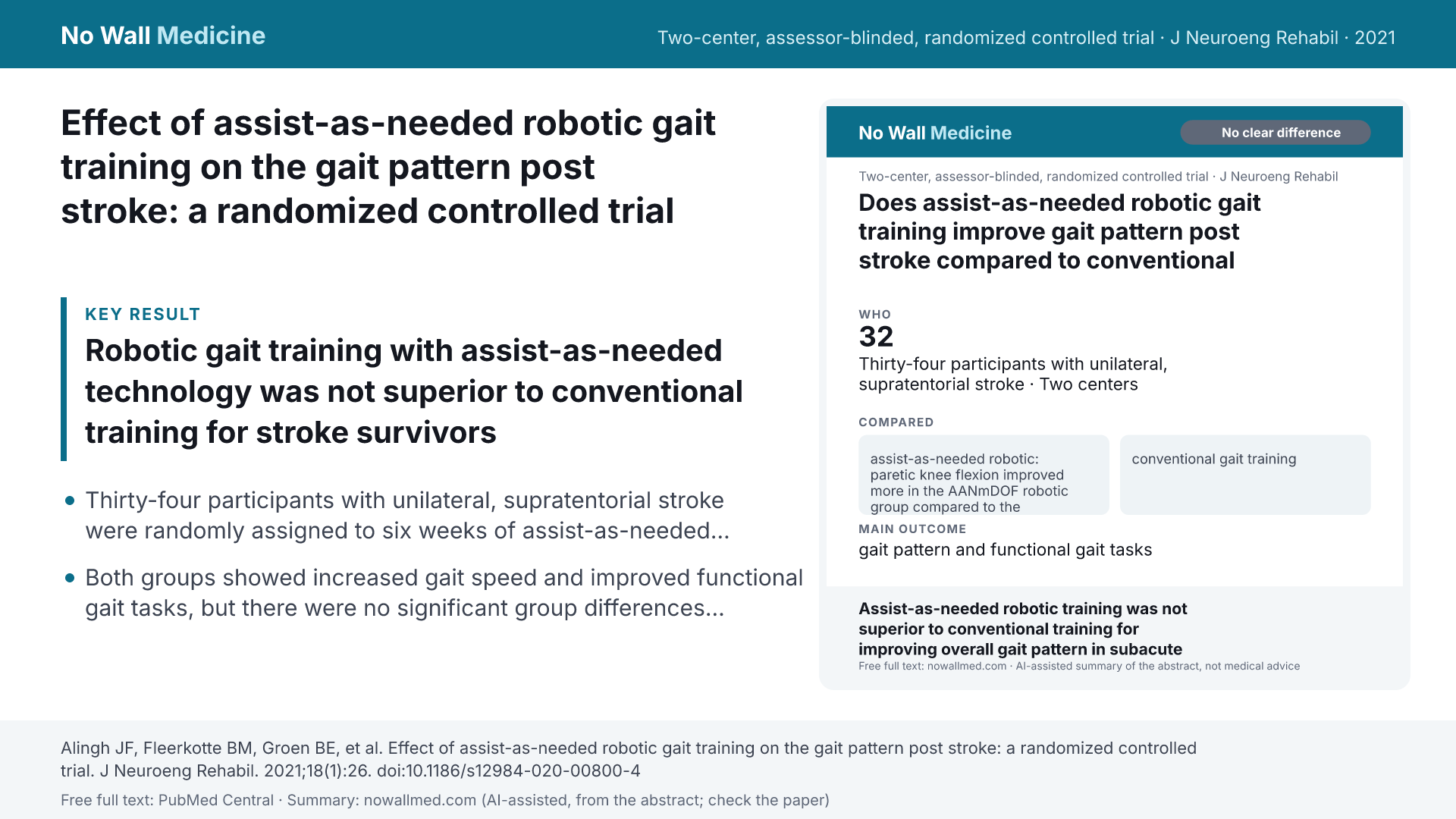
Robotic gait training with assist-as-needed technology was not superior to conventional training for stroke survivors
Effect of assist-as-needed robotic gait training on the gait pattern post stroke: a randomized controlled trial
Two-center, assessor-blinded, randomized controlled trialNo clear difference
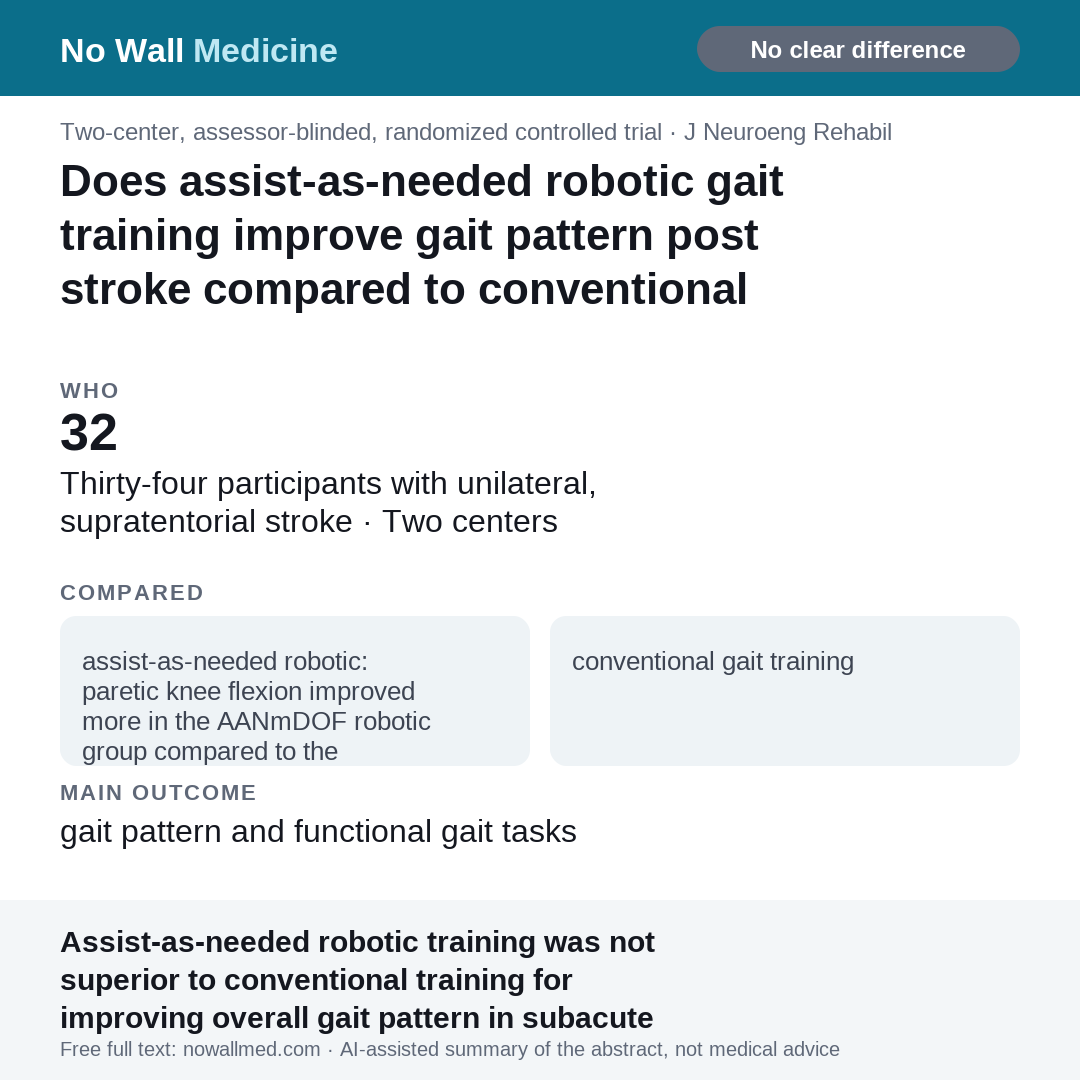
Does assist-as-needed robotic gait training improve gait pattern post stroke compared to conventional training?
Who
32
Thirty-four participants with unilateral, supratentorial stroke · Two centers
Compared
assist-as-needed robotic: paretic knee flexion improved more in the AANmDOF robotic group compared to the conventional group
conventional gait training
Main outcome
gait pattern and functional gait tasks
Bottom line: Assist-as-needed robotic training was not superior to conventional training for improving overall gait pattern in subacute stroke survivors.
J Neuroeng Rehabil · 2021-02-05Download image
Clinical question: Does assist-as-needed robotic gait training improve gait pattern post stroke compared to conventional training?
Why it matters: It was unknown if robots that provide assistance only when needed and offer multiple degrees of freedom are more effective than conventional training for improving gait patterns after a stroke.
Key points
- Thirty-four participants with unilateral, supratentorial stroke were randomly assigned to six weeks of assist-as-needed robotic training or conventional gait training.
- Both groups showed increased gait speed and improved functional gait tasks, but there were no significant group differences for most gait parameters at follow-up.
- In participants with a goal for foot clearance, paretic knee flexion improved more in the robotic group compared to the conventional group from baseline to 4-months.
Headline and key points written with AI from the paper’s abstract, with every number checked against it. Read the paper before relying on them.
Was this summary helpful?
Subject terms
Cite this article
Alingh JF, Fleerkotte BM, Groen BE, et al. Effect of assist-as-needed robotic gait training on the gait pattern post stroke: a randomized controlled trial. J Neuroeng Rehabil. 2021. doi:10.1186/s12984-020-00800-4
Spotted a mistake? Suggest a correction