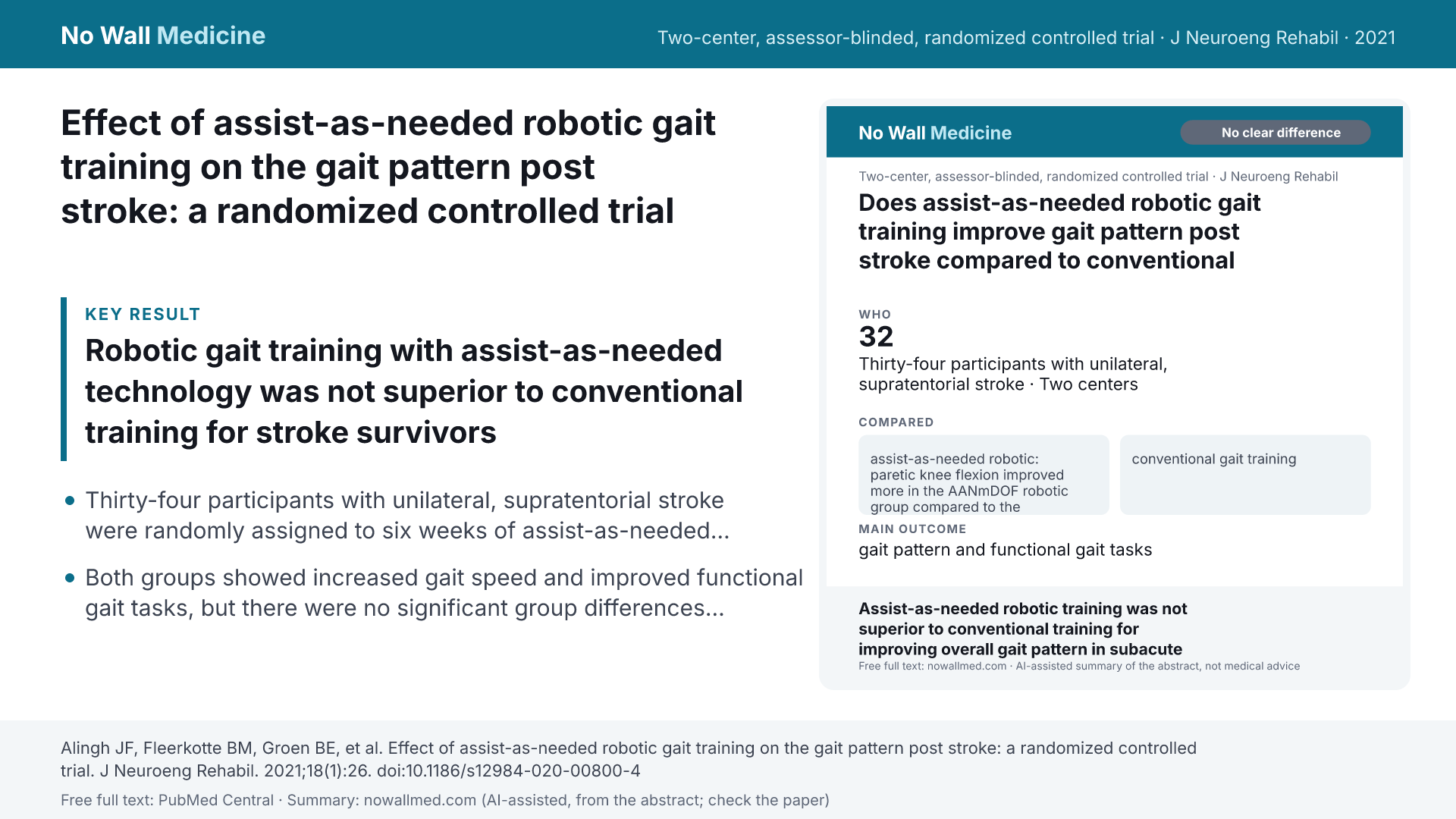
Effect of assist-as-needed robotic gait training on the gait pattern post stroke: a randomized controlled trial
Key result: Robotic gait training with assist-as-needed technology was not superior to conventional training for stroke survivors
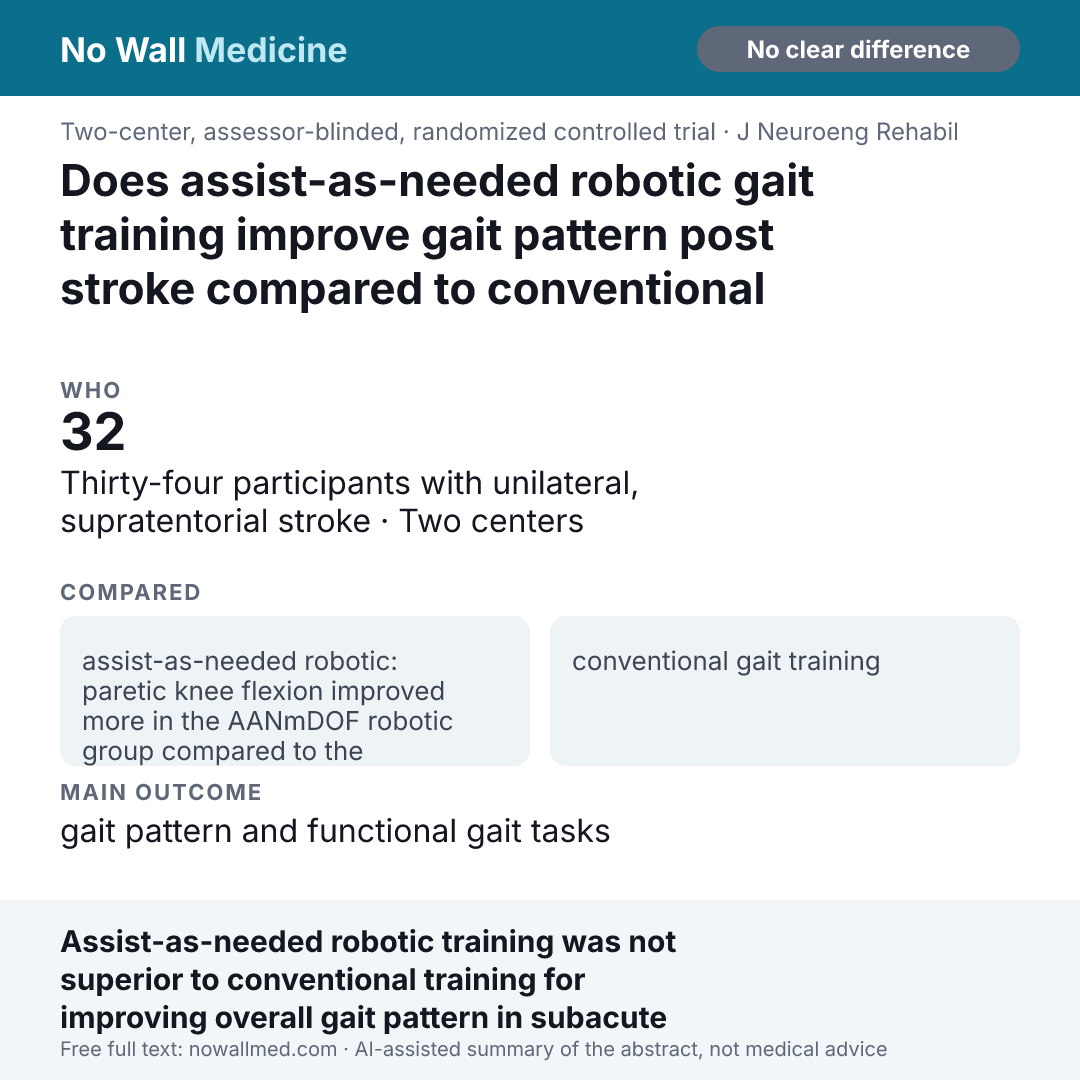
Two-center, assessor-blinded, randomized controlled trialNo clear difference
Does assist-as-needed robotic gait training improve gait pattern post stroke compared to conventional training?
Who
32
Thirty-four participants with unilateral, supratentorial stroke · Two centers
Compared
assist-as-needed robotic: paretic knee flexion improved more in the AANmDOF robotic group compared to the conventional group
conventional gait training
Main outcome
gait pattern and functional gait tasks
Bottom line: Assist-as-needed robotic training was not superior to conventional training for improving overall gait pattern in subacute stroke survivors.
J Neuroeng Rehabil · 2021-02-05 · Save PNG
Key points
- Thirty-four participants with unilateral, supratentorial stroke were randomly assigned to six weeks of assist-as-needed robotic training or conventional gait training.
- Both groups showed increased gait speed and improved functional gait tasks, but there were no significant group differences for most gait parameters at follow-up.
- In participants with a goal for foot clearance, paretic knee flexion improved more in the robotic group compared to the conventional group from baseline to 4-months.
Discussion prompts
- Would these patients look like yours? Who was left out?
- Is the main outcome one that matters to patients?
- Is the difference large enough to change what you do?
Cite: Alingh JF, Fleerkotte BM, Groen BE, et al. Effect of assist-as-needed robotic gait training on the gait pattern post stroke: a randomized controlled trial. J Neuroeng Rehabil. 2021;18(1):26. doi:10.1186/s12984-020-00800-4
Free full text: PubMed Central · Summary and visual abstract: nowallmed.com/a/effect-of-assist-as-needed-robotic-gait-training-on-the-gait-pattern-1msrzuh/ (AI-assisted from the abstract; check the paper before relying on it).