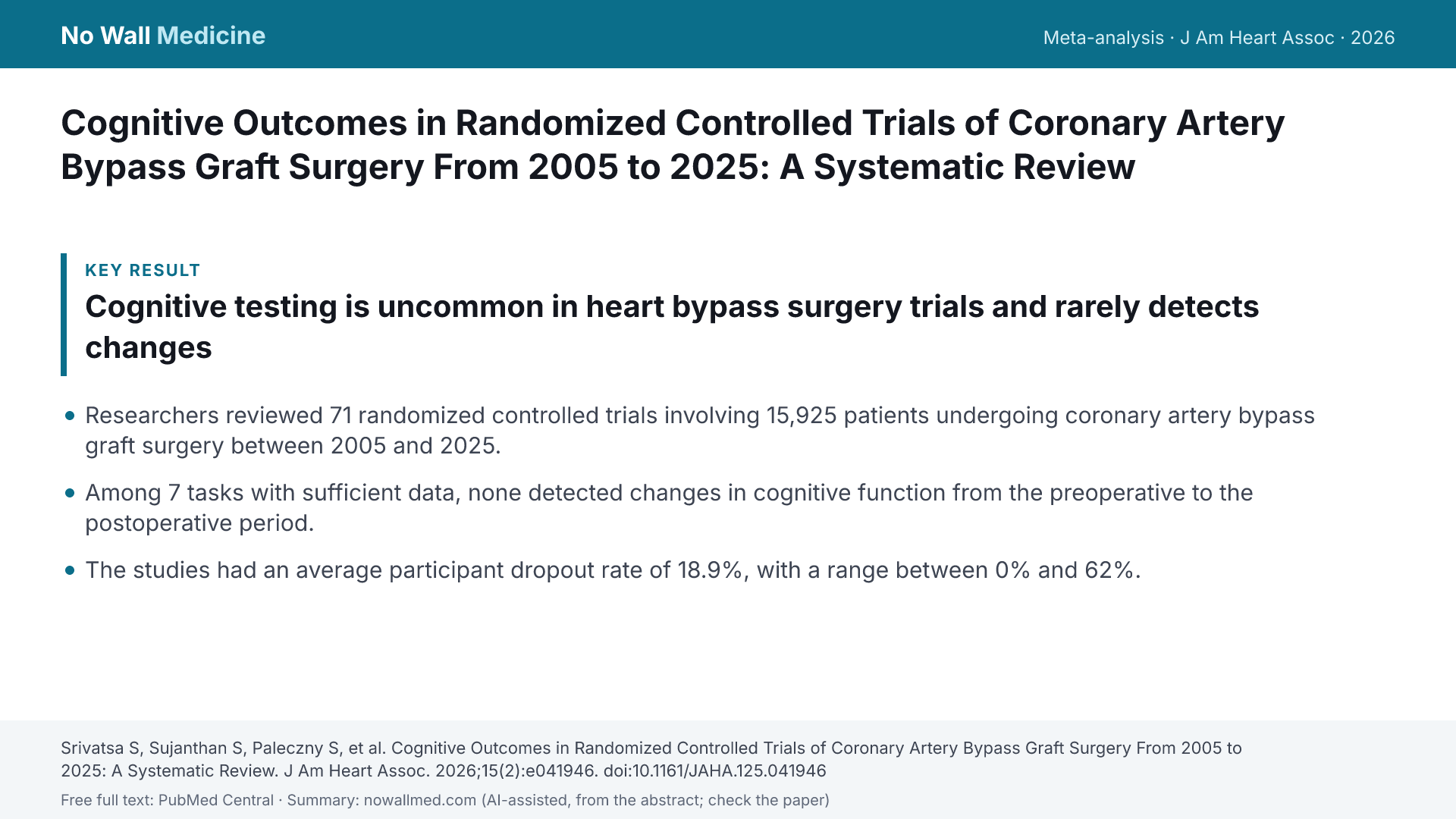
Cognitive testing is uncommon in heart bypass surgery trials and rarely detects changes
Cognitive Outcomes in Randomized Controlled Trials of Coronary Artery Bypass Graft Surgery From 2005 to 2025: A Systematic Review
Why it matters: Cognitive decline after heart bypass surgery is common, but researchers lack information on how trials assess these changes.
Key points
- Researchers reviewed 71 randomized controlled trials involving 15,925 patients undergoing coronary artery bypass graft surgery between 2005 and 2025.
- Among 7 tasks with sufficient data, none detected changes in cognitive function from the preoperative to the postoperative period.
- The studies had an average participant dropout rate of 18.9%, with a range between 0% and 62%.
Limitation the authors note: High attrition rates and heterogeneity among the studies precluded a meta-analysis.
Headline and key points written with AI from the paper’s abstract, with every number checked against it. Read the paper before relying on them.
Was this summary helpful?
Subject terms
Cite this article
Srivatsa S, Sujanthan S, Paleczny S, et al. Cognitive Outcomes in Randomized Controlled Trials of Coronary Artery Bypass Graft Surgery From 2005 to 2025: A Systematic Review. J Am Heart Assoc. 2026. doi:10.1161/JAHA.125.041946
Spotted a mistake? Suggest a correction