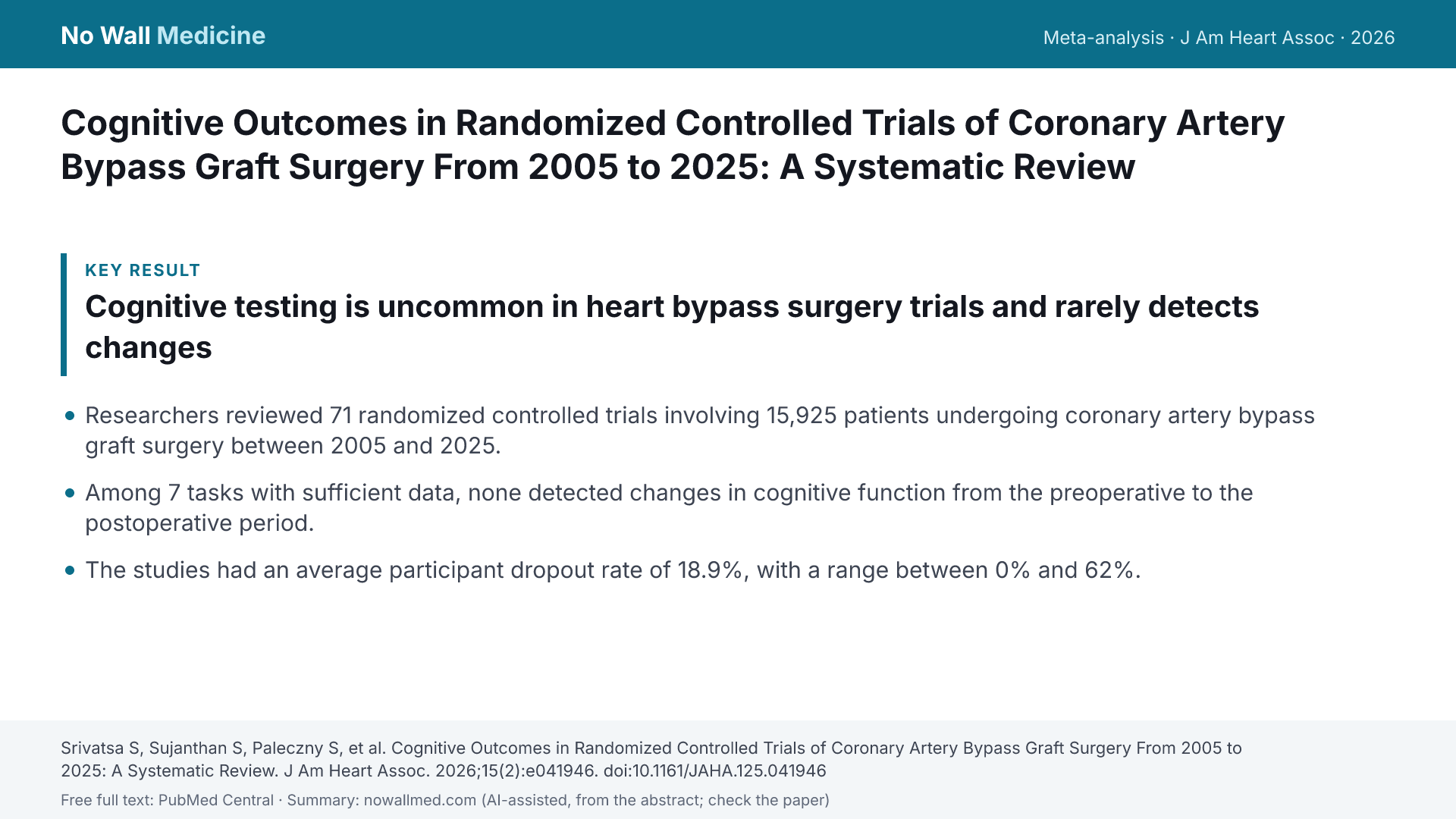
Cognitive Outcomes in Randomized Controlled Trials of Coronary Artery Bypass Graft Surgery From 2005 to 2025: A Systematic Review
Key result: Cognitive testing is uncommon in heart bypass surgery trials and rarely detects changes
Key points
- Researchers reviewed 71 randomized controlled trials involving 15,925 patients undergoing coronary artery bypass graft surgery between 2005 and 2025.
- Among 7 tasks with sufficient data, none detected changes in cognitive function from the preoperative to the postoperative period.
- The studies had an average participant dropout rate of 18.9%, with a range between 0% and 62%.
Why it matters: Cognitive decline after heart bypass surgery is common, but researchers lack information on how trials assess these changes.
Limitation the authors note: High attrition rates and heterogeneity among the studies precluded a meta-analysis.
Discussion prompts
- Would these patients look like yours? Who was left out?
- Is the main outcome one that matters to patients?
- Is the difference large enough to change what you do?
Cite: Srivatsa S, Sujanthan S, Paleczny S, et al. Cognitive Outcomes in Randomized Controlled Trials of Coronary Artery Bypass Graft Surgery From 2005 to 2025: A Systematic Review. J Am Heart Assoc. 2026;15(2):e041946. doi:10.1161/JAHA.125.041946
Free full text: PubMed Central · Summary and visual abstract: nowallmed.com/a/cognitive-outcomes-in-randomized-controlled-trials-of-coronary-artery-1xodnnm/ (AI-assisted from the abstract; check the paper before relying on it).