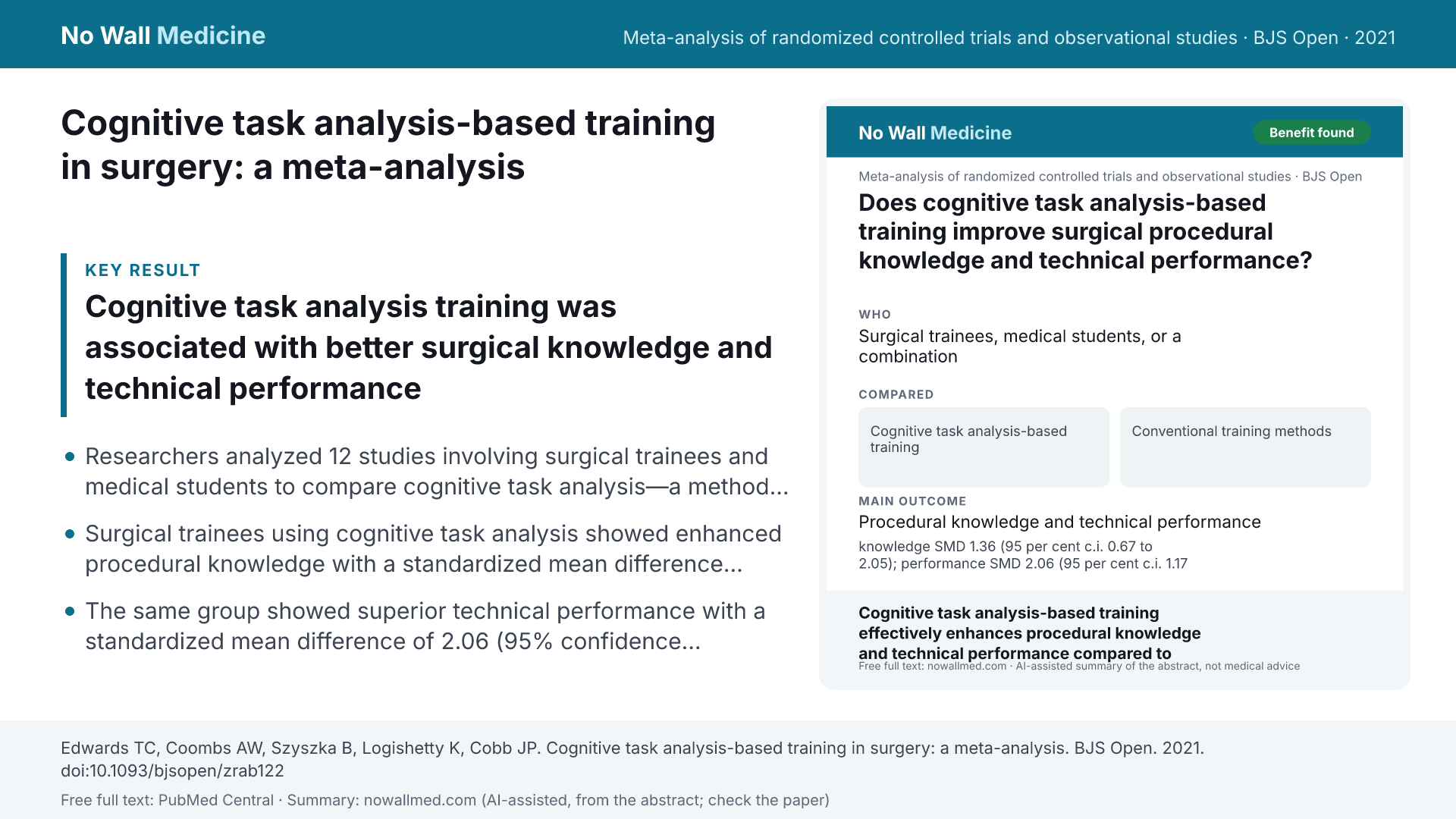
Cognitive task analysis training was associated with better surgical knowledge and technical performance
Cognitive task analysis-based training in surgery: a meta-analysis
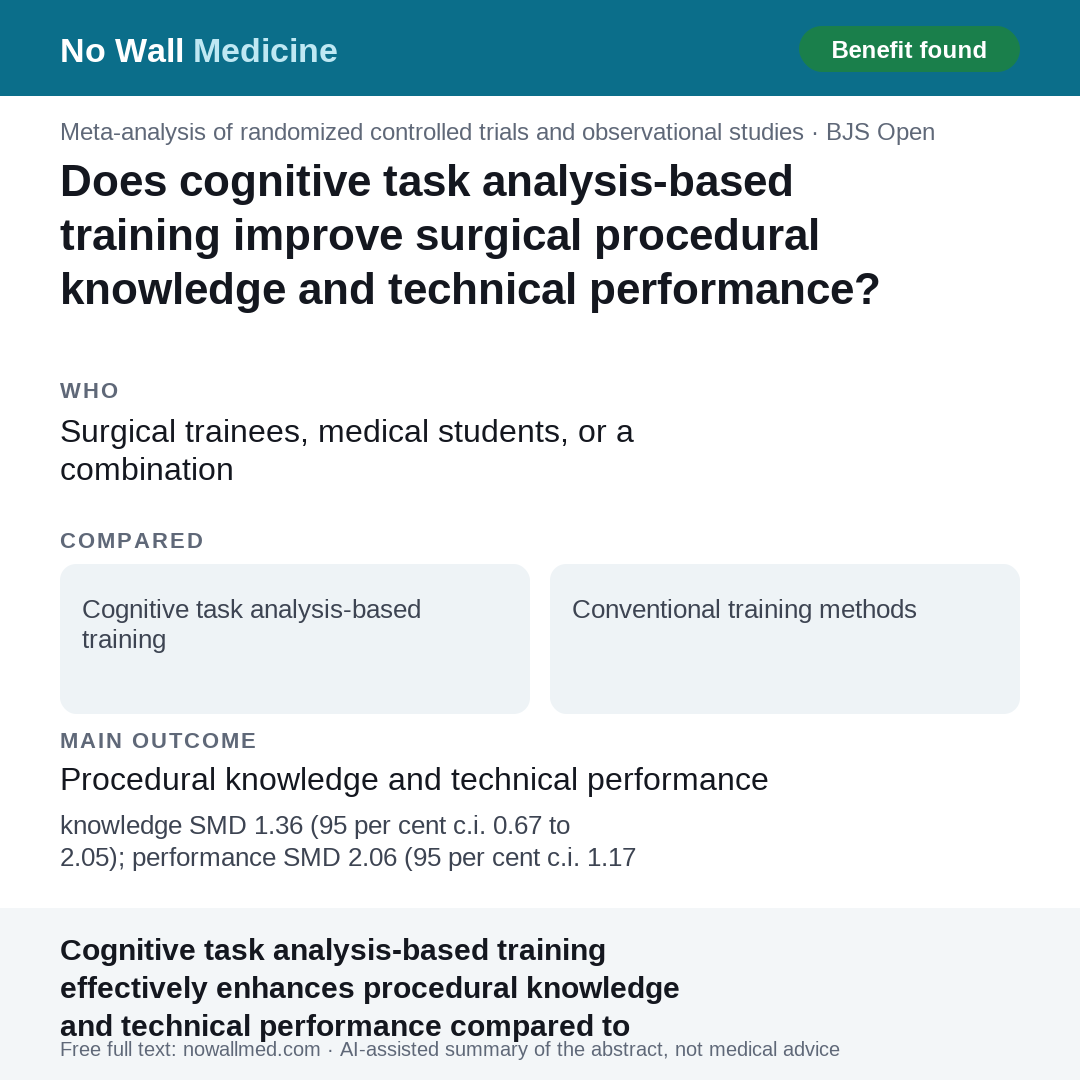
Meta-analysis of randomized controlled trials and observational studiesBenefit found
Does cognitive task analysis-based training improve surgical procedural knowledge and technical performance?
Who
Surgical trainees, medical students, or a combination
Compared
Cognitive task analysis-based training
Conventional training methods
Main outcome
Procedural knowledge and technical performance
Result: knowledge SMD 1.36 (95 per cent c.i. 0.67 to 2.05); performance SMD 2.06 (95 per cent c.i. 1.17 to 2.96)
Bottom line: Cognitive task analysis-based training effectively enhances procedural knowledge and technical performance compared to conventional training methods.
BJS Open · 2021-12-14Download image
Clinical question: Does cognitive task analysis-based training improve surgical procedural knowledge and technical performance?
Why it matters: It is unknown if extracting and teaching the complex thinking processes of experts through cognitive task analysis helps novices acquire surgical skills and knowledge.
Key points
- Researchers analyzed 12 studies involving surgical trainees and medical students to compare cognitive task analysis—a method to teach expert thinking processes—against conventional training.
- Surgical trainees using cognitive task analysis showed enhanced procedural knowledge with a standardized mean difference of 1.36 (95% confidence interval 0.67 to 2.05).
- The same group showed superior technical performance with a standardized mean difference of 2.06 (95% confidence interval 1.17 to 2.96).
Headline and key points written with AI from the paper’s abstract, with every number checked against it. Read the paper before relying on them.
Was this summary helpful?
Subject terms
Cite this article
Edwards TC, Coombs AW, Szyszka B, Logishetty K, Cobb JP. Cognitive task analysis-based training in surgery: a meta-analysis. BJS Open. 2021. doi:10.1093/bjsopen/zrab122
Spotted a mistake? Suggest a correction