Cognitive task analysis-based training in surgery: a meta-analysis
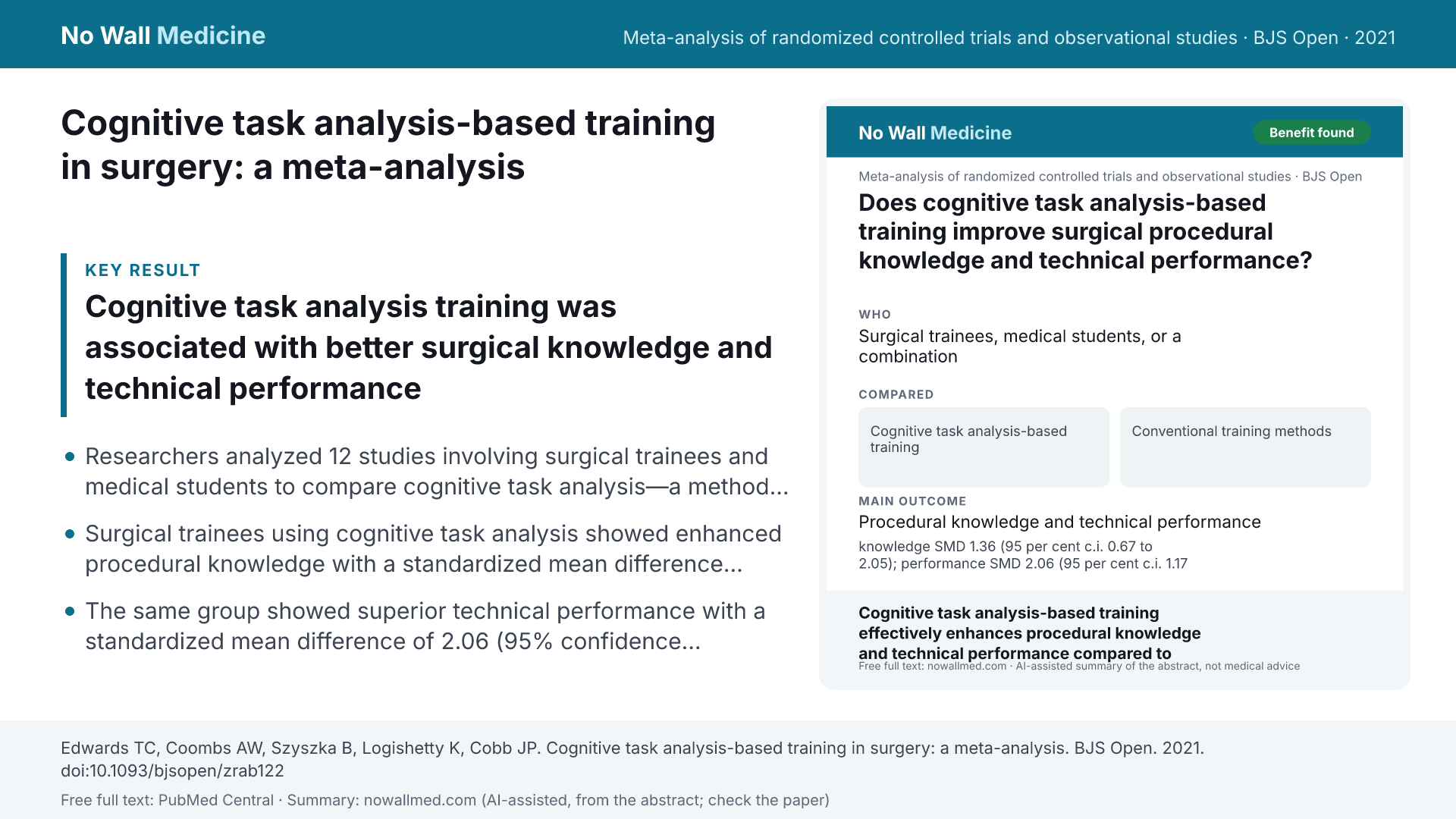
Key result: Cognitive task analysis training was associated with better surgical knowledge and technical performance
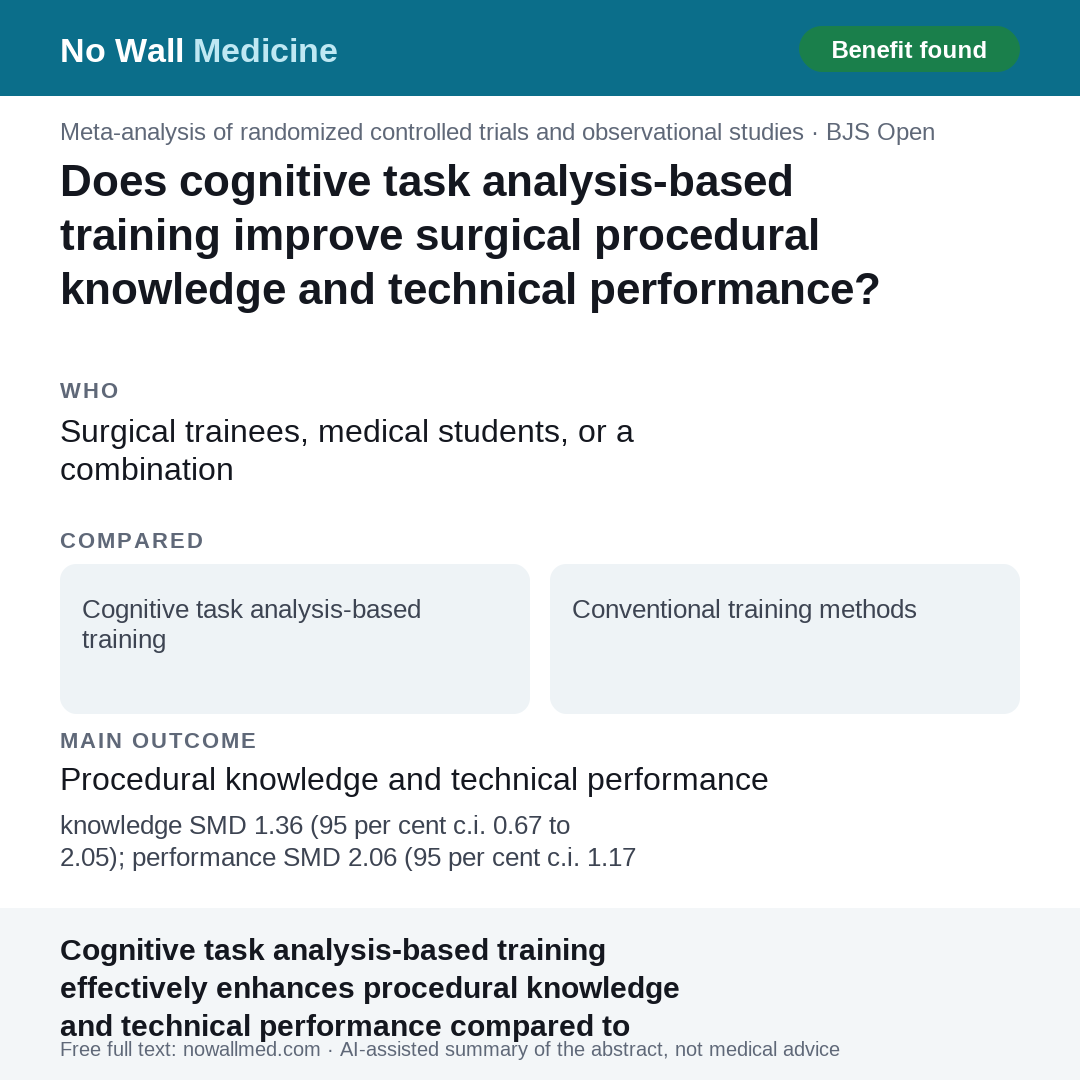
Meta-analysis of randomized controlled trials and observational studiesBenefit found
Does cognitive task analysis-based training improve surgical procedural knowledge and technical performance?
Who
Surgical trainees, medical students, or a combination
Compared
Cognitive task analysis-based training
Conventional training methods
Main outcome
Procedural knowledge and technical performance
Result: knowledge SMD 1.36 (95 per cent c.i. 0.67 to 2.05); performance SMD 2.06 (95 per cent c.i. 1.17 to 2.96)
Bottom line: Cognitive task analysis-based training effectively enhances procedural knowledge and technical performance compared to conventional training methods.
BJS Open · 2021-12-14Download image
Key points
- Researchers analyzed 12 studies involving surgical trainees and medical students to compare cognitive task analysis—a method to teach expert thinking processes—against conventional training.
- Surgical trainees using cognitive task analysis showed enhanced procedural knowledge with a standardized mean difference of 1.36 (95% confidence interval 0.67 to 2.05).
- The same group showed superior technical performance with a standardized mean difference of 2.06 (95% confidence interval 1.17 to 2.96).
Why it matters: It is unknown if extracting and teaching the complex thinking processes of experts through cognitive task analysis helps novices acquire surgical skills and knowledge.
Discussion prompts
- Would these patients look like yours? Who was left out?
- Is the main outcome one that matters to patients?
- Is the difference large enough to change what you do?
Cite: Edwards TC, Coombs AW, Szyszka B, Logishetty K, Cobb JP. Cognitive task analysis-based training in surgery: a meta-analysis. BJS Open. 2021. doi:10.1093/bjsopen/zrab122
Free full text: PubMed Central · Summary and visual abstract: nowallmed.com/a/cognitive-task-analysis-based-training-in-surgery-a-meta-bt5mtg/ (AI-assisted from the abstract; check the paper before relying on it).