Cognitive training for working memory did not change visuospatial processing in very preterm children
Cognitive Training for Visuospatial Processing in Children Aged 5½ to 6 Years Born Very Preterm With Working Memory Dysfunction: A Randomized Clinical Trial
Open-label randomized clinical trialNo clear difference
Does cognitive working memory training improve visuospatial processing in very preterm children?
Who
169
Very preterm children aged 5½ to 6 years with working memory impairment · 18 French university hospitals
Compared
Working memory cognitive training: not different
Standard care management: not different
Main outcome
Visuospatial index score from Wechsler Preschool and Primary Scale of Intelligence
Result: difference, 0.1 points; 95% CI, -5.4 to 5.1 points
Bottom line: Cognitive working memory training had no lasting effect on visuospatial processing in very preterm children.
JAMA Netw Open · 2023-09-05Download image
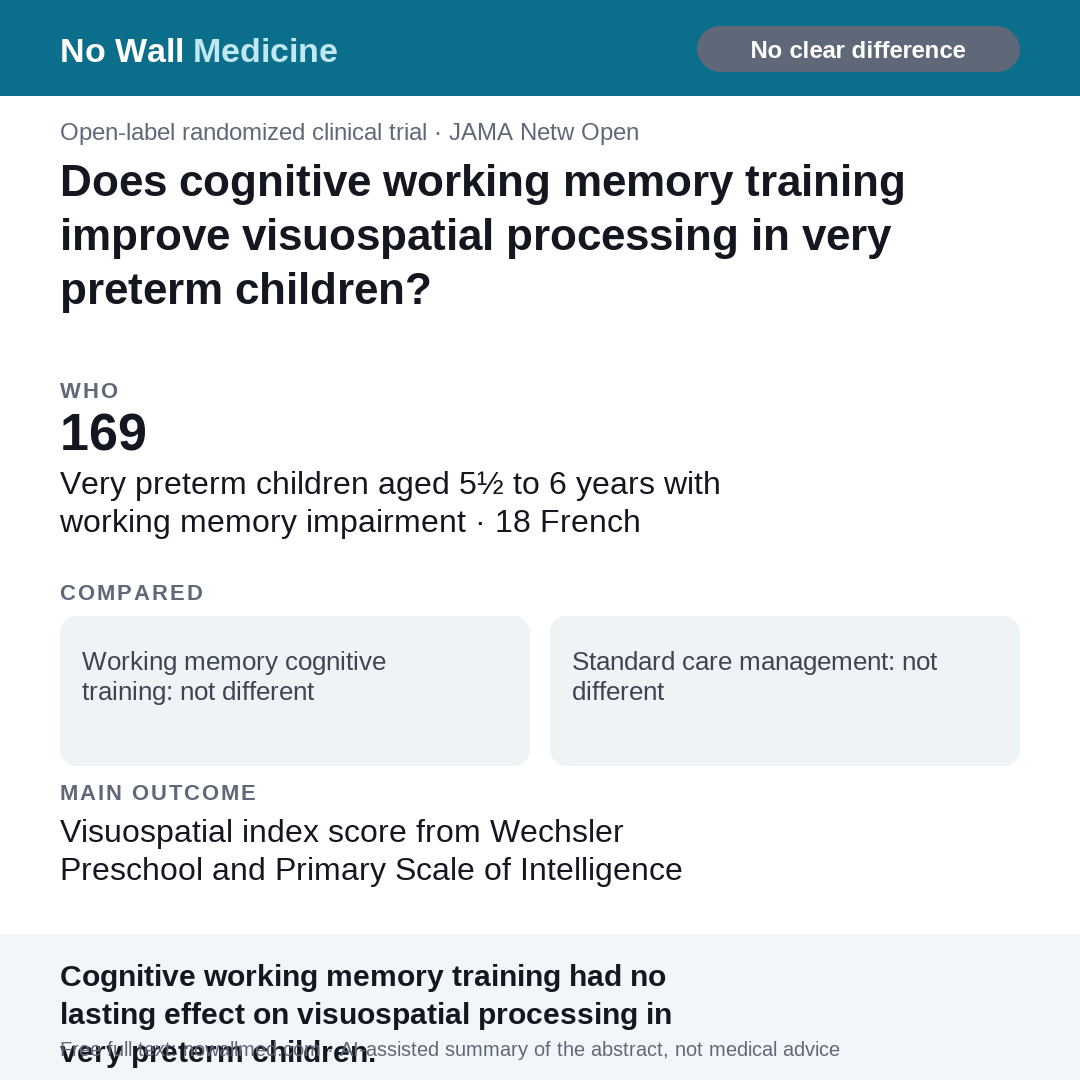
Clinical question: Does cognitive working memory training improve visuospatial processing in very preterm children?
Why it matters: It was unknown if computerized working memory training could improve visuospatial processing in very preterm children by utilizing neuroplasticity.
Key points
- The study randomized 169 children born between 24 and 34 weeks' gestation to either 8 weeks of computerized cognitive training or standard care.
- The visuospatial index score showed no difference between groups at 3.0 months (difference, -0.6 points) or 12.9 months (difference, 0.1 points).
- Working memory index scores in the training group improved from baseline at the intermediate assessment, but this improvement was not maintained at the final assessment.
Headline and key points written with AI from the paper’s abstract, with every number checked against it. Read the paper before relying on them.
Was this summary helpful?
Subject terms
Cite this article
Gire C, Beltran Anzola A, Marret S, Foix L'Hélias L, Roze JC, Granier M. Cognitive Training for Visuospatial Processing in Children Aged 5½ to 6 Years Born Very Preterm With Working Memory Dysfunction: A Randomized Clinical Trial. JAMA Netw Open. 2023. doi:10.1001/jamanetworkopen.2023.31988
Spotted a mistake? Suggest a correction
Top studies every Monday
The week’s key trials and guidelines in your specialties, plus any topics you follow. By email, free.
Get the weekly digest