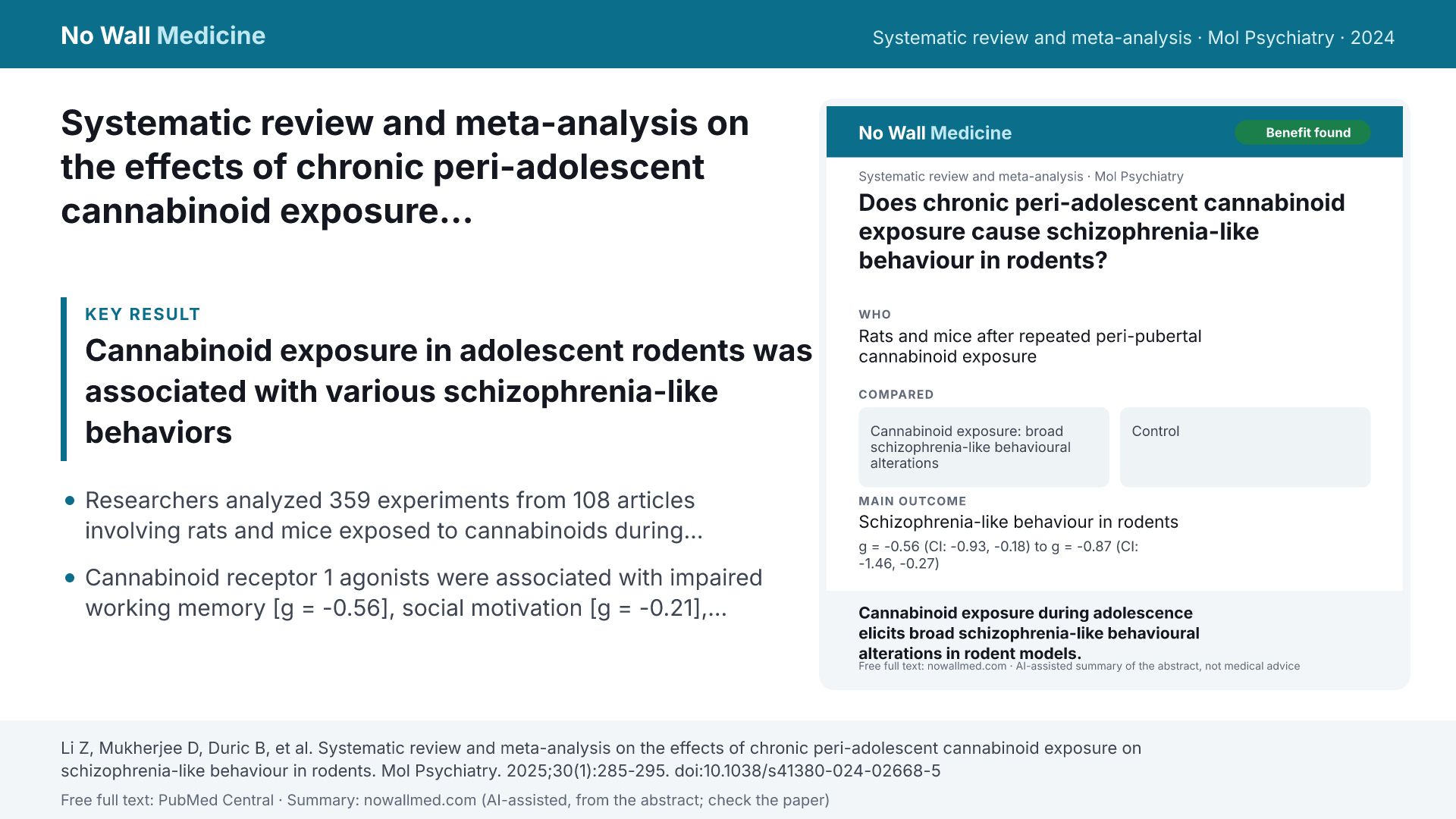
Cannabinoid exposure in adolescent rodents was associated with various schizophrenia-like behaviors
Systematic review and meta-analysis on the effects of chronic peri-adolescent cannabinoid exposure on schizophrenia-like behaviour in rodents
Systematic review and meta-analysisBenefit found
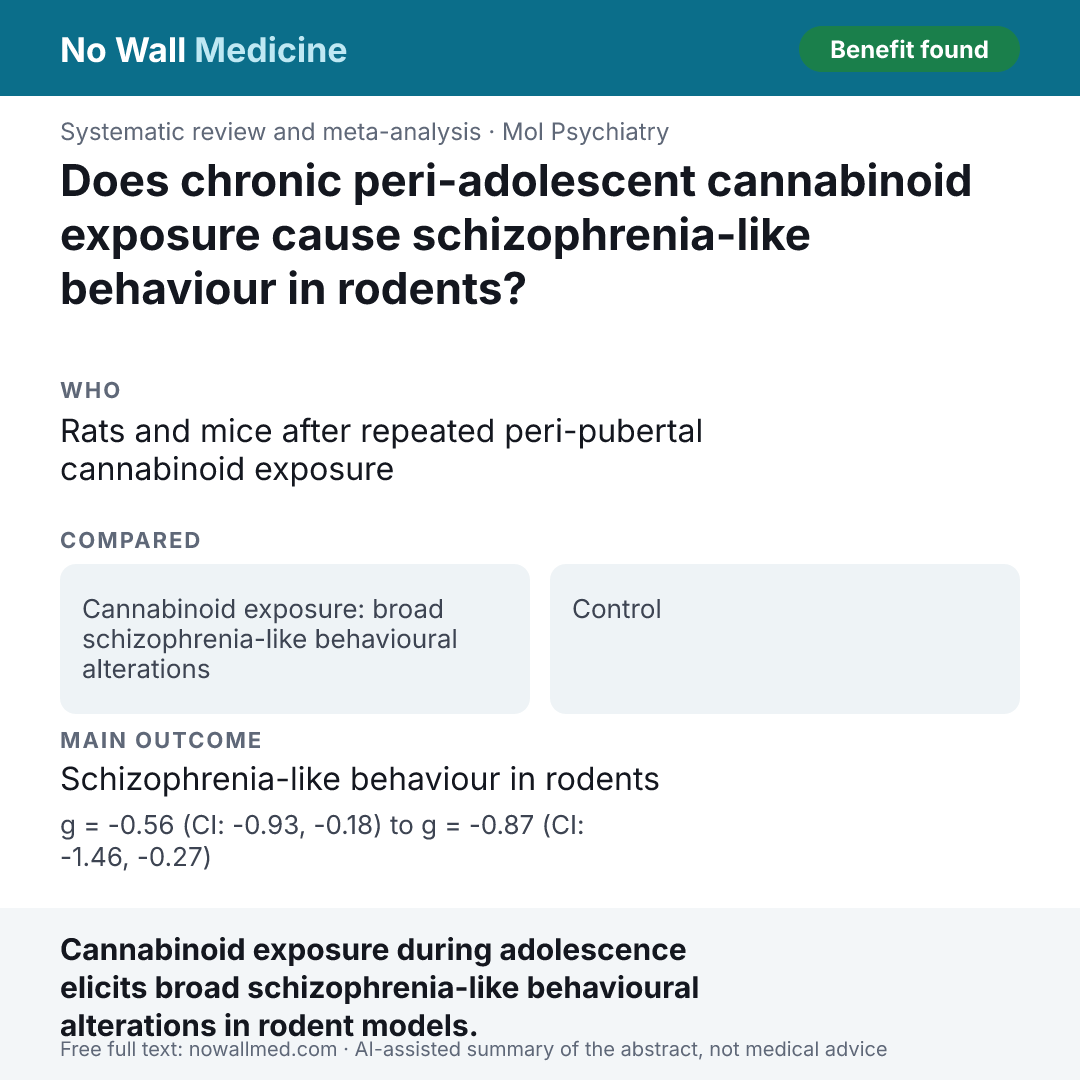
Does chronic peri-adolescent cannabinoid exposure cause schizophrenia-like behaviour in rodents?
Who
Rats and mice after repeated peri-pubertal cannabinoid exposure
Compared
Cannabinoid exposure: broad schizophrenia-like behavioural alterations
Control
Main outcome
Schizophrenia-like behaviour in rodents
Result: g = -0.56 (CI: -0.93, -0.18) to g = -0.87 (CI: -1.46, -0.27)
Bottom line: Cannabinoid exposure during adolescence elicits broad schizophrenia-like behavioural alterations in rodent models.
Limitation: Substantial variance in protocols and moderate-to-high heterogeneity in behavioural outcomes.
Mol Psychiatry · 2024-08-02 · Save PNG
Clinical question: Does chronic peri-adolescent cannabinoid exposure cause schizophrenia-like behaviour in rodents?
Why it matters: The association between adolescent cannabis use and schizophrenia is well-established in humans, but the link in rodent models remains less clear.
Key points
- Researchers analyzed 359 experiments from 108 articles involving rats and mice exposed to cannabinoids during the peri-pubertal period.
- Cannabinoid receptor 1 agonists were associated with impaired working memory [g = -0.56], social motivation [g = -0.21], and sucrose preference [g = -0.87].
- The effects were similar across different species and sexes, though effects on novelty-induced locomotion were negligible.
Limitation the authors note: The researchers observed substantial variance in protocols and moderate-to-high heterogeneity in behavioral outcomes.
Headline and key points written with AI from the paper’s abstract, with every number checked against it. Read the paper before relying on them.
Was this summary helpful?
Subject terms
Headline, design, result, key points, caveat and citation as plain text.
Cite this article
Li Z, Mukherjee D, Duric B, et al. Systematic review and meta-analysis on the effects of chronic peri-adolescent cannabinoid exposure on schizophrenia-like behaviour in rodents. Mol Psychiatry. 2025;30(1):285-295. doi:10.1038/s41380-024-02668-5
Spotted a mistake? Suggest a correction