Patients with treatment-resistant schizophrenia show cognitive differences compared to those who respond to medication
Neuropsychological differences between treatment-resistant and treatment-responsive schizophrenia: a meta-analysis
Systematic review and meta-analysisHarm found
Are there neuropsychological differences between treatment-resistant and treatment-responsive schizophrenia?
Who
1864
Patients with treatment-resistant schizophrenia and treatment-responsive controls
Compared
Treatment-resistant schizophrenia
Treatment-responsive controls
Main outcome
Neuropsychological function across five cognitive domains
Result: dl = -0.53; 95% confidence interval (CI) -0.29 to -0.76
Bottom line: Treatment-resistant schizophrenia is associated with small-to-moderate neuropsychological deficits across all measured cognitive domains.
Limitation: Methodological limitations in this emergent field of research have obscured neuropsychological discriminability.
Psychol Med · 2021-11-01Download image
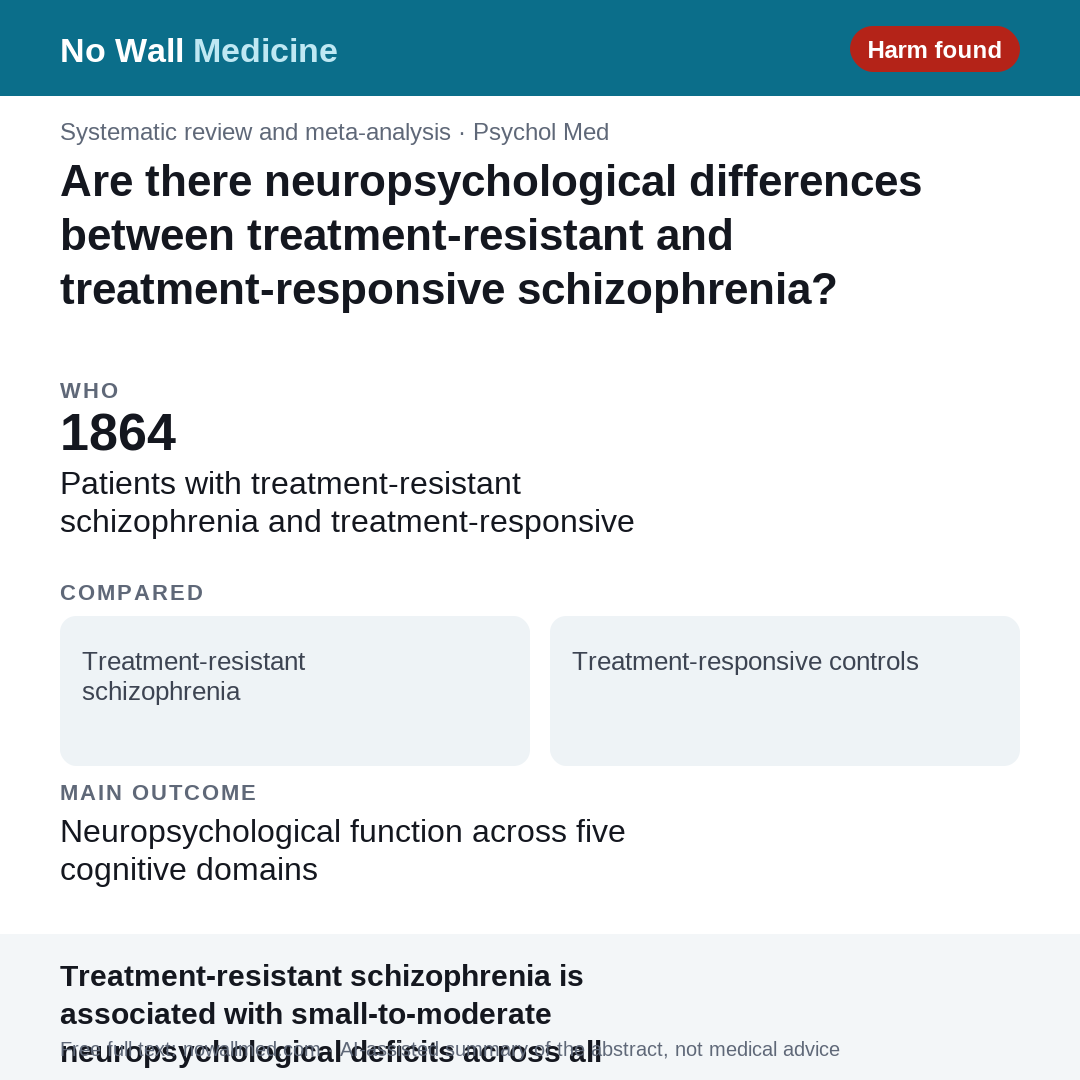
Clinical question: Are there neuropsychological differences between treatment-resistant and treatment-responsive schizophrenia?
Why it matters: Methodological limitations in existing research have obscured whether neuropsychological differences can distinguish treatment-resistant schizophrenia from responsive cases.
Key points
- Researchers analyzed 17 studies involving 1864 participants to compare neuropsychological performance between treatment-resistant schizophrenia and treatment-responsive controls.
- Small-to-moderate effect sizes were found across all cognitive domains, with the largest effect size observed in verbal memory and learning [dl = -0.53; 95% CI -0.29 to -0.76; p < 0.001].
- A sub-analysis of language-related functions showed a comparable effect size [dl = -0.53, 95% CI -0.82 to -0.23; p < 0.001].
Headline and key points written with AI from the paper’s abstract, with every number checked against it. Read the paper before relying on them.
Was this summary helpful?
Subject terms
Cite this article
Millgate E, Hide O, Lawrie SM, Murray RM, MacCabe JH, Kravariti E. Neuropsychological differences between treatment-resistant and treatment-responsive schizophrenia: a meta-analysis. Psychol Med. 2021. doi:10.1017/S0033291721004128
Spotted a mistake? Suggest a correction
Top studies every Monday
The week’s key trials and guidelines in your specialties, plus any topics you follow. By email, free.
Get the weekly digest