Drug targeting mGluR2 receptors increased brain activity during working memory tasks in schizophrenia patients
Effect of mGluR2 positive allosteric modulation on frontostriatal working memory activation in schizophrenia
Double-blind, placebo-controlled, randomized cross-over pilot studyMixed results
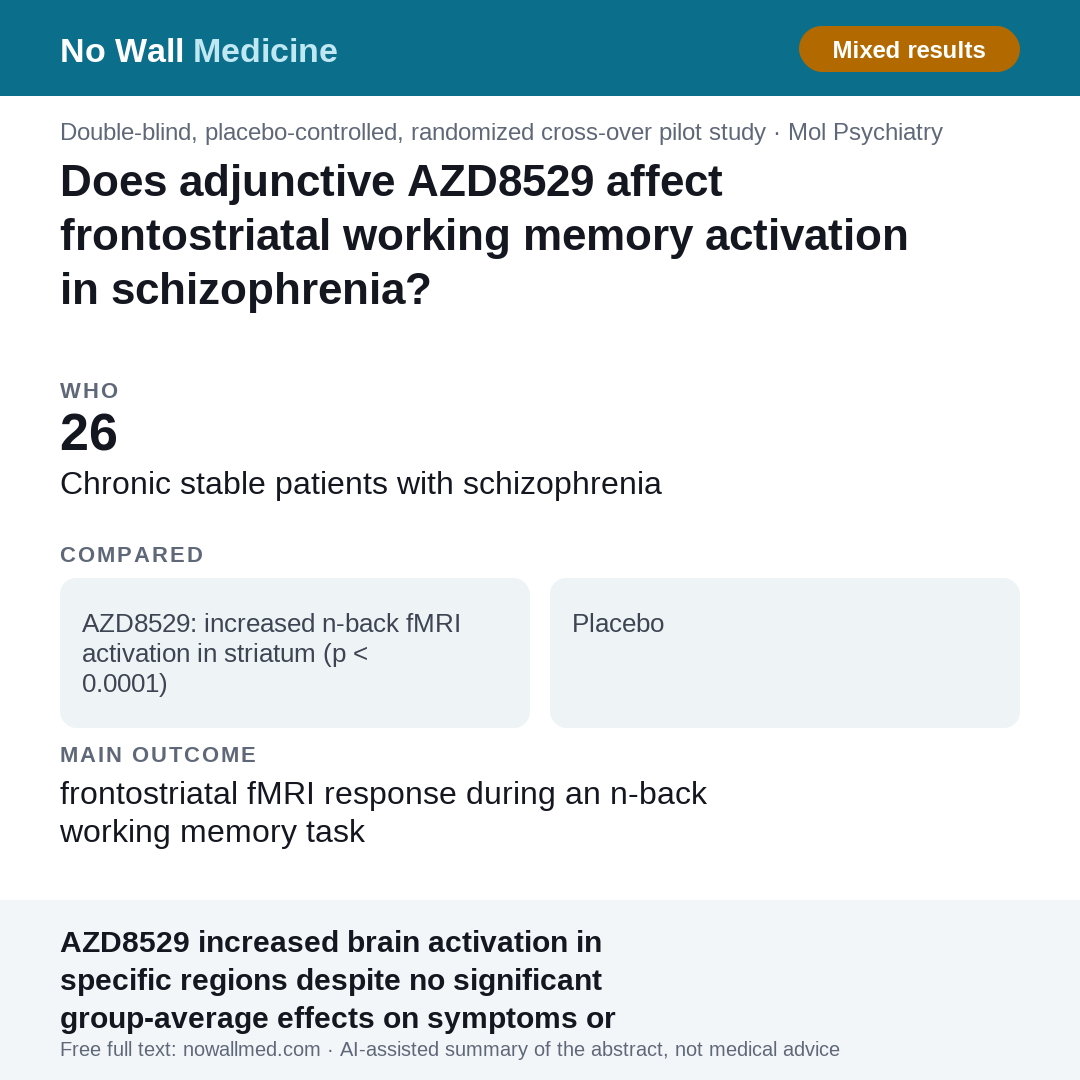
Does adjunctive AZD8529 affect frontostriatal working memory activation in schizophrenia?
Who
26
Chronic stable patients with schizophrenia
Compared
AZD8529: increased n-back fMRI activation in striatum (p < 0.0001)
Placebo
Main outcome
frontostriatal fMRI response during an n-back working memory task
Bottom line: AZD8529 increased brain activation in specific regions despite no significant group-average effects on symptoms or cognitive accuracy.
Limitation: Negative clinical results at the group level
Mol Psychiatry · 2021-10-20Download image
Clinical question: Does adjunctive AZD8529 affect frontostriatal working memory activation in schizophrenia?
Why it matters: The clinical utility of agents that increase NMDA function by targeting mGluR2/3 signaling remains uncertain for treating schizophrenia symptoms.
Key points
- Researchers conducted a randomized, placebo-controlled crossover study of 26 patients with chronic stable schizophrenia using the drug AZD8529.
- AZD8529 did not produce significant group-average effects on symptoms or cognitive accuracy, but increased brain activation in the striatum (p < 0.0001) and anterior cingulate/paracingulate (p = 0.002).
- Greater drug-versus-placebo effects on caudate activation was associated with greater reductions in PANSS negative symptom scores (r = -0.42, p = 0.031).
Headline and key points written with AI from the paper’s abstract, with every number checked against it. Read the paper before relying on them.
Was this summary helpful?
Subject terms
Cite this article
Wolf DH, Zheng D, Kohler C, Turetsky BI, Ruparel K, Satterthwaite TD. Effect of mGluR2 positive allosteric modulation on frontostriatal working memory activation in schizophrenia. Mol Psychiatry. 2021. doi:10.1038/s41380-021-01320-w
Spotted a mistake? Suggest a correction
Top studies every Monday
The week’s key trials and guidelines in your specialties, plus any topics you follow. By email, free.
Get the weekly digest