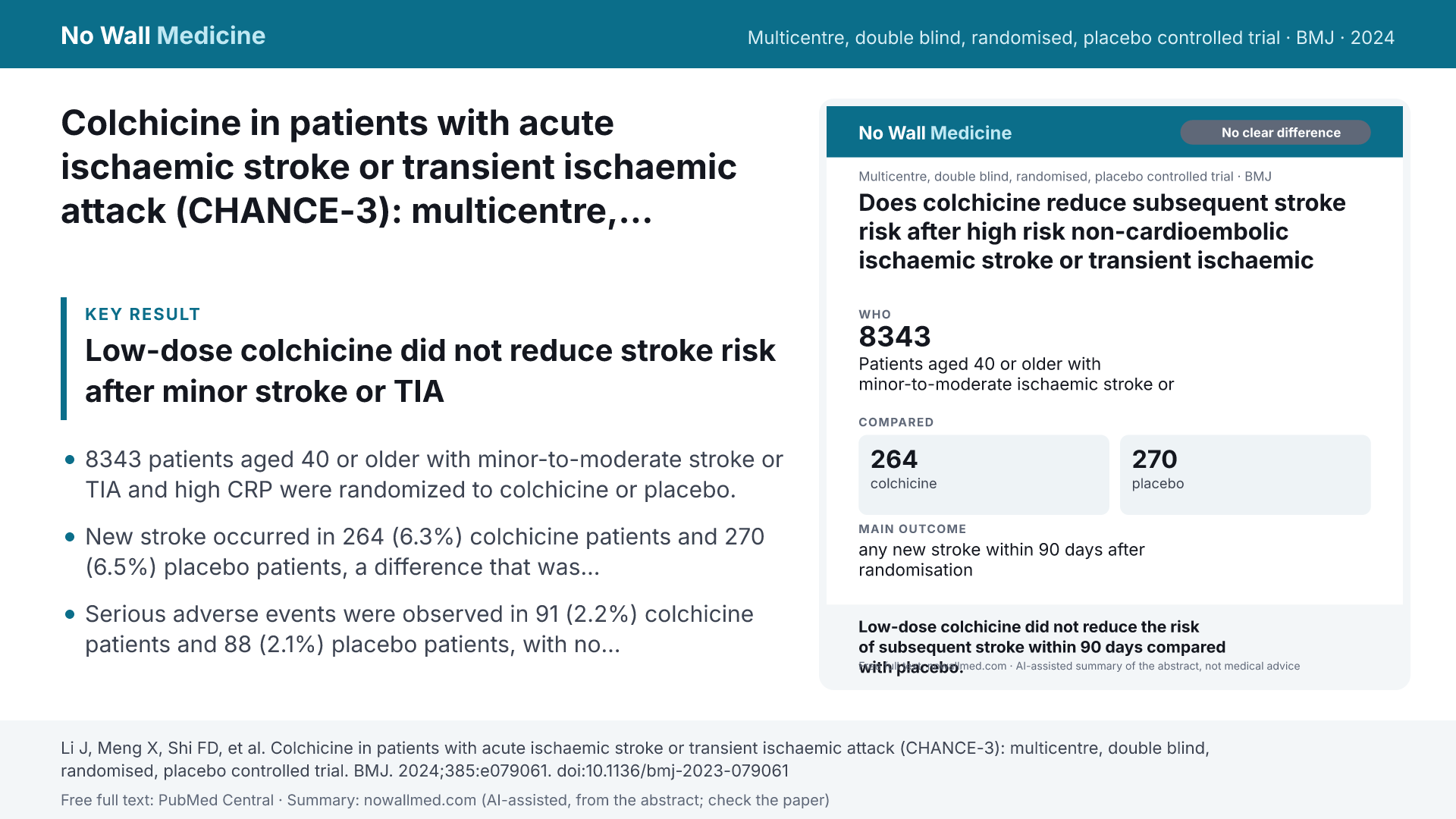
Low-dose colchicine did not reduce stroke risk after minor stroke or TIA
Colchicine in patients with acute ischaemic stroke or transient ischaemic attack (CHANCE-3): multicentre, double blind, randomised, placebo controlled trial
Multicentre, double blind, randomised, placebo controlled trialNo clear difference
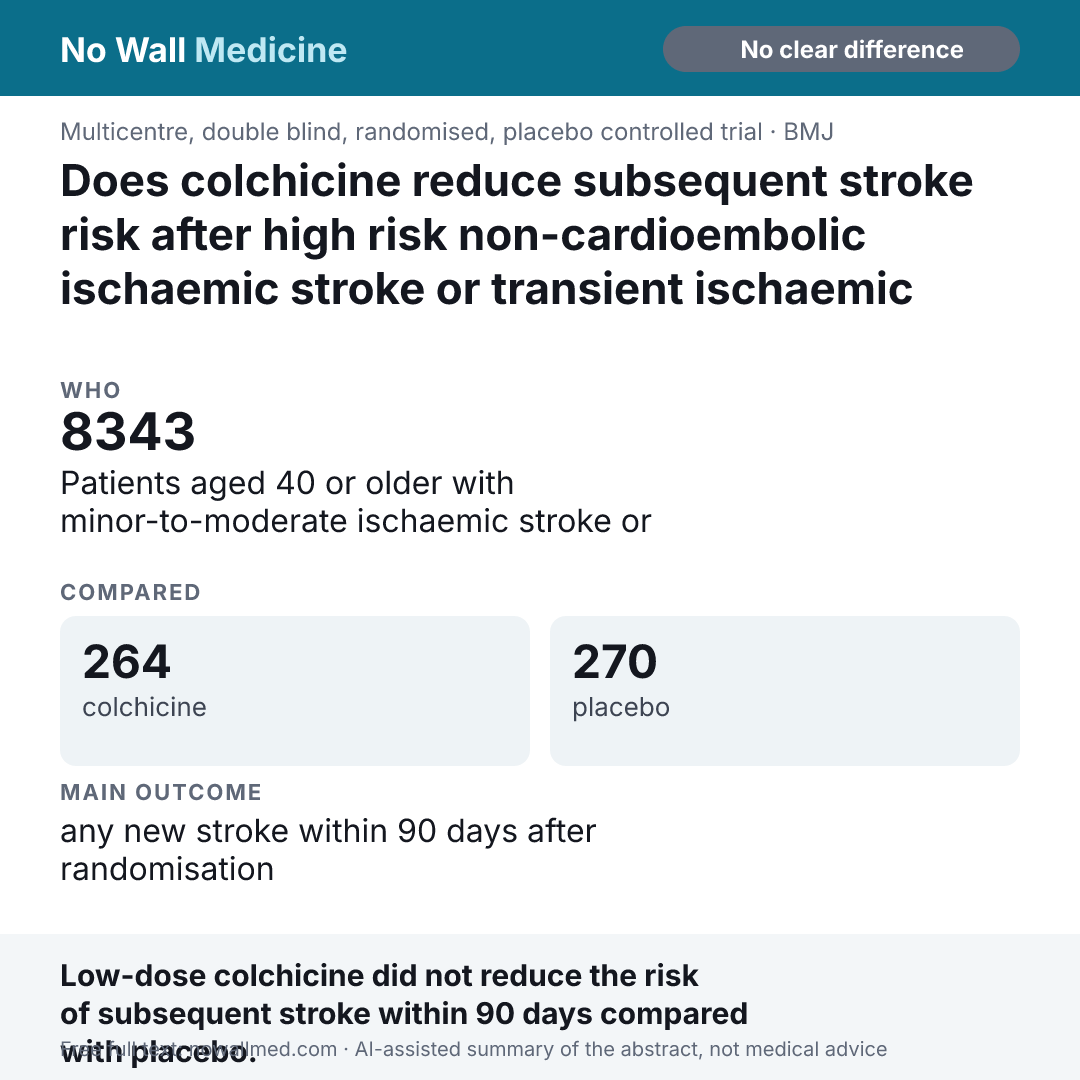
Does colchicine reduce subsequent stroke risk after high risk non-cardioembolic ischaemic stroke or transient ischaemic attack?
Who
8343
Patients aged 40 or older with minor-to-moderate ischaemic stroke or transient ischaemic attack · 244 hospitals in China
Compared
264colchicine (6.3%)
270placebo (6.5%)
Main outcome
any new stroke within 90 days after randomisation
Result: hazard ratio 0.98 (95% confidence interval 0.83 to 1.16)
Bottom line: Low-dose colchicine did not reduce the risk of subsequent stroke within 90 days compared with placebo.
BMJ · 2024-06-26 · Save PNG
Same trial (NCT05439356)
Papers we list that report this registered trial, oldest first. Read a secondary analysis alongside the main results.
- Main results No clear difference
This paper BMJ 2024-06 - Secondary analysis Harm found
Colchicine was associated with higher stroke rates in patients with symptomatic intracranial artery stenosis eClinicalMedicine 2025-05
Clinical question: Does colchicine reduce subsequent stroke risk after high risk non-cardioembolic ischaemic stroke or transient ischaemic attack?
Key points
- 8343 patients aged 40 or older with minor-to-moderate stroke or TIA and high CRP were randomized to colchicine or placebo.
- New stroke occurred in 264 (6.3%) colchicine patients and 270 (6.5%) placebo patients, a difference that was not statistically significant.
- Serious adverse events were observed in 91 (2.2%) colchicine patients and 88 (2.1%) placebo patients, with no significant difference between groups.
Headline and key points written with AI from the paper’s abstract, with every number checked against it. Read the paper before relying on them.
Was this summary helpful?
Abstract
Objectives
To assess the efficacy and safety of colchicine versus placebo on reducing the risk of subsequent stroke after high risk non-cardioembolic ischaemic stroke or transient ischaemic attack within the first three months of symptom onset (CHANCE-3). Design
Multicentre, double blind, randomised, placebo controlled trial. Setting
244 hospitals in China between 11 August 2022 and 13 April 2023. Participants
8343 patients aged 40 years of age or older with a minor-to-moderate ischaemic stroke or transient ischaemic attack and a high sensitivity C-reactive protein ≥2 mg/L were enrolled. Interventions
Patients were randomly assigned 1:1 within 24 h of symptom onset to receive colchicine (0.5 mg twice daily on days 1-3, followed by 0.5 mg daily thereafter) or placebo for 90 days. Main outcome measures
The primary efficacy outcome was any new stroke within 90 days after randomisation. The primary safety outcome was any serious adverse event during the treatment period. All efficacy and safety analyses were by intention to treat. Results
4176 patients were assigned to the colchicine group and 4167 were assigned to the placebo group. Stroke occurred within 90 days in 264 patients (6.3%) in the colchicine group and 270 patients (6.5%) in the placebo group (hazard ratio 0.98 (95% confidence interval 0.83 to 1.16); P=0.79). Any serious adverse event was observed in 91 (2.2%) patients in the colchicine group and 88 (2.1%) in the placebo group (P=0.83). Conclusions
The study did not provide evidence that low-dose colchicine could reduce the risk of subsequent stroke within 90 days as compared with placebo among patients with acute non-cardioembolic minor-to-moderate ischaemic stroke or transient ischaemic attack and a high sensitivity C-reactive protein ≥2 mg/L. Trial registration
ClinicalTrials.gov, NCT05439356.
Abstract reproduced under the article’s CC BY licence.
Subject terms
Headline, design, result, key points, caveat and citation as plain text.
Cite this article
Li J, Meng X, Shi FD, et al. Colchicine in patients with acute ischaemic stroke or transient ischaemic attack (CHANCE-3): multicentre, double blind, randomised, placebo controlled trial. BMJ. 2024;385:e079061. doi:10.1136/bmj-2023-079061
Spotted a mistake? Suggest a correction