Combining virtual reality and mirror therapy improved upper limb motor function in stroke patients
Combined Immersive and Nonimmersive Virtual Reality With Mirror Therapy for Patients With Stroke: Systematic Review and Meta-Analysis of Randomized Controlled Trials
Systematic review and meta-analysis of randomized controlled trialsMixed results
Does combined virtual reality and mirror therapy improve stroke rehabilitation?
Who
475
Patients with stroke
Compared
Combined virtual reality and mirror therapy
Control
Main outcome
Upper extremity motor function and hand dexterity
Result: mean difference 3.50 (95% CI 1.47 to 5.53)
Bottom line: Combined virtual reality and mirror therapy improves upper extremity function, but may not reach minimal clinically important difference.
Limitation: The pooled Fugl-Meyer Assessment-Upper Extremity improvement did not consistently exceed the minimal clinically important difference.
J Med Internet Res · 2025-10-10Download image
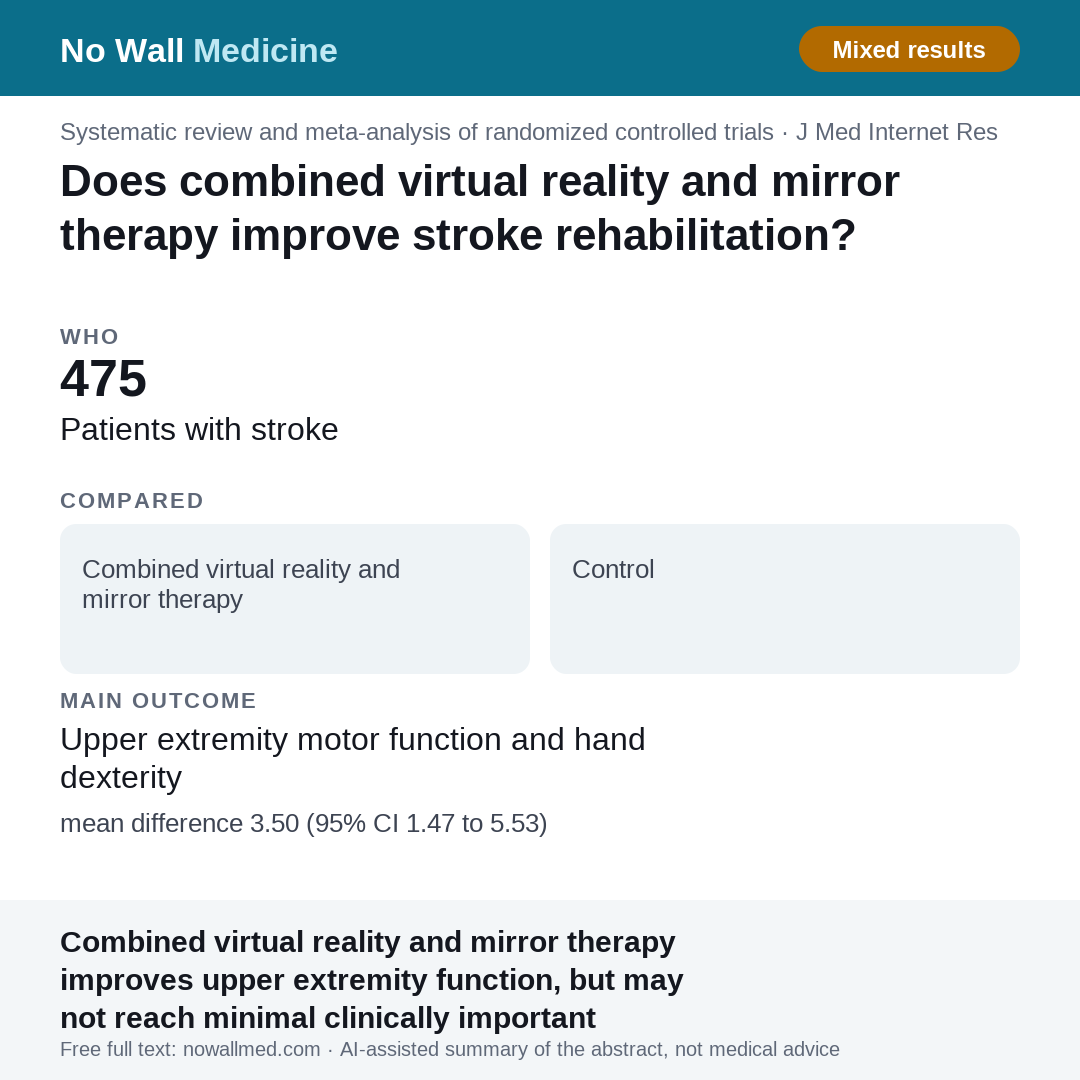
Clinical question: Does combined virtual reality and mirror therapy improve stroke rehabilitation?
Why it matters: The efficacy of combining immersive and nonimmersive virtual reality with mirror therapy for stroke rehabilitation needed evaluation.
Key points
- Researchers analyzed 14 randomized controlled trials involving 475 patients to evaluate combined virtual reality and mirror therapy for stroke rehabilitation.
- The combination was associated with improvements in upper extremity motor function (MD 3.50, 95% CI 1.47 to 5.53), manual function (MD 2.15, 95% CI 1.22 to 3.09), and hand dexterity (MD 1.09, 95% CI 0.14 to 2.05).
- The improvement in upper extremity motor function did not consistently exceed the established minimal clinically important difference of 4.25-7.25.
Headline and key points written with AI from the paper’s abstract, with every number checked against it. Read the paper before relying on them.
Topics
Cite this article
Gao C, Chen Y, Wei Y, Qiu Y, Song H, Gui C. Combined Immersive and Nonimmersive Virtual Reality With Mirror Therapy for Patients With Stroke: Systematic Review and Meta-Analysis of Randomized Controlled Trials. J Med Internet Res. 2025. doi:10.2196/73142
Spotted a mistake? Suggest a correction