Multisensory virtual reality training improved walking adaptability and balance in patients after a stroke
Effects of multi-sensory virtual reality training on gait adaptability and somatomotor network remodeling in patients with stroke: a randomized controlled trial
Randomized controlled trialBenefit found
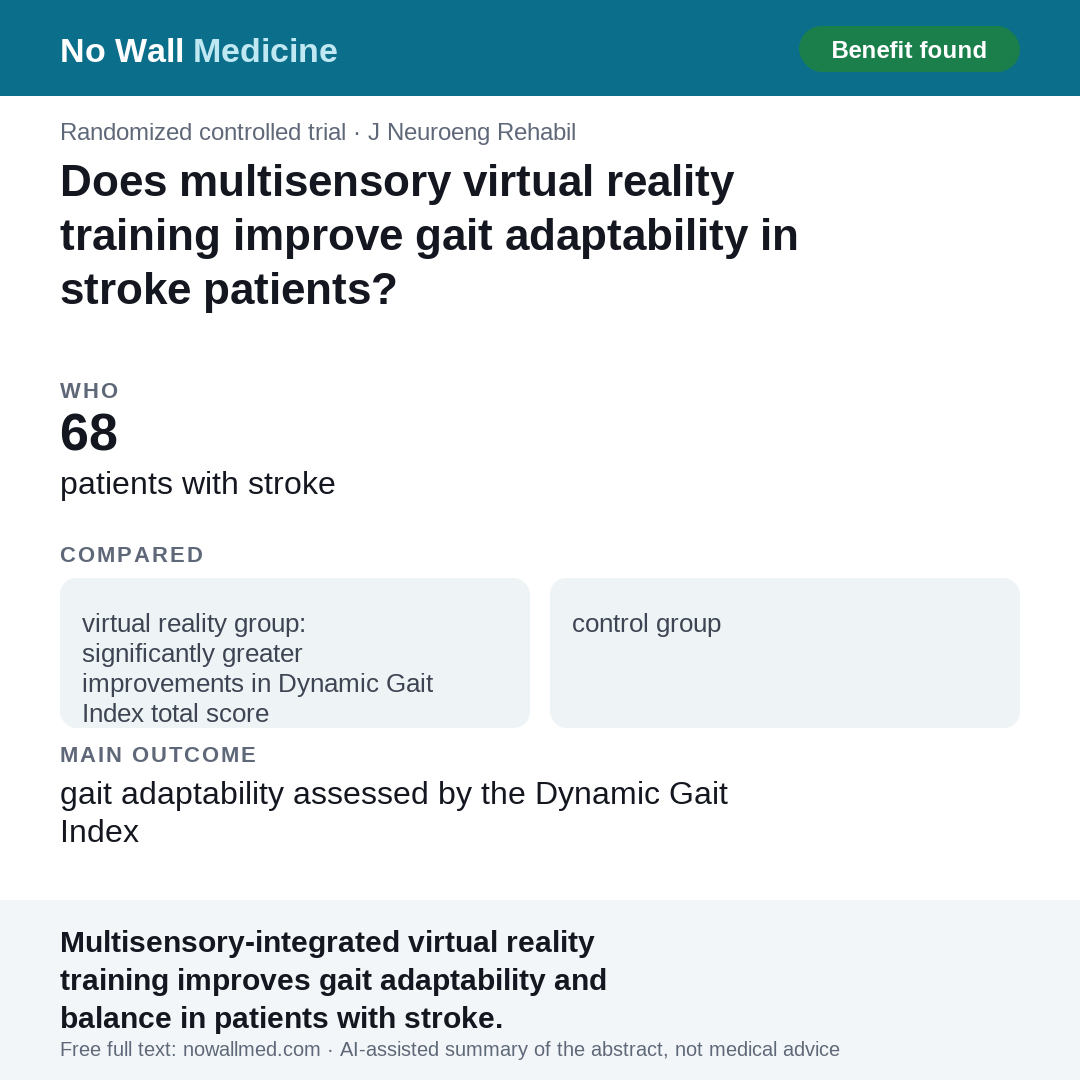
Does multisensory virtual reality training improve gait adaptability in stroke patients?
Who
68
patients with stroke
Compared
virtual reality group: significantly greater improvements in Dynamic Gait Index total score
control group
Main outcome
gait adaptability assessed by the Dynamic Gait Index
Bottom line: Multisensory-integrated virtual reality training improves gait adaptability and balance in patients with stroke.
Limitation: Improvements were not sustained under the most conservative assumptions about missing data.
J Neuroeng Rehabil · 2026-05-02Download image
Clinical question: Does multisensory virtual reality training improve gait adaptability in stroke patients?
Why it matters: It is unclear how multisensory-integrated virtual reality training affects walking adaptability and the underlying brain network changes in stroke survivors.
Key points
- Researchers studied 68 stroke patients who received either multisensory-integrated virtual reality training or conventional rehabilitation for 30 minutes, 5 days a week for 4 weeks.
- The virtual reality group showed significantly greater improvements in the Dynamic Gait Index (P = 0.010), Timed Up and Go Test (P = 0.005), and Berg Balance Scale (P < 0.001).
- Brain imaging showed increased activation in the supplementary motor area and right posterior parietal cortex, alongside enhanced connectivity within the somatomotor network.
Headline and key points written with AI from the paper’s abstract, with every number checked against it. Read the paper before relying on them.
Topics
Cite this article
Xie Q, Xiong X, Liu M, Huang Y, Sheng B, Zhang Y. Effects of multi-sensory virtual reality training on gait adaptability and somatomotor network remodeling in patients with stroke: a randomized controlled trial. J Neuroeng Rehabil. 2026. doi:10.1186/s12984-026-02003-9
Spotted a mistake? Suggest a correction